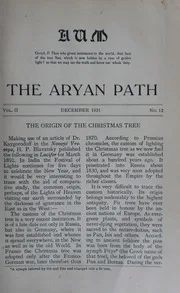
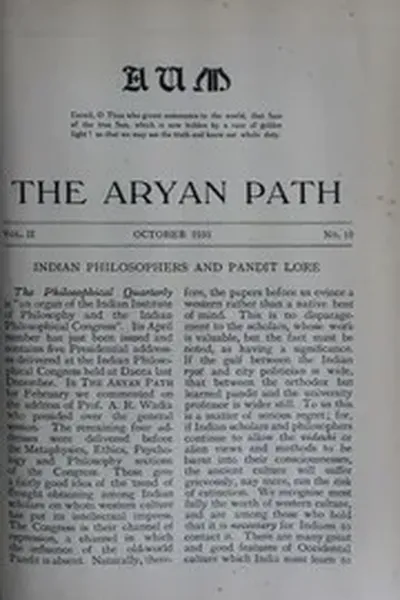
The Aryan Path Vol-II No-12
 83
83

The Aryan Path Vol-II No-12



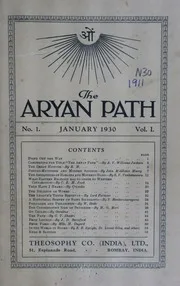
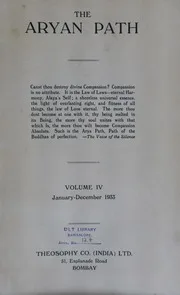
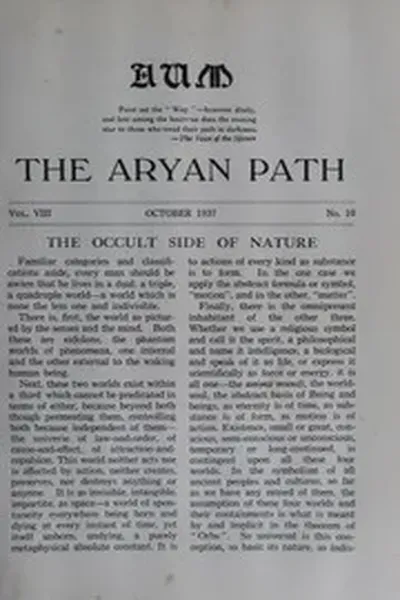
The Aryan Path Vol-II No-12 (1931) stands as a testament to the enduring relevance of Theosophical and Anthroposophical thought. Edited by Shri B.P Wadia, this journal offers a rich tapestry of esoteric insights, meticulously curated to resonate with modern seekers. The contributions from various scholars and thinkers provide a multifaceted exploration of spiritual and philosophical themes, making it an invaluable resource for contemporary esoteric studies. For modern readers, this text serves as a bridge between ancient wisdom and contemporary spirituality, offering timeless truths that remain as relevant today as they were in 1931. The journal's adherence to the original teachings of Madame Blavatsky and William Q. Judge ensures an authentic and unadulterated experience, making it a must-have for anyone serious about their spiritual journey.
📝 Description
83
Published in The Aryan Path, Vol. II, No. 12, this issue examines esoteric concepts through contributions from various thinkers.
This issue of The Aryan Path, Vol. II, No. 12, presents a collection of essays touching upon Theosophy and Anthroposophy. Edited by B.P. Wadia, the journal features writings intended to shed light on ancient esoteric traditions for contemporary readers. The content includes discussions on symbolism, philosophical ideas, and interpretations of historical esoteric records. The volume aims to foster introspection and spiritual understanding among its readership. It is suitable for individuals interested in occult studies and a deeper contemplation of existence.
The authors contribute diverse perspectives, aiming to connect readers with less commonly known aspects of esoteric thought. The collected pieces encourage a thoughtful engagement with spiritual and philosophical questions. Readers will find discussions that move beyond surface-level explanations to consider underlying principles and hidden meanings. The goal is to provide material that stimulates contemplation and personal insight.
The Aryan Path journal was active in the mid-20th century, a period when movements like Theosophy and Anthroposophy were widely discussed. These traditions sought to synthesize Eastern and Western esoteric philosophies, often drawing on ancient texts and interpretations of spiritual evolution. This particular volume, edited by B.P. Wadia, likely continued this aim by presenting articles that connected these schools of thought with broader spiritual and philosophical inquiries.
💡 Why Read This Book?
Reading The Aryan Path Vol-II No-12 (1931) today offers a unique opportunity to delve into the profound teachings of Theosophy and Anthroposophy. This journal provides a comprehensive exploration of esoteric themes, making it an invaluable resource for spiritual seekers. By engaging with the original and unaltered teachings of Madame Blavatsky and William Q. Judge, readers can gain a deeper understanding of ancient spiritual truths and their relevance in the modern world. This text is particularly beneficial for those interested in the intersection of spirituality, philosophy, and ancient wisdom.
⭐ Reader Reviews
Honest opinions from readers who have explored this book.
❓ Frequently Asked Questions
Who edited The Aryan Path Vol-II No-12 (1931)?
The journal was edited by Shri B.P Wadia, a visionary inspired by the original teachings of Madame H.P. Blavatsky and William Q. Judge.
What subjects does this journal cover?
The Aryan Path Vol-II No-12 (1931) covers a wide range of subjects, including metaphysical explorations, philosophical inquiries, and ancient spiritual truths.
Why is this journal important for modern esoteric seekers?
This journal offers a rich tapestry of esoteric insights, meticulously curated to resonate with modern seekers, providing a bridge between ancient wisdom and contemporary spirituality.
🔮 Key Themes & Symbolism
Ancient Wisdom
The journal explores the ancient wisdom of Theosophy, providing readers with insights into the timeless truths of the ancient records. It explores how these truths can be applied to the modern era, offering a bridge between the past and the present.
Esoteric Symbolism
The Aryan Path Vol-II No-12 is rich in esoteric symbolism, with contributions from artists and thinkers who examine the hidden meanings behind ancient symbols. This theme is explored from a Theosophical perspective, providing clear insights into the mystical underpinnings of existence.
Modern Spiritual Insights
The journal offers modern spiritual insights by inviting eminent thinkers and philosophers to contribute articles on various subjects. These insights are reviewed from a universal Theosophical perspective, making them accessible yet profound.
💬 Memorable Quotes
Direct passages from the work, attributed to the author.
“The great truths of the Ancient Records”
— This phrase highlights the journal's aim to repeat timeless truths for the modern era.
“Theosophical Company (Mysore) Pvt Ltd”
— This refers to the organization behind the journal, known for its commitment to Theosophical thought.
“The lofty aim to repeat the great truths”
— This phrase captures the journal's mission to illuminate modern seekers with ancient wisdom.
💡 Key Ideas
Editorial paraphrase of the work's core concepts — not direct quotes.
Universal perspective of Theosophical Philosophy
This quote underscores the journal's unique approach to exploring mystical insights.
Eminent thinkers, artists, and philosophers
This quote emphasizes the diverse contributions that enrich the journal's content.
🌙 Esoteric Significance
Tradition
The Aryan Path Vol-II No-12 belongs to the Theosophical tradition, which is rooted in the esoteric teachings of ancient wisdom. It aims to bridge the gap between ancient mysticism and modern spiritual seekers.
Symbolism
The journal is rich in esoteric symbolism, with contributions from artists and thinkers who explore the hidden meanings behind ancient symbols. These symbols are interpreted from a Theosophical perspective, providing clear insights into the mystical underpinnings of existence.
Modern Relevance
The Aryan Path Vol-II No-12 remains relevant today as it offers modern spiritual insights by inviting eminent thinkers and philosophers to contribute articles on various subjects. These insights are reviewed from a universal Theosophical perspective, making them accessible yet profound for contemporary practitioners.
👥 Who Should Read This Book
Beginners in the field of Theosophy and Anthroposophy will find this journal to be an excellent introduction to the mystical underpinnings of these traditions. Scholars and researchers will appreciate the depth and breadth of esoteric insights provided. Spiritual seekers will be drawn to the journal's exploration of ancient wisdom and its relevance in the modern era. Practitioners of the occult will find it to be a valuable resource for understanding the hidden knowledge and symbolism within Theosophical thought.
📜 Historical Context
The Aryan Path Vol-II No-12 was published during a time when Theosophy was gaining significant traction in the West. Edited by Shri B.P. Wadia, a disciple of Madam H.P. Blavatsky and William Q Judge, the journal aimed to revive and reinterpret ancient Theosophical teachings for a modern audience. It played an important role in spreading Theosophical ideas and influencing the development of modern occult and metaphysical literature.
📔 Journal Prompts
How does the journal's exploration of ancient wisdom resonate with your own spiritual journey?
What are some of the key esoteric symbols discussed in the journal, and how do they relate to your understanding of Theosophy?
How do the modern spiritual insights provided in the journal apply to your daily life?
In what ways does the journal's universal perspective of Theosophical philosophy enrich your understanding of mystical traditions?
What are some of the timeless truths from the ancient records that you find most relevant to the modern era?
🗂️ Glossary
Theosophy
Theosophy is a spiritual philosophy that seeks to understand the mysteries of life and the universe through the study of ancient wisdom and esoteric teachings.
Anthroposophy
Anthroposophy is a spiritual science that aims to bridge the gap between the physical world and the spiritual world through the study of human nature and its relationship with the cosmos.
Esoteric Symbolism
Esoteric symbolism refers to the hidden meanings behind symbols, often used in mystical and occult traditions to convey deep spiritual truths.
Universal Perspective
A universal perspective in Theosophical philosophy refers to the view that all spiritual traditions share a common core of truth, which can be understood and applied universally.
Ancient Records
Ancient records refer to the timeless teachings and wisdom of ancient mystical traditions, which are studied and interpreted in Theosophical thought.
This book appears in 2 collections
🔮 Readers Also Liked
Browse all →






From the “Theosophy” Collection
View all →

More Free Theosophy & Anthroposophy Books
View all →