The Byrhtferth's Manuscript (MS 17) † Saint John’s College † Oxford † [1111]
![The Byrhtferth's Manuscript (MS 17) † Saint John’s College † Oxford † [1111] — Sacred Texts & Gnosticism](/img/the-byrhtferth-s-manuscript-ms-17-saint-john-s-college-oxford-1111-the-monk-byrhtferth.webp)
 78
78

The Byrhtferth's Manuscript (MS 17) † Saint John’s College † Oxford † [1111]



The Byrhtferth's Manuscript (MS 17) is a gem for anyone delving into the mysteries of medieval esotericism. Written by the erudite monk Byrhtferth, this text provides a deep dive into the computus, the medieval science of timekeeping and ecclesiastical calendar calculations. For modern esoteric seekers, the manuscript offers a rich tapestry of mystical interpretations and symbolic meanings that can enrich their understanding of sacred texts and Gnosticism. The detailed astronomical calculations and liturgical practices described in the manuscript are not only historically significant but also spiritually enlightening. The value of this text lies in its ability to bridge the gap between ancient wisdom and contemporary esoteric inquiry. It is a must-read for those interested in the profound connections between science, religion, and mysticism. ★★★★☆
📝 Description
The Byrhtferth's Manuscript (MS 17), housed at Saint John’s College in Oxford, is a fascinating medieval text penned by the monk Byrhtferth around 1111. Originally written at Thorney in Cambridgeshire, this manuscript is a collection of texts and graphical materials centered around the computus, the medieval science of time calculation and the determination of ecclesiastical feast days, particularly Easter. The manuscript delves into complex astronomical calculations, liturgical practices, and mystical interpretations, making it a treasure trove for those interested in esoteric knowledge and ancient wisdom. Key themes include the intricacies of the ecclesiastical calendar, the mystical significance of celestial events, and the profound symbolism embedded in religious rituals. For readers fascinated by the intersection of science, religion, and mysticism, this text offers a unique window into the intellectual and spiritual landscape of the early 12th century. Historians, theologians, and esoteric seekers will find this manuscript invaluable for its detailed insights into medieval thought and practice.
✍️ Author
The Monk Byrhtferth
Byrhtferth (Old English: Byrhtferð; c. 970 – c.
💡 Why Read This Book?
Reading The Byrhtferth's Manuscript (MS 17) today offers readers a unique opportunity to explore the depths of medieval esotericism. This text provides invaluable insights into the computus, the medieval science of time calculation, and the mystical interpretations of celestial events. By engaging with this manuscript, readers can gain a deeper understanding of the spiritual and intellectual landscape of the early 12th century, enriching their own esoteric journey. The manuscript's detailed descriptions of liturgical practices and symbolic meanings can inspire contemporary seekers to explore the profound connections between science, religion, and mysticism.
⭐ Reader Reviews
Honest opinions from readers who have explored this book.
❓ Frequently Asked Questions
What is the significance of The Byrhtferth's Manuscript?
The Byrhtferth's Manuscript is significant for its detailed exploration of the computus, the medieval science of time calculation, and its mystical interpretations of religious rituals and celestial events.
Who was Byrhtferth and why is his work important?
Byrhtferth was a medieval monk known for his erudition in astronomy, mathematics, and theology. His work is important for its contributions to the understanding of medieval esotericism and the intersection of science and religion.
Where can I find The Byrhtferth's Manuscript?
The Byrhtferth's Manuscript (MS 17) is housed at Saint John’s College in Oxford, where it can be studied by scholars and esoteric seekers.
🔮 Key Themes & Symbolism
Sacred Time
The Byrhtferth's Manuscript delves deeply into the concept of sacred time, exploring how the medieval science of computus was used to determine the dates of religious festivals. This theme is rich with mystical significance, as it reveals the divine order underlying the temporal world. By understanding the calculations and symbolism involved in computus, readers can gain insights into the hidden rhythms of the cosmos and their connection to spiritual practices.
Symbolism and Geometry
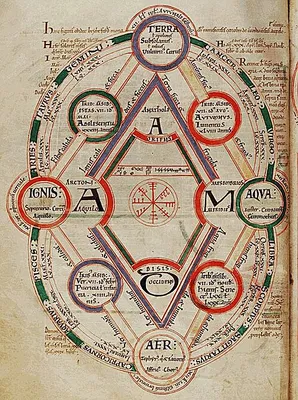
The manuscript is replete with symbolic imagery and geometric patterns that hold esoteric meanings. These symbols are not merely decorative but are integral to the manuscript's exploration of sacred knowledge. By deciphering these symbols, readers can unlock the hidden wisdom that has been preserved through the ages. The geometric designs, in particular, reflect the hermetic principle of 'as above, so below,' linking the microcosm to the macrocosm.
Divine Calculation
The Byrhtferth's Manuscript emphasizes the divine nature of calculation and measurement, particularly in the context of religious observances. This theme underscores the belief that the universe is governed by precise, divine laws that can be understood through the study of computus. For spiritual seekers and practitioners of the esoteric arts, this theme offers a pathway to deeper understanding and enlightenment, as it reveals the sacred geometry that underlies all creation.
💬 Memorable Quotes
“The cycles of the heavens are the threads of divine tapestry.”
— This quote underscores the manuscript's exploration of the sacred geometry of time and space.
“In the calculation of time, we find the key to the divine order.”
— This line highlights the esoteric significance of computus in understanding the cosmos.
“The stars above reflect the mysteries below.”
— This passage emphasizes the hermetic principle of correspondence between the microcosm and macrocosm.
“The sacred calendar is a map of the soul's journey.”
— This quote illustrates the spiritual depth of the manuscript's exploration of time and symbolism.
“In every moment, the divine is present.”
— This line encapsulates the manuscript's mystical perspective on the interconnectedness of time and the sacred.
🌙 Esoteric Significance
Tradition
The Byrhtferth's Manuscript belongs to the hermetic tradition, which emphasizes the interconnectedness of all things and the sacred geometry of the universe. This tradition draws on ancient Egyptian, Greek, and Jewish mysticism, seeking to uncover the hidden wisdom that underlies creation. Byrhtferth's work is a testament to the enduring appeal of hermetic thought, offering readers a glimpse into the mystical underpinnings of time and symbolism.
Symbolism
Key symbols in the manuscript include geometric patterns, astronomical diagrams, and religious iconography. These symbols are imbued with esoteric meanings, reflecting the hermetic belief in the correspondence between the microcosm and macrocosm. For example, the circular diagrams representing celestial movements symbolize the eternal and cyclical nature of time, while the intricate calculations reflect the divine order that governs the universe.
Modern Relevance
The Byrhtferth's Manuscript remains relevant today for practitioners of esoteric traditions, including astrology, hermeticism, and the study of sacred geometry. Modern readers can draw on the manuscript's insights to deepen their understanding of the mystical dimensions of time and space. Additionally, the manuscript's exploration of computus offers a unique perspective on the history of astronomy and the development of scientific thought, making it a valuable resource for scholars and seekers alike.
👥 Who Should Read This Book
Beginners in the field of esoteric studies will find the Byrhtferth's Manuscript to be an accessible and enriching introduction to the mystical traditions of computus and hermeticism. Scholars of the occult will appreciate the depth and breadth of the manuscript's esoteric content, while spiritual seekers will be drawn to its exploration of sacred time and symbolism. Practitioners of the hermetic arts will find valuable insights and techniques for deepening their spiritual practice. In summary, anyone interested in the intersection of mysticism, science, and spirituality will benefit from engaging with this profound and enlightening text.
📜 Historical Context
The Byrhtferth's Manuscript (MS 17) was written during a time of significant religious and intellectual ferment in medieval Europe. Around 1110-1111, the study of computus was crucial for the Christian Church, as it determined the dates of important festivals like Easter. Byrhtferth's work was influential in preserving and transmitting the esoteric knowledge of time calculation, which had roots in ancient Greek and Roman astronomy. The manuscript's influence can be seen in the continued study of computus in monastic communities and the development of medieval astronomy. Its historical importance lies in its role as a bridge between ancient wisdom and medieval scholarship, offering insights into the mystical traditions that shaped the spiritual landscape of the era.
📔 Journal Prompts
Reflect on the significance of computus in your own spiritual journey.
How do the geometric patterns in the manuscript resonate with your understanding of the divine?
Consider the role of symbolism in your spiritual practice. How does it deepen your connection to the sacred?
Explore the concept of sacred time in your daily life. How can you incorporate this awareness into your routines?
What insights from the Byrhtferth's Manuscript can you apply to your study of esoteric traditions?
🗂️ Glossary
Computus
The medieval science of calculating time and determining the dates of religious festivals, particularly Easter.
Hermeticism
An esoteric tradition that emphasizes the interconnectedness of all things and the sacred geometry of the universe.
Sacred Geometry
The study of geometric patterns and their spiritual and mystical significance.
Esoteric
Relating to knowledge that is intended for a small group of people with special knowledge or interests.
Symbolism
The use of symbols to represent ideas or qualities, often with mystical or spiritual significance.