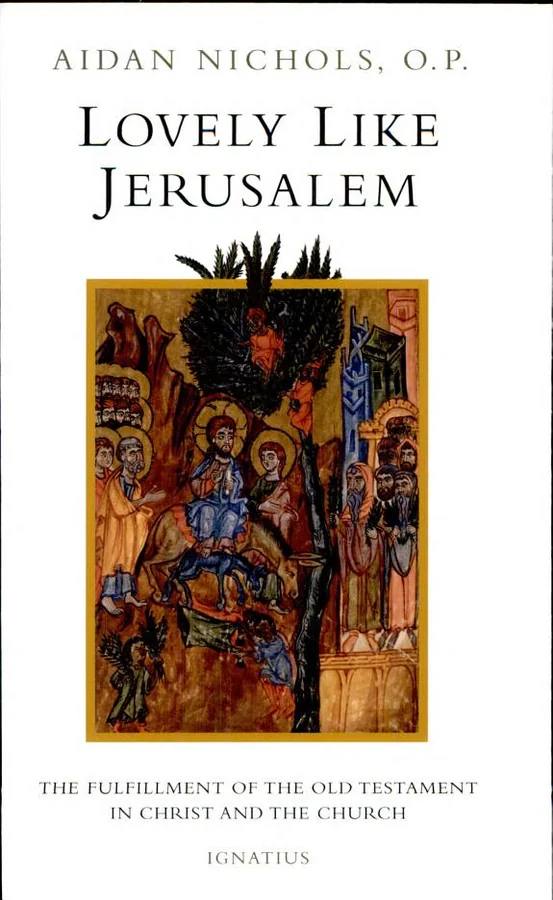
Lovely, Like Jerusalem
 78
78

Lovely, Like Jerusalem
Aidan Nichols’ Lovely, Like Jerusalem presents a carefully argued case for the indispensable nature of the Old Testament in understanding Christian scripture. Nichols avoids simplistic allegorization, instead focusing on the inherent theological weight and narrative coherence that he argues runs from Genesis through Malachi. His strength lies in drawing explicit connections, demonstrating how concepts like the Davidic covenant or the prophecies concerning Zion serve as theological scaffolding for New Testament claims. For instance, his discussion of the "servant songs" in Isaiah as prefiguring Christ’s redemptive role is particularly effective. A limitation, however, is that the dense academic prose might present a barrier for readers not already steeped in biblical scholarship. While the analysis of Isaiah 53 is compelling, the dense citation practices sometimes interrupt the flow for the less specialized reader. Nonetheless, Nichols successfully makes the case that a robust grasp of the Old Testament is not optional for a profound engagement with the New.
📝 Description
78
Aidan Nichols' 2007 book argues that understanding the Old Testament is key to the New.
Published in 2007, Aidan Nichols' Lovely, Like Jerusalem examines the Old Testament. Nichols argues that a deep grasp of these older texts is not just an academic pursuit but a necessary step for comprehending the New Testament more fully. The book is aimed at those involved in theological study, biblical interpretation, and comparative religion. It will particularly interest readers who seek a unified view of Christian scripture, especially how the traditions of ancient Israel influence later Christian thought. Students and academics focused on religious history will find its arguments pertinent.
Nichols' work comes at a time when scholars often separate the Old and New Testaments. Instead, he champions a connection between them, tracing theological and symbolic links. This perspective echoes earlier Christian interpretations that saw unity in divine revelation across both covenants. Nichols provides a modern voice to this ongoing theological discussion.
While not strictly an esoteric text, Nichols' work engages with traditions that explore deeper, often hidden meanings within scripture. His focus on typological and prophetic connections between covenants can be seen as a scholarly approach to uncovering layers of meaning beyond the literal sense. This resonates with Gnostic and other mystical traditions that seek spiritual understanding through allegorical and symbolic readings of sacred texts, positing that divine truth unfolds progressively through history and scripture.
💡 Why Read This Book?
• Gain a nuanced understanding of the Old Testament’s theological significance, moving beyond historical narrative to grasp its prophetic and typological weight, as explored in discussions of Isaiah. • Appreciate the integral link between Old Testament covenants, particularly the Davidic covenant, and the New Testament’s Christological claims, as demonstrated by Nichols’ detailed analysis. • Develop a more integrated approach to biblical interpretation, recognizing how the early chapters of Christian scripture provide essential context for later developments, a perspective highlighted in the book’s examination of Old Testament law.
⭐ Reader Reviews
Honest opinions from readers who have explored this book.
❓ Frequently Asked Questions
What is the primary argument of Aidan Nichols' Lovely, Like Jerusalem?
The book argues that understanding the Old Testament is fundamentally necessary for comprehending the New Testament, positing a deep theological and narrative continuity between the two.
Who is the intended audience for this book?
It is primarily for students of theology, biblical scholars, and those interested in comparative religious studies seeking a deeper, integrated understanding of Christian scripture.
Does the book rely on specific theological traditions?
Yes, it engages with and revisits earlier patristic and medieval interpretations that emphasized the unity of biblical revelation, offering a modern perspective on these historical theological viewpoints.
What historical period does the book focus on regarding its interpretation?
While examining ancient texts, the book's publication in 2007 places its interpretive stance within contemporary theological discourse, contrasting with purely historical-critical methods.
Can this book help someone understand prophecies in the Old Testament?
Absolutely. A key focus is on how prophetic traditions within the Old Testament, such as the servant songs in Isaiah, are presented as finding their fulfillment in the New Testament.
Is the book accessible to a general reader or primarily for academics?
The book is written with an academic rigor, making it more suitable for those with some background in theological studies, though its arguments are substantial for any serious biblical student.
🔮 Key Themes & Symbolism
Old Testament as Foundation
The core of Nichols' argument is that the Old Testament is not a superseded text but the essential groundwork for Christian faith. He meticulously traces how concepts like covenant, law, and messianic expectation, first articulated in texts like Genesis and Deuteronomy, form the theological bedrock upon which the New Testament builds. This perspective challenges purely historical-critical readings that might isolate the testaments, instead advocating for a unified scriptural vision where the earlier texts illuminate the later.
Typological Fulfillment
A significant theme is the exploration of typological relationships between Old Testament figures, events, and institutions, and their fulfillment in Christ. Nichols examines passages, particularly from the Prophets like Isaiah, demonstrating how these ancient narratives and predictions are presented as prefiguring the person and salvific work of Jesus. This involves understanding Old Testament events not just as historical occurrences but as divinely ordained types pointing toward a greater reality.
The Nature of Jerusalem
The title itself points to a deeper symbolic meaning. Jerusalem, as the historical and spiritual center for Israel, functions as a potent symbol throughout the Old Testament. Nichols likely explores its significance not just as a city but as a representation of God's presence, covenant faithfulness, and the anticipated kingdom. This symbolic weight is then carried into the New Testament, where the concept of a heavenly or new Jerusalem emerges, linking the earthly and divine realms.
Continuity of Revelation
Nichols champions the idea that divine revelation is a continuous process, with the Old Testament serving as the initial, indispensable phase. He argues against viewing the New Testament as a radical break, but rather as the unfolding and completion of promises and patterns established much earlier. This perspective emphasizes the coherence of the biblical narrative as a whole, presented by God across different historical epochs.
💬 Memorable Quotes
Direct passages from the work, attributed to the author.
“Prophecies concerning Zion find their ultimate meaning in Christ.”
— This interpretation highlights how Nichols connects specific prophetic texts, likely those related to Jerusalem and its future restoration, to the person and mission of Jesus, demonstrating a typological link.
“Understanding the Law illuminates the grace found in the Gospel.”
— This interpretation suggests that Nichols explores the relationship between the Mosaic Law and the New Testament's emphasis on grace, arguing that the former provides necessary context for appreciating the latter's redemptive power.
“The historical Jerusalem points toward a spiritual reality.”
— This interpretation reflects the book's likely exploration of Jerusalem not just as a geographical location but as a potent symbol whose earthly significance foreshadows a deeper, eschatological or heavenly reality.
💡 Key Ideas
Editorial paraphrase of the work's core concepts — not direct quotes.
The Old Testament is the indispensable foundation for the New.
This paraphrased concept captures the book's central thesis: that a genuine and profound understanding of Christian scripture necessitates a thorough engagement with the Hebrew Bible, viewing it as foundational rather than merely historical.
Covenantal promises to Israel are essential for understanding Christian salvation.
This paraphrased concept emphasizes the book's focus on how the promises made to the people of Israel, particularly through covenants, are not abrogated but fulfilled and recontextualized within the Christian framework of salvation.
🌙 Esoteric Significance
Tradition
While not overtly a text of Hermeticism or Kabbalah, Nichols' work engages with a tradition of biblical interpretation that has historically informed esoteric thought. This includes the patristic and medieval emphasis on typology and allegory, methods often employed in esoteric traditions to uncover hidden meanings within sacred texts. The book fits within a broader Christian esoteric lineage that seeks spiritual truths embedded within the biblical narrative, viewing the scriptures as a multi-layered divine communication.
Symbolism
The concept of 'Jerusalem' itself serves as a potent symbol, moving beyond its literal geographical meaning to represent divine presence, covenantal faithfulness, and the eschatological kingdom. Furthermore, Nichols likely examines symbolic figures within the Old Testament, such as the Suffering Servant from Isaiah, whose depiction carries profound spiritual weight and is interpreted typologically as prefiguring Christ’s redemptive role in Christian esoteric thought.
Modern Relevance
Contemporary thinkers and practitioners interested in integrated biblical theology, who seek to bridge the gap between historical study and spiritual application, find resonance in Nichols' approach. Movements emphasizing the continuity of God's plan across both testaments, or those exploring the typological connections between Old and New Testament figures and events, draw upon the kind of reasoned argumentation presented here. It informs contemporary discussions on biblical unity and the enduring relevance of the Old Testament for Christian understanding.
👥 Who Should Read This Book
• Students of Christian theology: Those pursuing formal or informal theological education will benefit from Nichols' rigorous defense of the Old Testament's essential role in understanding Christian doctrine. • Biblical scholars and exegetes: Researchers seeking to deepen their understanding of the relationship between the Old and New Testaments will find valuable arguments and interpretive strategies. • Readers interested in theological hermeneutics: Individuals curious about how scripture has been interpreted across different historical periods, particularly regarding the unity of the biblical message, will find this work useful.
📜 Historical Context
Lovely, Like Jerusalem was published in 2007, an era marked by diverse approaches to biblical studies. While the historical-critical method, prominent since the 19th century, often emphasized the distinctiveness of Old and New Testament contexts, Nichols’ work aligns with a ressourcement movement that sought to reconnect with earlier theological traditions. This included revisiting patristic exegesis, which frequently saw the Old Testament as prefiguring Christ. In the field of 21st-century theology, scholars like N.T. Wright were also exploring the Jewish roots of Christianity, though Nichols' specific focus leans more towards a theological continuity than Wright’s emphasis on Second Temple Judaism’s direct influence. The book’s emphasis on a unified scriptural vision offers a counterpoint to some contemporary trends that might separate the Testaments, positioning it within ongoing debates about biblical hermeneutics.
📔 Journal Prompts
The Old Testament's foundational role for the New Testament.
The symbolic significance of Jerusalem across biblical epochs.
Connections between Old Testament covenants and New Testament theology.
Typological interpretations of figures like the Suffering Servant.
The concept of continuous divine revelation through scripture.
🗂️ Glossary
Typology
A method of biblical interpretation where persons, events, or institutions in the Old Testament are seen as prefiguring or foreshadowing persons, events, or institutions in the New Testament, especially Christ and the Church.
Covenant
A solemn agreement or bond, particularly between God and humanity, established through specific promises and obligations, such as those made with Noah, Abraham, Moses, and David.
Exegesis
Critical explanation or interpretation of a text, especially of the Bible, involving careful analysis of its original meaning and context.
Christology
The branch of Christian theology concerned with the nature, person, and work of Jesus Christ.
Hermeneutics
The theory and methodology of interpretation, especially the interpretation of biblical texts, literary works, or sources of knowledge.
Patristic
Relating to the writings of the early Church Fathers, typically considered to be the period from the 1st to the 8th century AD.
Suffering Servant
A figure described in the Book of Isaiah (particularly chapters 42, 49, 50, and 53) who endures hardship and sacrifice for the sake of others, often interpreted typologically as a prefiguration of Christ.
This book appears in 1 collection
🔮 Readers Also Liked
Browse all →







From the “Revelation” Collection
View all →







![A LITTLE HISTORY - [ Truth about ] THE SHEPHERDING MOVEMENT](/img/thumb/a-little-history-truth-about-the-shepherding-movement-allan-clare-bill-hamon-ern-baxter-charles-simpson-derek-prince-don-basham-bob-mumford-john-bevere-r-c-sproul-bredesen-juan-carlos-ortiz-bruce-metz.webp)

More Free Sacred Texts & Gnosticism Books
View all →