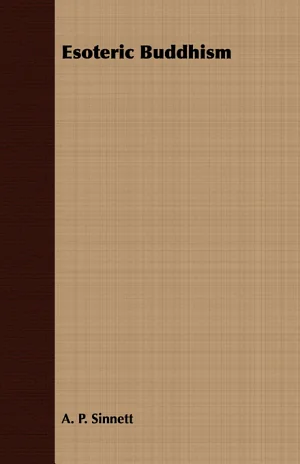
Esoteric Buddhism
 81
81

Esoteric Buddhism
A. P. Sinnett’s *Esoteric Buddhism* offers a particular, and by now historical, lens through which to view Buddhist philosophy. Published in 1883, its significance lies less in its accuracy as a representation of Buddhism and more in its role within the burgeoning Western esoteric movements of the late 19th century. Sinnett, a prominent figure in the Theosophical Society, frames Buddhist concepts like karma and reincarnation within the society’s broader metaphysical system, often emphasizing a hierarchical spiritual evolution guided by unseen ‘Masters.’ While valuable for understanding the Theosophical interpretation of Eastern thought, the work frequently reinterprets Buddhist ideas through a Western occultist lens, sometimes diverging significantly from traditional Buddhist understanding. A notable passage discusses the nature of the ‘higher self’ and its connection to successive reincarnations, a concept central to Theosophy but less explicitly defined in many Buddhist schools. The limitation here is the inherent bias of interpretation; it is Theosophy *about* Buddhism, not a direct exposition of Buddhist doctrine itself. Nevertheless, for scholars of esoteric history or comparative religion, it provides crucial insight into how Eastern ideas were adopted and adapted.
📝 Description
81
A. P. Sinnett's 1883 "Esoteric Buddhism" interprets Buddhist doctrines for their inner meanings.
This text presents a specific interpretation of Buddhist doctrines, focusing on their inner, hidden meanings rather than their exoteric, popular forms. It aims to reveal a deeper, more arcane dimension of Buddhist thought, touching on philosophical underpinnings and potential psychic development. The volume is intended for serious students of comparative religion, occult philosophy, and those interested in the Theosophical movement's engagement with Eastern traditions. It is not a primer for beginners in Buddhism but for those who have some familiarity with its core tenets and seek to understand its more esoteric interpretations.
The book emerges from a period of intense Western interest in Eastern religions and philosophies in the late 19th and early 20th centuries. It reflects efforts to synthesize spiritual ideas from various cultures, presenting them in a framework accessible to Western esotericists. This era saw attempts to reconcile scientific and spiritual worldviews.
The work examines concepts such as karma, reincarnation, and the nature of consciousness through an esoteric lens. It posits that these doctrines, when understood esoterically, are keys to unlocking higher states of awareness and understanding the subtle energies that govern existence. The exploration often touches upon the idea of hidden masters and spiritual evolution.
Published in 1883, "Esoteric Buddhism" is a product of the late 19th-century Western fascination with Eastern religions, particularly within the Theosophical Society. The book sought to present Buddhist concepts, such as karma and reincarnation, as part of a broader, hidden spiritual science. It aligned with a movement that aimed to synthesize disparate religious and philosophical traditions into a unified esoteric framework, making these ideas accessible to Western occultists and spiritual seekers. This work is situated within the Theosophical endeavor to interpret world religions through an occult lens.
💡 Why Read This Book?
• Understand the Theosophical Society's specific interpretation of Buddhist concepts like karma and reincarnation, as detailed in discussions of spiritual evolution and the nature of the 'Masters' within the text. • Gain insight into the intellectual climate of the late 19th century, when Western esotericists like A. P. Sinnett actively engaged with and reinterpreted Eastern philosophies, as evidenced by the book's publication date and its engagement with figures like Helena Blavatsky. • Explore how Buddhist ideas were integrated into a Western esoteric framework, particularly concerning the concept of 'chelas' or disciples and their path, which offers a distinct perspective from traditional monastic Buddhism.
⭐ Reader Reviews
Honest opinions from readers who have explored this book.
❓ Frequently Asked Questions
What is the primary focus of A. P. Sinnett's Esoteric Buddhism?
The book focuses on presenting Buddhist doctrines through an esoteric or hidden interpretation, emphasizing their inner spiritual significance and connection to psychic development, rather than their exoteric, popular forms.
When was Esoteric Buddhism first published and why is its historical context important?
First published in 1883, its historical context is crucial as it emerged during a period of intense Western interest in Eastern religions and was a key text for the Theosophical Society, reflecting their unique synthesis of Eastern and Western occult ideas.
Does Esoteric Buddhism offer a traditional view of Buddhism?
No, it offers a specific interpretation influenced by Theosophy and Western esotericism. It reinterprets concepts like karma and reincarnation through that lens, which may differ from traditional Buddhist teachings.
Who are the 'Masters' mentioned in Esoteric Buddhism?
In the context of Sinnett's work and Theosophy, the 'Masters' are understood as highly evolved spiritual beings or adepts who guide humanity and transmit spiritual knowledge, including the esoteric interpretations of Buddhism presented in the book.
What is the significance of the term 'chela' in this book?
'Chela' is a Sanskrit term for a disciple or spiritual student. In Sinnett's 'Esoteric Buddhism,' it refers to an individual undertaking a disciplined path of spiritual development under the guidance of a guru or Master.
Is this book suitable for someone new to Buddhism?
It is generally not recommended for absolute beginners in Buddhism. It is best suited for those with some prior knowledge who are interested in esoteric interpretations and the history of Western engagement with Eastern thought.
🔮 Key Themes & Symbolism
Theosophical Reinterpretation of Buddhist Doctrines
Sinnett's work centers on presenting Buddhist concepts like karma, reincarnation, and nirvana through the specific metaphysical framework of the Theosophical Society. This involves emphasizing the role of 'Masters' and a hierarchical path of spiritual evolution. The book posits that these doctrines, when viewed esoterically, are not mere philosophical constructs but active principles governing human consciousness and development. It seeks to reveal a hidden, arcane dimension to familiar Buddhist ideas, aligning them with a Western occult understanding of spiritual progression and the nature of the soul.
Spiritual Evolution and the Path of the Chela
A core theme is the concept of spiritual evolution, a journey undertaken by the 'chela' or disciple. Sinnett outlines a progression through various stages of consciousness and existence, driven by karmic forces and guided by higher intelligences. This path is not passive but requires active effort, discipline, and the study of esoteric principles. The book frames this evolution as a universal process, with Buddhism offering a particularly potent symbolic language for its exploration and attainment.
The Nature of Consciousness and Subtle Bodies
The work looks at the intricate nature of human consciousness, proposing that it is not confined to the physical brain but extends through various subtle bodies or planes of existence. Sinnett elaborates on these finer vehicles of consciousness, explaining how they are affected by karma and play a role in the processes of death and rebirth. This exploration aims to provide a more detailed, esoteric understanding of the self beyond conventional materialistic or purely spiritual explanations.
The Role of Hidden Masters and Guidance
Central to Sinnett's presentation is the idea of hidden spiritual guides, often referred to as 'Masters' or 'Mahatmas,' who are said to possess profound wisdom and oversee the spiritual development of humanity. These beings are presented as the source of the esoteric teachings, including the specific interpretations of Buddhism offered in the book. Their existence is crucial for understanding the transmission of this occult knowledge and the guidance available to sincere seekers.
💬 Memorable Quotes
Direct passages from the work, attributed to the author.
“The doctrine of Karma is the doctrine of retributive justice, not in the vulgar sense of punishment and reward, but as an explanation of the causes that shape our present condition.”
— This highlights Sinnett's attempt to frame karma not as divine judgment but as a natural, impersonal law of cause and effect that explains individual circumstances and predispositions.
“Reincarnation is the natural process by which the individualized consciousness works out its karmic consequences through successive physical lives.”
— This interpretation presents reincarnation as an inherent mechanism for the soul's progression and the working out of past actions, integral to the cycle of existence described.
“The higher self, once awakened, recognizes its continuity across multiple physical existences.”
— This concept emphasizes the immortal aspect of the soul or higher consciousness, which persists and gains experience through successive lifetimes, a key tenet in Theosophical thought.
“The path of the chela is one of arduous self-discipline, purification, and devotion to spiritual knowledge.”
— This describes the dedicated student's journey, stressing the active effort and moral rectitude required to advance on the spiritual path under esoteric guidance.
“Esoteric Buddhism reveals the universal laws underlying all spiritual traditions.”
— Sinnett suggests that the esoteric principles he discusses are not unique to Buddhism but represent fundamental truths applicable across various spiritual and mystical paths.
🌙 Esoteric Significance
Tradition
This work is deeply rooted in the Theosophical tradition, which itself draws heavily from various esoteric lineages including Hermeticism, Gnosticism, Neoplatonism, and Eastern philosophies like Hinduism and Buddhism. Sinnett's contribution lies in his specific articulation of Buddhist concepts within the Theosophical framework, emphasizing a hierarchical spiritual evolution and the guidance of 'Masters.' It represents a key moment in the Theosophical Society's effort to create a universal synthesis of ancient wisdom, adapting and reinterpreting Eastern doctrines for a Western esoteric audience.
Symbolism
The book frequently employs symbolism associated with spiritual development. The concept of the 'Lotus' is often used to represent the unfolding consciousness, with its multiple petals symbolizing different stages of spiritual awareness or planes of existence. 'Cycles' or 'Rounds' are symbolic of the grand cosmic and evolutionary processes, depicting the cyclical nature of birth, death, and rebirth on both individual and planetary scales, as governed by karmic law.
Modern Relevance
Modern thinkers and practitioners in New Age spirituality, contemporary Theosophy, and various forms of Western esotericism continue to reference Sinnett's work. His interpretations of karma and reincarnation have influenced subsequent generations of occultists and those exploring consciousness studies. Contemporary discussions on consciousness, subtle energies, and the nature of reality often echo the frameworks established by Sinnett and his Theosophical contemporaries, making *Esoteric Buddhism* a foundational text for understanding this lineage of thought.
👥 Who Should Read This Book
• Students of the Theosophical Society's history and doctrines will find this an essential text for understanding their early interpretations of Eastern religions. • Comparative religion scholars interested in how Western esoteric movements have engaged with and adapted Buddhist philosophy will gain valuable context. • Individuals exploring esoteric interpretations of karma, reincarnation, and spiritual evolution will find a historical perspective on these concepts within a Western occult framework.
📜 Historical Context
A. P. Sinnett's *Esoteric Buddhism*, first published in 1883, arrived at an important moment for Western engagement with Eastern thought. The late 19th century witnessed a surge of interest in spiritualism, occultism, and comparative religion, fueled by figures like Helena Blavatsky and the establishment of the Theosophical Society in 1875. Sinnett, a prominent member and editor of The Theosophist, sought to present Buddhist doctrines, particularly karma and reincarnation, within the Society's evolving metaphysical system. This era also saw the rise of scientific materialism, prompting many to look towards ancient wisdom traditions for alternative explanations of existence and consciousness. Sinnett’s work was a significant contribution to this dialogue, attempting to synthesize Buddhist ideas with Theosophical tenets, thereby shaping the perception of Buddhism for many Western esotericists. Its reception was enthusiastic within Theosophical circles, though it also drew criticism for its interpretations, particularly from those more aligned with traditional Buddhist scholarship or other esoteric schools of thought.
📔 Journal Prompts
The doctrine of Karma as a shaping force for our present condition.
The concept of the 'chela' and the path of spiritual discipline.
How the 'higher self' might perceive continuity across physical existences.
The role of 'Masters' in guiding spiritual development.
The interpretation of reincarnation as a natural process for working out karmic consequences.
🗂️ Glossary
Karma
In Sinnett's interpretation, karma is understood not as arbitrary punishment or reward, but as the impersonal law of cause and effect that shapes an individual's present circumstances and future experiences through a cycle of actions and consequences.
Reincarnation
The process by which an individualized consciousness undergoes successive physical lives, driven by karmic impulses, to evolve and work out past actions. It is presented as a natural and necessary mechanism for spiritual development.
Chela
A Sanskrit term for a disciple or student of esoteric wisdom. In the context of the book, it refers to an individual committed to a rigorous path of spiritual purification and self-discipline under the guidance of a teacher or 'Master'.
Masters (Mahatmas)
Highly evolved spiritual beings or adepts believed by Theosophists to guide humanity's spiritual progress and transmit esoteric knowledge. Sinnett posits them as the source of the teachings presented in the book.
Subtle Bodies
Non-physical or energetic vehicles of consciousness that are believed to accompany the physical body. These are seen as the means through which karma operates and consciousness experiences different states and after-death experiences.
Esoteric
Pertaining to hidden or inner meanings, as opposed to exoteric, which refers to outward or publicly accessible teachings. In this context, it signifies a deeper, mystical interpretation of religious and philosophical doctrines.
Nirvana
While often understood as cessation or enlightenment in Buddhism, Sinnett's interpretation may align it with a state of spiritual liberation achieved through the completion of evolutionary cycles and karmic resolutions.
This book appears in 1 collection
🔮 Readers Also Liked
Browse all →








From the “Theosophy” Collection
View all →




More Free Sacred Texts & Gnosticism Books
View all →