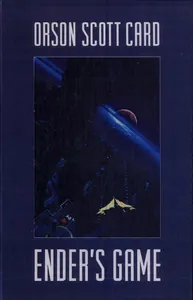
Ender's Game

 77
77

Ender's Game
Orson Scott Card’s "Ender's Game" is less a straightforward military sci-fi romp and more a chilling examination of manufactured genius. The narrative thrust, tracking Ender Wiggin’s brutal ascent through Battle School, is undeniable. Card excels at depicting the psychological warfare waged not just against the alien Formics, but within the very human systems designed to mold Ender. The novel’s strength lies in its unflinching portrayal of how pressure, isolation, and the constant threat of failure can forge exceptional individuals, albeit at a profound personal cost. However, the depiction of child manipulation, while central to the plot, can at times feel almost too clinical, bordering on detachment, which may alienate readers seeking deeper emotional resonance with the younger characters.
A specific passage where Ender, in a simulated battle, uses his ship's "Dr. Device" to annihilate the enemy fleet, only to discover it was a real event, crystallizes the book’s unsettling core. This moment encapsulates the ethical quagmire at the heart of the story. "Ender's Game" succeeds as a complex parable on the burdens of command and the terrifying efficacy of strategic thinking detached from immediate human consequence.
📝 Description
77
Orson Scott Card published Ender's Game in 1985, a novel examining child soldiers and preemptive war.
Ender's Game follows Andrew "Ender" Wiggin, a child identified for his strategic talent in a war against the alien Formics. He is sent to Battle School, an orbital facility designed to hone his military genius through isolation and rigorous training. The narrative focuses on the psychological pressures of leadership and the moral questions surrounding warfare.
The book questions the ethics of manipulating gifted children for military purposes. Ender's development is shaped by intense competition and the isolation he experiences, forcing him to consider the enemy's perspective to achieve victory. This strategic principle is central to his eventual success and the profound consequences it carries.
Beyond its military themes, the novel probes the nature of intelligence and the impact of extreme pressure on developing minds. It also touches upon the biological and cultural differences between humanity and the Formics, adding a layer of xenological consideration to the conflict.
While not overtly mystical, Ender's Game engages with esoteric ideas through its focus on consciousness, manipulation, and the nature of perception. The concept of "the enemy's way of thinking" suggests a form of empathetic projection, a technique found in various contemplative traditions. Ender's struggle with his own identity and the burden of his actions mirrors archetypal journeys of the reluctant hero. The novel also touches on themes of collective consciousness and the potential for understanding between vastly different species, hinting at concepts explored in spiritual and philosophical texts.
💡 Why Read This Book?
• Gain insight into the psychological manipulation of prodigies by studying Ender Wiggin’s training regimen at Battle School, a process designed to weaponize his intellect. • Understand the concept of "the enemy's way of thinking," a core strategic principle Ender must internalize to overcome the Formics, revealing how empathy can be a tool of warfare. • Contemplate the ethical implications of preemptive warfare through the lens of the Third Invasion War, considering the moral weight of decisions made under existential threat.
⭐ Reader Reviews
Honest opinions from readers who have explored this book.
❓ Frequently Asked Questions
When was Orson Scott Card's Ender's Game first published?
Orson Scott Card's "Ender's Game" was first published in 1985, initially appearing as a serialized story in Analog Science Fiction/Science Fact magazine.
What are the main alien antagonists in Ender's Game?
The primary alien antagonists in "Ender's Game" are the Formics, an insectoid species also referred to as 'Buggers,' who pose an existential threat to humanity.
What is Battle School in Ender's Game?
Battle School is an orbital training facility where gifted children, like Ender Wiggin, are educated and rigorously trained in military strategy and tactics for future interstellar conflict.
Did Ender's Game win any major awards?
Yes, "Ender's Game" received significant acclaim, winning both the Nebula Award for Best Novel and the Hugo Award for Best Novel in 1986.
What is the "Dr. Device" mentioned in Ender's Game?
The "Dr. Device" is a fictional weapon used by Ender in a final simulation. Its true nature and devastating real-world application are a critical plot revelation.
What does "the descolada" refer to in Ender's Game?
In "Ender's Game," "the descolada" is a reference to a biological agent, a virus, that is central to the Formics' existence and their interaction with other life forms.
🔮 Key Themes & Symbolism
Child Soldier Ethics
The narrative relentlessly probes the morality of using children as instruments of war. Ender's isolation, manipulation, and the psychological toll of his "training" highlight the ethical costs. The book questions whether extreme pressure and accelerated development can justify the exploitation of innocence, framing Ender as both a weapon and a victim of a desperate conflict. The manipulation of Ender's emotional state, designed to foster aggression and strategic brilliance, serves as a stark commentary on the dehumanizing effects of prolonged conflict on developing minds.
The Nature of the Enemy
A central theme is understanding the "enemy's way of thinking." Ender's success hinges not on brute force but on empathy—imagining the Formics' motivations, biology, and strategic approaches. This requires a profound shift from viewing them as mere "monsters" to comprehending their alien logic and existential drives. The discovery of their hive mind and their biological imperative, particularly related to "the descolada," reveals a complex alien society whose actions are rooted in self-preservation, forcing a re-evaluation of their "evil" nature.
Strategic Deception and Manipulation
From the Battle School's simulated games to the ultimate "final exam," deception is a pervasive tool. Ender and his instructors constantly employ psychological manipulation and strategic misdirection. The reader, like Ender, is often kept in the dark about the true nature of events, particularly the reality of the war against the Formics. This theme explores how truth can be weaponized and how perception is shaped by those in power, forcing characters and readers alike to question what is real and who is truly in control.
Leadership and Isolation
Ender's journey is a study in leadership forged through profound isolation. The architects of Battle School intentionally alienate him, believing it necessary to develop his strategic acuity and independence. This isolation, however, comes at the cost of genuine connection and emotional well-being. The book examines the paradoxical nature of leadership: requiring both the ability to command and the capacity to connect, while simultaneously demanding personal sacrifice and emotional detachment.
💬 Memorable Quotes
“In the moment when I truly understand my enemies, understand them in their being, as deeply as I know my own being, then I can love them. As I begin to destroy them, I love them.”
— This statement encapsulates Ender's ultimate strategic and ethical realization. It suggests that true victory and understanding come not from hatred, but from complete empathy, even with an adversary. This paradox fuels his approach to warfare and his later atonement.
“The perfect commander, he thought, never needed to say anything. His men would know what to do, and would do it, because they knew he would.”
— This reflects Ender's early aspiration for effortless leadership, a state of complete trust and unspoken understanding with his subordinates. It highlights his desire for efficiency and his perception of ideal command as an almost telepathic connection.
“I have to think of the most efficient way to destroy them. I have to think of the enemy's way of thinking.”
— This is a core strategic principle for Ender. It emphasizes that to defeat an opponent, one must fully inhabit their mindset, understanding their motivations, capabilities, and limitations. It’s about strategic empathy as a path to victory.
“When I'm old and gray, I will not want to think about the Battle School years. I will not want to think about the war. I will not want to think about the buggers. I will not want to think about Ender.”
— This expresses Ender's profound trauma and his desire for dissociation from his past. It reveals the immense psychological burden of his experiences and his struggle to reconcile his actions with his identity.
“I can't do it. I can't be the enemy. I have to be the savior.”
— This quote reflects Ender's internal conflict and his struggle to maintain his moral compass. He grapples with the destructive actions he must take versus his innate desire to protect and redeem.
🌙 Esoteric Significance
Tradition
While not overtly aligned with a specific esoteric lineage, "Ender's Game" shares thematic concerns with Gnostic thought, particularly in its exploration of a flawed, manipulated reality and the struggle of a "chosen one" to perceive and overcome deception. The concept of a hidden "demiurge" or controlling intelligence (represented by the military strategists) shaping a controlled environment (Battle School) for a predetermined outcome echoes Gnostic narratives of awakening to a higher truth. The novel's focus on the "enemy's way of thinking" can be seen as a form of strategic gnosis, requiring profound inner understanding to transcend external conflict.
Symbolism
The "buggers" (Formics) themselves function as a potent symbol of the "other" or the shadow self, an alien entity that must be understood and integrated rather than simply annihilated. Battle School, as an orbital construct, symbolizes a liminal space—a crucible removed from the mundane world, designed for transformative pressure. The "Dr. Device" represents ultimate power and destructive potential, a symbol of the terrifying consequences of unchecked technological advancement and strategic detachment, forcing a confrontation with the shadow aspect of human capability.
Modern Relevance
Contemporary discussions around "Ender's Game" often connect to modern anxieties about advanced AI, predictive warfare, and the ethics of drone technology. Thinkers and practitioners in fields like artificial intelligence ethics and strategic studies frequently cite the novel's exploration of algorithmic warfare and the psychological profiling of "high-potential" individuals. Its themes of empathy as a strategic tool also find echoes in modern conflict resolution and intercultural communication theories, suggesting that understanding the "other's way of thinking" remains a critical, albeit challenging, aspect of navigating complex global relations.
👥 Who Should Read This Book
• Aspiring strategists and leaders interested in the psychological underpinnings of command, particularly how isolation and pressure shape decision-making. • Students of ethics and philosophy examining the moral justifications for warfare and the exploitation of child potential in extreme circumstances. • Science fiction enthusiasts who appreciate intricate world-building and narratives that blend speculative technology with deep character psychology and moral ambiguity.
📜 Historical Context
Orson Scott Card's "Ender's Game," published in 1985, arrived during a period marked by the intense geopolitical anxieties of the Cold War, a backdrop that lent a particular resonance to its themes of existential threat and strategic preemptive action. The novel quickly ascended to prominence, securing both the Nebula Award and the Hugo Award for Best Novel in 1986, a rare dual win that signaled its broad critical appeal. Its success placed it within a rich tradition of hard science fiction, engaging with ideas about future warfare and alien contact explored by contemporaries like Arthur C. Clarke and Isaac Asimov. The novel's profound impact was also met with some controversy; its themes of child soldiery and ethically ambiguous warfare have led to challenges and discussions about its suitability for younger readers, particularly in school settings, contributing to ongoing debates about censorship in literature.
📔 Journal Prompts
Ender's mastery of the "enemy's way of thinking" as a path to understanding.
The isolation of Battle School and its effect on Ender's development.
The ethical implications of the "Dr. Device" and its use.
Grappling with the concept of "demons" and "monsters" in Ender's psychological landscape.
The paradox of Ender's role as both destroyer and savior.
🗂️ Glossary
Formics
An insectoid alien species, also referred to as "Buggers," who are the primary antagonists in the Third Invasion War against humanity.
Battle School
An orbital training facility established by the International Fleet to identify and educate gifted children for command roles in interstellar warfare.
Third Invasion War
The interstellar conflict between humanity and the Formics, initiated by the Formics' attack on the Sol system, prompting Earth's defense and counter-offensive.
The descolada
A biological virus or agent that is fundamental to the Formics' existence and their interaction with other life forms, playing a crucial role in their biology and planetary colonization.
Dr. Device
A devastating weapon, used by Ender in a simulated battle, that is later revealed to have been a real weapon capable of annihilating entire enemy fleets.
The enemy's way of thinking
A core strategic principle taught to Ender, emphasizing the necessity of fully understanding an opponent's motivations, psychology, and perspective to achieve victory.
Demons
A term used by Ender to describe the frightening aspects of his own psyche and the aggressive impulses he must control, as well as the alien "monsters" he faces.