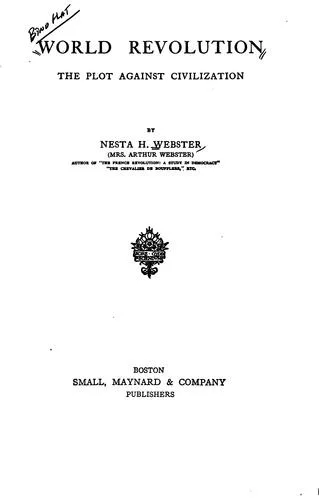
World revolution
 79
79

World revolution
Nesta Helen Webster’s "World Revolution" is less a dispassionate historical account and more a fervent polemic against perceived subterranean forces shaping global events. Published in 1921, it presents a sweeping, often alarmist, narrative of an unbroken chain of revolutionary conspiracy stretching back centuries. Webster meticulously links disparate movements—from the French Revolution's Jacobins to the nascent Soviet regime—under the umbrella of a singular, malevolent intent. Her strength lies in synthesizing a vast array of historical events into a coherent, albeit conspiratorial, framework, drawing connections that many historians would dismiss. However, this very coherence is also its limitation; the work suffers from a lack of critical distance, often treating its sources with uncritical acceptance when they align with its thesis and dismissing contradictory evidence. A notable passage details the supposed machinations of the Bavarian Illuminati, which Webster presents as an almost archetypal blueprint for subsequent revolutionary organizations. While "World Revolution" offers a fascinating window into early 20th-century anxieties and the enduring appeal of conspiracy narratives, it demands a highly critical reader.
Ultimately, Webster's "World Revolution" functions as a historical document of fear and suspicion rather than a reliable historical analysis.
📝 Description
79
Nesta Helen Webster's 1921 book argues a hidden agency orchestrates global upheaval.
Nesta Helen Webster's "World Revolution", published in 1921, examines what she saw as coordinated movements behind historical unrest. Webster contended that a single, secret organization was responsible for various revolutions and societal shifts, tracing this alleged conspiracy from the French Revolution through to events of the early 20th century. The book aims to reveal the supposed architects of these global changes.
This analysis is for readers interested in political history and theories of clandestine influence. It will appeal to those who question standard historical accounts and wish to understand the alleged goals and tactics of secret societies and revolutionary groups. Webster's work was written in the shadow of World War I and the Russian Revolution, reflecting the era's concerns about political radicalism and international subversion.
Webster's work fits within a tradition of conspiracy literature that sought to identify singular, often hidden, causes for complex historical phenomena. Her arguments draw on earlier writings concerning groups like the Illuminati and Freemasonry, placing "World Revolution" in a lineage that viewed history as shaped by clandestine forces. This perspective often arose during periods of significant social and political upheaval, attempting to make sense of widespread change through the lens of secret manipulation.
💡 Why Read This Book?
• Understand the historical roots of 20th-century conspiracy theories concerning global revolutions, as detailed in Webster's analysis of post-WWI anxieties and the Bolshevik Revolution. • Examine Webster's methodology in connecting disparate historical events, such as her linkage of the French Revolution's Jacobinism to later revolutionary movements. • Gain insight into the intellectual climate of the early 1920s, a period rife with speculation about hidden powers influencing societal structures.
⭐ Reader Reviews
Honest opinions from readers who have explored this book.
❓ Frequently Asked Questions
When was Nesta Helen Webster's 'World Revolution' first published?
Nesta Helen Webster's 'World Revolution' was first published in 1921, a period of significant global political upheaval following World War I and the Russian Revolution.
What historical events does 'World Revolution' analyze?
The book analyzes a broad sweep of history, focusing on events like the French Revolution, the rise of secret societies such as the Illuminati, and the early stages of Bolshevism in Russia.
What is the central thesis of 'World Revolution'?
The central thesis is that a continuous, clandestine conspiracy has been working throughout history to instigate revolutions and overthrow established social and political orders.
What is the author's perspective on secret societies?
Webster views secret societies, like the Illuminati and Freemasons, as instrumental in orchestrating revolutionary movements, seeing them as vehicles for subversive ideologies aimed at societal collapse.
Is 'World Revolution' considered a neutral historical text?
No, 'World Revolution' is widely considered a highly biased and polemical work, reflecting the author's strong anti-revolutionary and anti-conspiratorial stance rather than objective historical scholarship.
What political climate influenced the writing of 'World Revolution'?
The book was heavily influenced by the political climate of the early 20th century, particularly the widespread fear of radicalism, communism, and social unrest following World War I.
🔮 Key Themes & Symbolism
The Unbroken Conspiracy
Webster posits that a single, persistent conspiracy has been the driving force behind historical revolutions. She traces its lineage from the Enlightenment-era secret societies like the Bavarian Illuminati through the French Revolution's Jacobins and culminating in the early 20th-century communist movements. This unifying concept frames historical events not as organic societal shifts but as orchestrated events by a hidden hand seeking to dismantle established hierarchies and traditional values globally.
Subversive Ideologies
The book identifies specific ideologies—such as Jacobinism, socialism, and Bolshevism—as tools or manifestations of the overarching revolutionary conspiracy. Webster scrutinizes their philosophical underpinnings, arguing they are fundamentally opposed to order, religion, and national sovereignty. She analyzes how these ideas are propagated to destabilize societies from within, appealing to discontented elements and fostering class warfare or nationalistic fervor to achieve their aims.
The Role of Secret Societies
Secret societies are presented as crucial incubators and disseminators of revolutionary thought and action. Webster dedicates considerable attention to groups like the Freemasons and, especially, the Illuminati, portraying them as architects of sedition. The work explores how these clandestine organizations allegedly provide the structure, communication networks, and ideological cohesion necessary to plan and execute large-scale societal overthrows across different eras and nations.
Guardians of Order
As a counterpoint to the revolutionary forces, Webster implicitly champions the preservation of traditional order, established governments, and religious institutions. The book's alarmist tone serves as a warning, urging readers to recognize and resist the perceived threats. It frames the defense of existing structures as a critical duty against the destructive impulses of revolutionary movements, advocating for vigilance against those who seek to fundamentally alter society.
💬 Memorable Quotes
Direct passages from the work, attributed to the author.
“The revolution is not a local affair, but a world movement.”
— This statement captures Webster's core argument that revolutionary forces operate on a global scale, transcending national boundaries and acting as a unified, international phenomenon rather than isolated incidents.
“The Illuminati, founded in 1776, aimed to abolish monarchy, abolish private property, and abolish religion.”
— This highlights Webster's focus on specific historical groups and their alleged radical agendas. She presents the Illuminati's goals as a blueprint for subsequent revolutionary movements that she believes share similar aims.
“The French Revolution was the first great outbreak of the World Revolution.”
— This positions the 1789 French Revolution as an important, foundational event in the long historical arc of global conspiracy that Webster outlines in her book.
“The forces of revolution are always the same, though they may wear different masks.”
— This emphasizes Webster's belief in the unchanging nature of revolutionary motivations and methods, suggesting that despite superficial differences, the underlying 'conspiratorial spirit' persists through history.
“Bolshevism is the latest phase of this conspiracy.”
— This connects the contemporary (at the time of writing) Russian Revolution to the historical patterns Webster identifies, presenting it not as a unique event but as the latest iteration of a long-standing subversive agenda.
🌙 Esoteric Significance
Tradition
While not strictly adhering to a single esoteric lineage, Webster's work engages with themes found in certain strands of Western esotericism, particularly those influenced by anti-Masonic and anti-Illuminati literature that emerged in the late 18th and 19th centuries. It echoes Gnostic dualism in its portrayal of a cosmic struggle between forces of order and chaos, and shares with some Theosophical ideas a focus on hidden hierarchies and secret influences shaping world events, albeit with a diametrically opposed interpretation of their goals.
Symbolism
The primary symbolic motif is the 'hidden hand' or 'cabal' – an unseen agency manipulating global events. Secret societies like the Illuminati serve as potent symbols of clandestine power and subversive intent. The concept of 'revolution' itself becomes a symbol for societal dissolution, representing the tearing down of divinely ordained or historically validated structures in favor of radical, often atheistic, ideologies.
Modern Relevance
Webster's work continues to inform contemporary conspiracy theories, particularly those concerning global governance, secret societies, and the alleged manipulation of political events by shadowy elites. Thinkers and groups focused on national sovereignty, traditionalism, and anti-globalism often cite or allude to her analyses. Her framework for understanding historical change through the lens of a continuous, hidden conspiracy remains a recurring trope in certain online communities and fringe political discourse.
👥 Who Should Read This Book
• Students of political history and the evolution of conspiracy theories, seeking to understand early 20th-century anxieties about global revolution. • Researchers of secret societies and their alleged influence, particularly concerning the historical discourse surrounding the Illuminati and Freemasonry. • Readers interested in comparative ideological analysis, examining how authors like Webster framed and critiqued radical political movements of her time.
📜 Historical Context
Published in 1921, Nesta Helen Webster's "World Revolution" emerged from a period of intense geopolitical flux and ideological ferment. The Great War had shattered old empires, and the Bolshevik Revolution of 1917 had introduced a radical new force onto the world stage, sparking widespread fear of communist expansion. Webster's work tapped into a prevailing anxiety about hidden forces orchestrating global instability. Her analysis drew heavily on earlier conspiracy literature concerning the Illuminati, an organization founded in Bavaria in 1776, and the Freemasons, positing them as precursors to modern revolutionary movements. Contemporary intellectuals like H.G. Wells, though not directly engaged with Webster's specific theories, were grappling with the societal transformations and the potential for both progress and destruction in the modern era. The book's reception was largely within circles already predisposed to conspiracy theories, while mainstream historians approached its sweeping claims with skepticism.
📔 Journal Prompts
The notion of a 'World Revolution' as a continuous force: How does this concept differ from organic social change?
Webster's portrayal of the Illuminati: What specific historical accusations does she amplify?
The 'hidden hand' concept: How does this idea serve as a unifying explanation for disparate historical events?
Comparing the French Revolution's Jacobinism to Bolshevism: What common threads does Webster identify?
The role of secret societies in Webster's framework: What evidence does she present for their conspiratorial activities?
🗂️ Glossary
Jacobinism
A political movement during the French Revolution associated with radical egalitarianism, secularism, and extreme revolutionary fervor. Webster views it as a key manifestation of the world revolutionary impulse.
Illuminati
A historical secret society founded in Bavaria in 1776, known for its Enlightenment ideals and alleged subversive aims. Webster presents it as a foundational organization for global revolutionary conspiracies.
Bolshevism
The revolutionary socialist movement led by Vladimir Lenin that seized power in Russia in 1917. Webster sees it as the latest stage in the ongoing world revolution she describes.
Conspiracy
In Webster's context, a secret, organized plot by a group or groups to achieve revolutionary or subversive aims, often on a global scale, undermining established governments and social orders.
Social Upheaval
Widespread and often violent disturbance of the social or political order. Webster argues that such events are not spontaneous but are instigated by conspiratorial forces.
Clandestine
Kept secret or done secretively, especially because illicit. Webster applies this term to the methods and organizations she believes are responsible for orchestrating revolutions.
Subversive
Seeking or intending to undermine the power and authority of an established system or institution. Webster identifies various ideologies and groups as being fundamentally subversive.
🔮 Readers Also Liked
Browse all →









More by Nesta Helen Webster
All books →
More Free Occult Philosophy Books
View all →