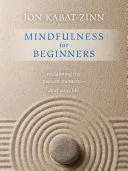
Mindfulness for Beginners
 75
75

Mindfulness for Beginners
Jon Kabat-Zinn’s approach in Mindfulness for Beginners is characterized by its disarming directness. He presents the practice not as a mystical attainment but as a fundamental human capacity waiting to be rediscovered. The strength lies in its radical simplicity, stripping away jargon to reveal the core of attentive living. A particularly effective passage details the "body scan" exercise, guiding the reader to systematically bring awareness to different parts of the body, a concrete method for grounding oneself. However, for those deeply entrenched in spiritual seeking, the secular framing might feel somewhat reductive, potentially omitting the richer metaphysical dimensions explored in other traditions. Despite this, the book offers a robust, evidence-based introduction to a practice that has demonstrably improved countless lives. It is an essential primer for anyone seeking a more grounded existence.
📝 Description
75
Jon Kabat-Zinn's 2012 book introduces core mindfulness practices to a general audience.
Mindfulness for Beginners presents mindfulness not as a complex spiritual path, but as a practical method for living more fully in the present. Kabat-Zinn, building on his work with the Stress Reduction Clinic, makes the principles of mindfulness accessible. He explains how to observe thoughts, feelings, and physical sensations without judgment. The aim is to foster greater calm and a clearer perspective on daily life.
This book is intended for those new to meditation or contemplative practices, especially individuals experiencing stress or seeking self-connection. It offers a secular approach, welcoming skeptics and the simply curious. Readers dealing with anxiety, chronic pain, or the general overwhelm of modern life will find concrete techniques for developing inner peace and resilience. The book emphasizes that the ability to be aware and present is innate and can be cultivated with gentle effort.
While this book presents mindfulness in a secular, accessible manner, its roots lie in Buddhist contemplative traditions. Jon Kabat-Zinn's development of Mindfulness-Based Stress Reduction (MBSR) adapted these practices for Western medicine and psychology, moving them from specific religious contexts. This work makes core concepts of meditation, like focused attention and equanimity, available to a broad audience, distinct from more academic or strictly spiritual interpretations. It translates ancient methods of cultivating awareness into practical tools for contemporary life.
💡 Why Read This Book?
• You will learn a foundational mindfulness technique, the body scan, as presented by its popularizer, Jon Kabat-Zinn, allowing you to directly engage with physical sensations for stress reduction, a method he developed. • You will gain an understanding of how to observe thoughts without attachment, a core principle derived from Buddhist Vipassanā meditation, enabling you to respond to challenges with greater equanimity. • You will be introduced to the concept of "present moment awareness" as articulated in his 2012 work, providing a practical framework for reducing anxiety about the future or regrets about the past.
⭐ Reader Reviews
Honest opinions from readers who have explored this book.
❓ Frequently Asked Questions
What is the primary benefit of practicing mindfulness as described by Jon Kabat-Zinn?
The primary benefit is cultivating present-moment awareness, which helps individuals transform their relationship with stressful thoughts, emotions, and physical sensations, leading to greater calm and clarity.
Is Mindfulness for Beginners religious or secular?
The book presents mindfulness as a secular practice, drawing on Buddhist principles but framed within a psychological and health-oriented context, making it accessible to people of all backgrounds.
What specific meditation techniques are taught in the book?
The book introduces fundamental techniques such as mindful breathing, the body scan, and mindful observation of thoughts and emotions, designed for easy integration into daily life.
When was Jon Kabat-Zinn's Mindfulness for Beginners first published?
Mindfulness for Beginners was first published on January 1, 2012, making it a relatively recent accessible introduction to his established methods.
How does this book differ from more advanced mindfulness resources?
This book is specifically tailored for individuals with no prior experience, offering a gentle and straightforward entry point, unlike more complex texts that assume existing familiarity with meditation.
Can mindfulness help with physical pain?
Yes, Kabat-Zinn's work, including this book, is rooted in Mindfulness-Based Stress Reduction (MBSR), which has shown effectiveness in helping individuals manage chronic pain by changing their relationship to discomfort.
🔮 Key Themes & Symbolism
Present Moment Awareness
The core tenet of mindfulness, emphasizing the importance of direct, non-judgmental attention to what is happening right now. This contrasts with the mind's tendency to dwell on past regrets or future anxieties. Kabat-Zinn frames this awareness as an inherent capacity, accessible through simple practices like mindful breathing and the body scan introduced in his 2012 work.
Non-Judgmental Observation
Cultivating an attitude of acceptance towards one's thoughts, feelings, and sensations without labeling them as 'good' or 'bad'. This practice, deeply rooted in Vipassanā meditation, allows for a more objective understanding of internal experiences, reducing reactivity and emotional distress. It's about observing the mind's patterns with curiosity rather than criticism.
Transforming Suffering
Mindfulness is presented not as an escape from difficulty, but as a means to change one's relationship to suffering. By becoming more aware of the present moment, individuals can disengage from habitual patterns that perpetuate stress and pain. This approach, developed through his work at UMass Medical School, offers practical tools for living more fully, even amidst challenges.
Embracing Wholeness
The book suggests that a sense of wholeness is not something to be achieved in the future but is already present. Mindfulness practice helps to uncover this inherent unity by fostering a deeper connection to oneself and the world. It encourages an embrace of life as it is, recognizing the interconnectedness of all experiences.
💬 Memorable Quotes
Direct passages from the work, attributed to the author.
“The truth is that it is already here and already ours.”
— This statement underscores the book's central message: the capacity for mindfulness and a sense of peace is not an external attainment but an inherent quality of being, readily available in the present moment.
“The practice of mindfulness holds the possibility of not just a fleeting sense of contentment, but a true embracing of a deeper unity.”
— This highlights the profound potential of mindfulness beyond temporary happiness, suggesting it can lead to a fundamental shift in one's perception of self and reality, fostering a sense of interconnectedness.
“transform your relationship to the way you think, feel, love, work, and play”
— This captures the practical application of mindfulness, suggesting that by changing how we relate to our internal and external experiences, we can fundamentally alter our overall quality of life.
“We may long for wholeness, but the truth is that it is already here and already ours.”
— This rephrasing emphasizes that the state of being complete or unified is not a future goal but a present reality that can be accessed through mindful awareness, challenging the common perception of seeking.
“An Invitation to the Practice of Mindfulness”
— This phrase from the original blurb sets the tone for the book, presenting mindfulness not as a rigid doctrine but as an open and welcoming invitation to explore one's own consciousness and experience.
🌙 Esoteric Significance
Tradition
While presented secularly, Mindfulness for Beginners draws heavily from the traditions of Buddhist Vipassanā (insight) meditation, a core practice within Theravada Buddhism. It translates the concept of 'bare attention' – observing reality as it is – into accessible, non-sectarian language. Esoterically, it aligns with the Hermetic principle of 'As Above, So Below,' by focusing on the microcosm of individual consciousness and experience to understand universal principles of presence and awareness.
Symbolism
The practice of mindful breathing serves as a fundamental symbol. The breath is the constant, immediate connection to the present moment, symbolizing life itself and the continuous flow of existence. The "body scan" can be seen as a symbolic journey through the self, mapping the territory of one's physical and sensory experience, bringing awareness to often-ignored parts of the being, much like an alchemical process of exploring the prima materia.
Modern Relevance
This work is foundational for numerous contemporary mindfulness-based interventions (MBIs) and apps, such as Headspace and Calm, which employ similar secularized techniques. Thinkers and practitioners in positive psychology, clinical psychology, and wellness coaching frequently cite Kabat-Zinn's foundational work. Its influence extends to corporate wellness programs and educational institutions seeking to foster resilience and focus in modern society.
👥 Who Should Read This Book
• Individuals new to meditation seeking practical, secular techniques to manage stress and anxiety, benefiting from Kabat-Zinn's established MBSR framework. • Skeptical or scientifically-minded readers who prefer evidence-based approaches to mental well-being, appreciating the book's focus on observable experience over dogma. • Those experiencing chronic pain or difficult emotions who wish to learn how to change their relationship to suffering, utilizing the direct methods outlined in the text.
📜 Historical Context
Published in 2012, Jon Kabat-Zinn's "Mindfulness for Beginners" arrived at a central moment for secular mindfulness. The preceding decades had seen a significant surge in interest, moving contemplative practices from niche Buddhist circles into mainstream Western culture, particularly within psychology and healthcare. Kabat-Zinn himself was a key figure, having established the Mindfulness-Based Stress Reduction (MBSR) program at the University of Massachusetts Medical School in 1979. His work was a significant counterpoint to purely theological or philosophical interpretations of meditation. While figures like Thich Nhat Hanh were also popularizing accessible Buddhist teachings, Kabat-Zinn's approach was distinctly framed around stress reduction and well-being, aligning with scientific research and clinical applications. The book solidified the secular, pragmatic application of mindfulness, making it a widely recognized tool for managing stress and enhancing daily life, distinct from earlier, more esoteric transmissions.
📔 Journal Prompts
The body scan's invitation to inhabit physical sensation.
Observing the arising and passing of thoughts during mindful breathing.
Accepting a difficult emotion without judgment.
The feeling of being fully present in a simple daily activity.
The contrast between habitual reactivity and mindful response.
🗂️ Glossary
Mindfulness
Paying attention in a particular way: on purpose, in the present moment, and non-judgmentally. It is about being aware of where you are and what you are doing.
Present Moment Awareness
The state of intentionally focusing one's attention on the current experience, including thoughts, feelings, bodily sensations, and the surrounding environment, without judgment.
Non-judgmental Observation
The practice of observing one's thoughts, feelings, and sensations as they arise, without labeling them as good or bad, right or wrong.
Body Scan
A mindfulness meditation technique involving systematically bringing gentle, curious awareness to different parts of the body, noticing any sensations that are present.
Vipassanā
A traditional Buddhist term for insight meditation, focusing on developing clear awareness of the present moment's reality, often translated as 'insight' or 'clear seeing'.
Stress Reduction
The process of identifying and managing stressors, often through techniques like mindfulness, to reduce the negative physical and psychological effects of stress.
Wholeness
A state of being complete, integrated, and undivided, often realized through mindfulness practice as an inherent quality rather than an external achievement.