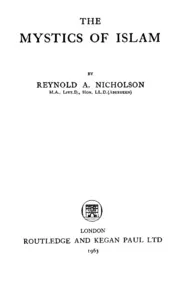
The Idea of Personality in Sufism, Three lectures

 73
73

The Idea of Personality in Sufism, Three lectures



Celeste Moreau (Divination & Symbolism Reviewer) — Smirna Si's 'The Idea of Personality in Sufism' is a luminous beacon for those navigating the esoteric currents of Islamic mysticism. Through three meticulously crafted lectures, Si unveils the Sufi paradigm of the self, revealing it not as a static entity, but a dynamic conduit for divine manifestation. The text is rich with symbolic language and profound philosophical insights, making complex theological concepts accessible. Nicholson's guiding notes add an invaluable layer of scholarly depth. This work is a treasure for serious students of Sufism, mystics, and anyone seeking a deeper understanding of spiritual identity beyond the mundane.
📝 Description
73
Smirna Si's 1972 lectures examine the Sufi concept of personality beyond the ego.
Originally delivered as three lectures in 1972, Smirna Si's 'The Idea of Personality in Sufism' investigates the Sufi conception of the self. The book moves beyond the ordinary human ego to discuss a divine essence within. Si draws on Sufi traditions and the work of Nicholson to illuminate this understanding. Readers will find discussions on the soul's path, the dissolution of the individual self, and the experience of divine unity.
The text encourages a contemplative approach, engaging with ideas that connect to fundamental human desires for inner change and spiritual truth. It aims to provide a guide for those interested in personal transformation and the pursuit of deeper meaning. The lectures focus on how Sufism views the development and realization of the self.
This work sits within the esoteric tradition of Islamic mysticism, known as Sufism. Sufism often contrasts the limited, individual ego ('nafs') with a higher, divine reality accessible through spiritual discipline. The lectures likely discuss practices and philosophical ideas aimed at purifying the self and realizing its connection to the divine. This approach is common in esoteric paths that seek direct spiritual experience and union with the ultimate reality.
💡 Why Read This Book?
Unravel the profound Sufi concept of the self, moving beyond ego to divine realization. Discover hidden esoteric knowledge and rich symbolism central to Islamic mysticism. This book offers a transformative perspective on spiritual identity and the journey toward unity. Ideal for seekers of truth, scholars of religion, and practitioners of contemplative practices.
⭐ Reader Reviews
Honest opinions from readers who have explored this book.
❓ Frequently Asked Questions
What is the core concept of 'personality' in Sufism as presented by Si?
In Sufism, personality is viewed not as the limited ego, but as a divine potential, a vessel capable of reflecting the attributes of Allah. It's about transcending the individual self to realize the universal, unified consciousness.
Who was Nicholson's role in this work?
Nicholson, a renowned scholar of Sufism, provided original notes and annotations that enrich Si's lectures, offering scholarly context and clarifying intricate points of Sufi doctrine and practice.
Is this book suitable for beginners in Sufism?
While rich in depth, the lectures are presented with clarity, making them accessible to dedicated beginners eager to understand core Sufi principles. Prior familiarity with mystical concepts would be beneficial.
What kind of knowledge can one expect to gain?
Readers can expect to gain insights into the nature of the soul, the path of spiritual purification, the concept of divine love, and the ultimate goal of annihilation of the self in God.
How does this book contribute to metaphysical understanding?
It offers a unique metaphysical framework where the human personality becomes a microcosm of the Divine, revealing the interconnectedness of all existence and the potential for inner divinity.
🔮 Key Themes & Symbolism
The Transcendent Self
This theme studies the Sufi understanding of the self as more than the ordinary ego. It explores the concept of the 'true self' or 'spirit' (ruh), which is seen as intrinsically connected to the Divine. Si illuminates how Sufi practice aims to purify the lower self (nafs) to reveal this higher, divinely-infused personality, capable of experiencing unity with God. It's a journey from limitation to boundless spiritual identity.
Symbolism of the Journey
The lectures are imbued with strong symbolism, depicting the spiritual path as a journey of transformation. This includes metaphors of ascent, purification, and unveiling. Si explains how Sufi masters use allegorical language to convey profound truths about the soul's return to its Divine Source. Understanding this symbolic language is key to unlocking the deeper meanings within Sufi teachings on personality and union.
Divine Love and Annihilation
Central to the Sufi concept of personality is the transformative power of Divine Love ('ishq). Si explores how this ardent love leads the individual towards the annihilation of the ego (fana'), a state where the personal will dissolves into the Divine will. This 'fana'' is not an end, but a gateway to a higher form of existence, a 'subsistence in God' (baqa'), where the personality is renewed and fully actualized in Divine consciousness.
💬 Memorable Quotes
Direct passages from the work, attributed to the author.
“Ego's walls crumble, revealing the boundless ocean within.”
— Symbolizes the spiritual process of ego dissolution (nafs), leading to the realization of one's true, infinite spiritual nature, connected to the Divine.
“Personality's true form is not owned, but borrowed from the Beloved.”
— Highlights the Sufi understanding that our individual essence is a manifestation of the Divine, a temporary reflection rather than an independent creation.
“The journey inward is the path to outward unity.”
— Emphasizes the interconnectedness of personal spiritual development and the realization of universal oneness, a core tenet of Sufi philosophy.
“In losing the 'I,' we find the All.”
— A concise expression of the Sufi paradox: through the relinquishing of the ego, one achieves a profound connection and identification with the entirety of existence.
💡 Key Ideas
Editorial paraphrase of the work's core concepts — not direct quotes.
The self is a mirror, awaiting the Divine gaze.
This quote captures the Sufi view of the human personality as a passive yet potent receptacle, capable of reflecting divine attributes once purified and oriented towards God.
🌙 Esoteric Significance
Tradition
This work is firmly rooted in the Sufi tradition, a mystical branch of Islam that seeks direct, experiential knowledge of God. Sufism emphasizes inner purification, devotion, and the annihilation of the ego to achieve union with the Divine. It represents a profound esoteric interpretation of Islamic scripture and practice, focusing on the hidden, spiritual dimensions of faith and existence.
Symbolism
Sufi thought is rich in symbolism, employing metaphors of wine, the Beloved, the moth and flame, and the journey to represent spiritual states and processes. In 'The Idea of Personality,' symbols likely revolve around the heart as the seat of divine knowledge, the nafs (ego) as a veil, and the soul's journey as an ascent or pilgrimage towards the Divine presence.
Modern Relevance
In a world often characterized by materialism and fragmented identities, the Sufi perspective on personality offers a profound counterpoint. It speaks to the universal human yearning for meaning, connection, and transcendence. The emphasis on inner transformation and the realization of a deeper, unified self appeals to contemporary seekers exploring spirituality, mindfulness, and holistic well-being.
👥 Who Should Read This Book
This clear text is a vital resource for anyone drawn to the depths of Islamic mysticism. Scholars of religion and philosophy will find invaluable insights into Sufi metaphysics and ethics. Spiritual seekers and practitioners, particularly those interested in contemplative traditions, will discover profound guidance on self-understanding and the path to divine union. Beginners curious about Sufism can approach this work for a foundational understanding of its core concepts regarding the self and spiritual realization.
📜 Historical Context
These lectures emerge from a rich intellectual and spiritual tradition within Islam, primarily flourishing from the 8th century onwards. Sufism, or Islamic mysticism, developed as a response to the perceived worldliness within early Islamic society, emphasizing inner spiritual experience and direct knowledge of God. The period of its greatest efflorescence saw the rise of influential figures like Rumi, Al-Ghazali, and Ibn Arabi, whose works profoundly shaped the understanding of the soul, love, and divine union. This tradition, though sometimes facing orthodox opposition, has consistently offered a path of intense devotion, asceticism, and philosophical inquiry into the nature of reality and human existence, influencing art, literature, and spiritual practice across the Islamic world and beyond.
📔 Journal Prompts
Reflect on the distinction between the ego (nafs) and the true self (ruh) in your own experience. Where do you see the ego's limitations most strongly?
How does the concept of 'Divine Love' influence your understanding of your own personality and your relationships?
Consider the symbols of the spiritual journey. What metaphors best represent your own path of inner growth?
In what ways can the dissolution of the ego lead to a greater sense of connection with others and the universe?
How can the aspiration for 'unity with the Divine' shape your daily actions and intentions?
🗂️ Glossary
Nafs
The lower self or ego in Islamic terminology. It represents the carnal desires, egoistic tendencies, and worldly attachments that must be purified on the spiritual path.
Ruh
The spirit or soul. In Sufism, it is considered the divine essence within a human being, intrinsically connected to God and the source of spiritual awareness.
Fana'
Annihilation or dissolution. In Sufism, it refers to the annihilation of the ego and worldly attachments in the Divine presence, a state of selflessness.
'Ishq
Divine love. An ardent, passionate love for God that is a driving force in the Sufi path, leading to spiritual transformation and union.
Baqa'
Subsistence or abiding. The state that follows fana', where the self, having been annihilated in God, then 'subsists' or abides in God's attributes and consciousness.
This book appears in 2 collections
🔮 Readers Also Liked
Browse all →







More by Smirna Si
All books →


From the “Christian Mysticism” Collection
View all →








More Free Mysticism & Contemplation Books
View all →