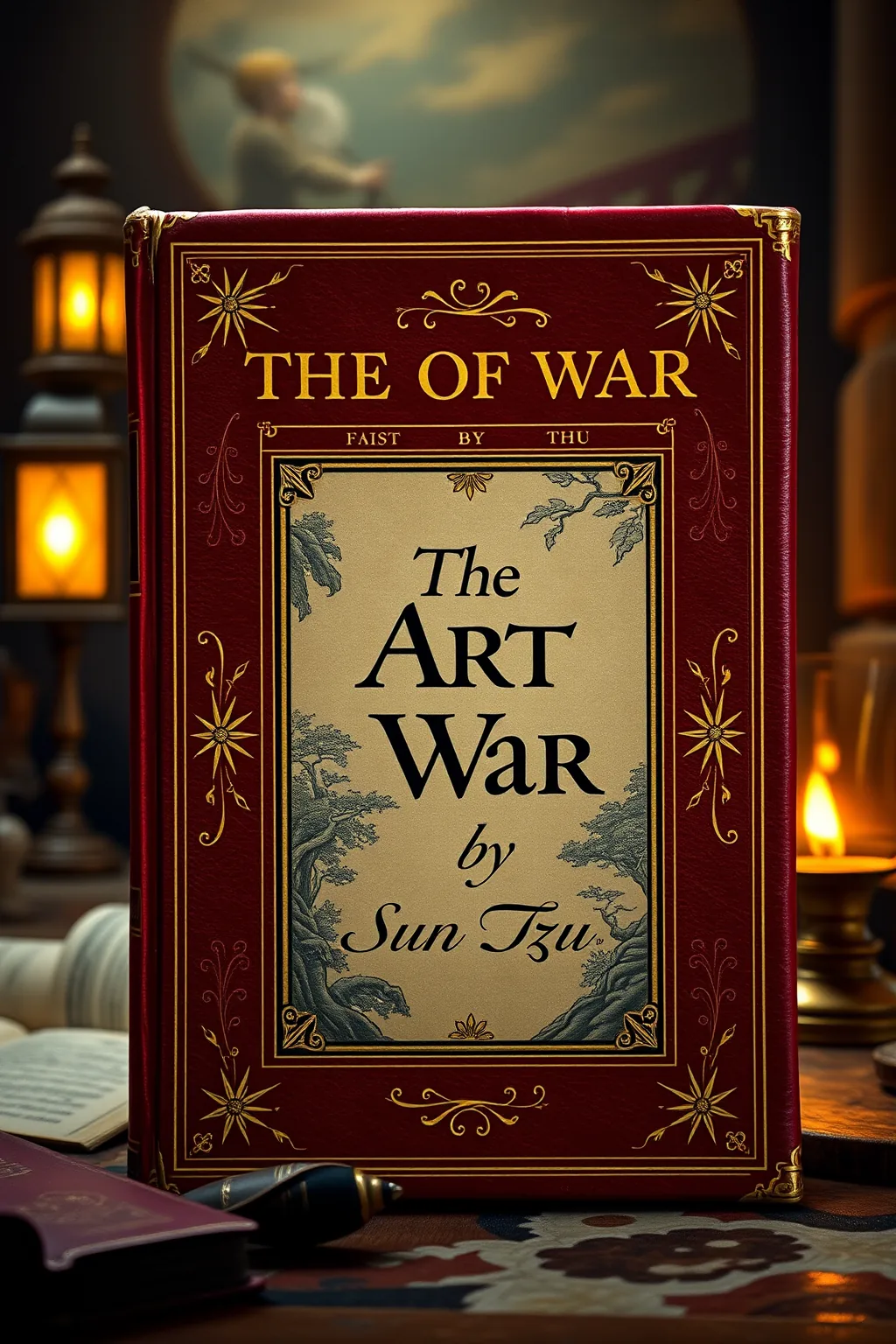
The Art of War by Sun Tzu
 76
76

The Art of War by Sun Tzu



Balthazar Finch (Senior Critic, Occult Philosophy) — Sun Tzu's "The Art of War" remains an unparalleled repository of esoteric strategy, far exceeding its martial origins. Gagliardi's translation illuminates the text's deeper metaphysical layers, revealing its potent applications for spiritual practitioners and seekers of hidden knowledge. The emphasis on knowing oneself and one's adversary, on the subtle energies of position and timing, resonates deeply with occult principles. This edition is a treasure, offering profound insights into the archetypal forces that govern all forms of conflict and resolution. It is a potent tool for the discerning mind, a guide to overcoming the illusions and obstacles that obscure the path to enlightenment.
📝 Description
76
Sun Tzu's "The Art of War", written around the 5th century BCE, is more than a military treatise.
Sun Tzu's "The Art of War" presents strategies for conflict that extend beyond the battlefield. This translation by Gary Gagliardi makes available the text's core principles. The book examines how to approach conflict with understanding and foresight, emphasizing strategy over direct confrontation. It discusses concepts like deception, knowing your enemy and yourself, and the importance of timing. The text suggests that true victory comes from preparation and wisdom, not just force.
These ideas are applied to various aspects of life, aiming for resolution and inner peace. It teaches methods for dealing with challenges, from understanding subtle tactics to using decisive actions like "attack with fire." The book guides the reader toward self-mastery and achieving goals through intelligent application of principles. It posits that power is found in stillness and deep knowledge.
While often read as a military manual, "The Art of War" also functions within esoteric traditions that seek universal principles for navigating conflict. Its emphasis on knowing oneself and the opponent, and on achieving victory with minimal struggle, aligns with Taoist ideas of harmony and effortless action. The text suggests a path to mastery that involves inner discipline and understanding the underlying patterns of events, rather than direct, forceful intervention. This approach can be seen as a form of applied philosophy, aiming for a balanced state of being and effective action in the world.
✍️ Author
Sun Tzu. This eBook is the complete Engli
Classic literature author · Public Domain
💡 Why Read This Book?
Unearth timeless strategies for navigating conflict, both external and internal. This book offers profound philosophical insights applicable to life's challenges, spiritual growth, and personal mastery. Ideal for seekers of wisdom, scholars of ancient thought, and practitioners of contemplative disciplines who wish to cultivate foresight and achieve harmonious resolution.
⭐ Reader Reviews
Honest opinions from readers who have explored this book.
❓ Frequently Asked Questions
Is 'The Art of War' solely about military conflict?
While rooted in military strategy, its principles are universally applicable to business, personal relationships, and spiritual development, offering timeless wisdom for navigating all forms of conflict.
What makes Gary Gagliardi's translation significant?
Gagliardi's translation is celebrated for its accuracy and its ability to convey the nuanced philosophical and spiritual undertones of Sun Tzu's original text, making it more accessible to a modern, contemplative audience.
How does this book relate to mysticism and contemplation?
It offers a framework for understanding universal principles of balance, foresight, and strategic action, which are core to many mystical traditions and contemplative practices aimed at self-mastery and inner peace.
Who is the ideal reader for this eBook?
The ideal reader is someone interested in ancient philosophy, strategic thinking, personal growth, and the application of wisdom to overcome life's obstacles, including spiritual seekers and scholars.
What are some key practical takeaways from the book?
Key takeaways include the importance of preparation, understanding the enemy (and oneself), the value of deception, the art of avoiding unnecessary conflict, and achieving victory through minimal engagement.
🔮 Key Themes & Symbolism
The Tao of Strategy
This theme explores how Sun Tzu's teachings align with the principles of the Tao, emphasizing natural flow, adaptability, and the power of effortless action. It reveals strategy not as forceful imposition, but as an understanding of underlying currents, akin to water finding its path. The book teaches that true mastery comes from harmonizing with the 'Way,' achieving objectives with minimal resistance and maximum effectiveness, a profound lesson for both worldly and spiritual endeavors.
Foresight and Knowing
A central pillar of Sun Tzu's philosophy is the paramount importance of foresight and deep understanding. This theme examines the esoteric concept of 'knowing,' which extends beyond mere observation to intuitive perception and clairvoyant awareness of potential futures. By cultivating this profound knowledge of self, adversary, and circumstance, one can preempt conflict, neutralize threats before they materialize, and read through the complexities of existence with exceptional wisdom and certainty.
The Inner Battlefield
Beyond the physical realm, 'The Art of War' offers a potent metaphor for the internal struggles we all face. This theme illuminates how Sun Tzu's principles can be applied to the cultivation of mental discipline, emotional regulation, and the overcoming of personal limitations. It guides the reader in understanding and mastering their own inner forces, transforming the mind into a strategic fortress from which to launch assaults against doubt, fear, and ignorance, leading to a state of inner peace and true victory.
💬 Memorable Quotes
Direct passages from the work, attributed to the author.
“All warfare is based on deception.”
— This statement highlights the importance of perception management and understanding the illusory nature of reality. True mastery lies in seeing beyond appearances.
“Know thy enemy and know thyself; in a hundred battles, you will never be in peril.”
— This emphasizes the critical need for self-awareness and useful insights into external forces as the foundation for success and safety in any endeavor.
“The supreme art of war is to subdue the enemy without fighting.”
— This profound principle underscores the ultimate goal: achieving victory through wisdom, diplomacy, and strategic positioning, rather than through destructive conflict.
“Appear weak when you are strong, and strong when you are weak.”
— This speaks to the art of psychological warfare and the manipulation of perception, a key element in understanding the hidden dynamics of power and influence.
💡 Key Ideas
Editorial paraphrase of the work's core concepts — not direct quotes.
In the midst of chaos, there is also opportunity.
This quote reveals the esoteric understanding that even in turmoil, forces can be manipulated to one's advantage, highlighting resilience and perceptive adaptability.
🌙 Esoteric Significance
Tradition
While not explicitly tied to a single Western esoteric tradition, "The Art of War" resonates deeply with the principles found in Taoism, Zen Buddhism, and Stoicism. Its emphasis on flow, non-resistance, strategic inaction, and the cultivation of inner stillness aligns with the core tenets of Eastern mystical philosophies. It speaks to the universal search for balance, foresight, and mastery over the self and one's environment, a common thread in many contemplative practices.
Symbolism
The text is replete with symbolic language. 'Water' represents adaptability and the power of yielding. 'Fire' symbolizes decisive, transformative action. 'Spies' represent the intuitive and perceptive faculties needed to gather hidden knowledge. The 'battlefield' itself can be seen as a metaphor for the challenges of life or the inner field of the mind. These symbols offer layered meanings for those seeking deeper, spiritual interpretations of strategy and conflict resolution.
Modern Relevance
In an increasingly complex and interconnected world, Sun Tzu's wisdom is more relevant than ever. Its principles of strategic foresight, understanding human psychology, adaptability, and conflict de-escalation are crucial for navigating modern challenges in business, leadership, personal development, and even global diplomacy. The book provides a timeless framework for achieving success with minimal disruption, fostering resilience, and cultivating a more mindful and effective approach to life's inevitable struggles.
👥 Who Should Read This Book
This timeless treatise is essential for ambitious leaders seeking to sharpen their strategic acumen, and for philosophers and scholars interested in the evolution of thought. Spiritual seekers and contemplative practitioners will find profound metaphors for inner mastery and navigating life's challenges with wisdom. Beginners in strategy will discover foundational principles, while experienced practitioners will uncover deeper layers of insight. It is a vital read for anyone aiming for effective action, harmonious resolution, and a profound understanding of the dynamics of conflict and victory.
📜 Historical Context
Emerging from the turbulent Spring and Autumn period of ancient China (771-476 BCE), a time rife with warring states and shifting alliances, Sun Tzu's "The Art of War" was forged in the crucible of constant conflict. This era of profound social and political upheaval demanded innovative approaches to survival and dominance. The text reflects a sophisticated understanding of human nature, logistics, and the psychological dimensions of warfare, deeply influenced by prevailing philosophical currents like Taoism and Confucianism. Its enduring legacy lies in its ability to abstract military principles into timeless strategic wisdom, transcending its specific historical context to become a foundational text for leaders, strategists, and thinkers across millennia and diverse cultures, influencing everything from political maneuvering to modern business practices.
📔 Journal Prompts
Reflect on a recent 'battle' in your life. How could Sun Tzu's principles of deception or knowing your adversary have altered the outcome?
Consider a situation where you acted impulsively versus strategically. How did the difference in approach affect the result?
How can the principle of 'subduing the enemy without fighting' be applied to a persistent inner conflict or negative habit?
Identify a 'weakness' you perceive in yourself or your circumstances. How might you strategically leverage this perceived weakness?
In what ways does 'knowing yourself' and 'knowing your enemy' manifest in your daily interactions and decision-making processes?
🗂️ Glossary
Tao
In the context of "The Art of War," the Tao refers to the fundamental Way or natural order of things. Understanding and aligning with the Tao allows for effortless and effective action, minimizing resistance.
Ch'i (Qi)
Often translated as vital energy or life force, Ch'i encompasses the dynamic forces and momentum in any situation. Strategic mastery involves understanding and manipulating these energies.
Shen Fa (Form)
Refers to the underlying structure or position of forces. Understanding and shaping Form is crucial for gaining a strategic advantage, much like a well-formed chess position.
Shih (Potential Power)
The inherent power or potential that exists within a situation or force. Shih is the latent energy waiting to be unleashed through skillful maneuvering.
Wu Wei
A core Taoist concept meaning 'non-action' or 'effortless action.' In strategy, it signifies achieving results through minimal, precise, and natural interventions, rather than forceful imposition.
This book appears in 1 collection
🔮 Readers Also Liked
Browse all →




From the “Christian Mysticism” Collection
View all →




More Free Mysticism & Contemplation Books
View all →