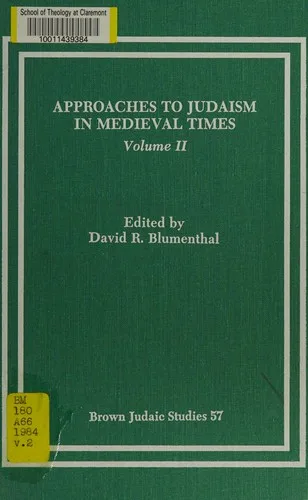
Philosophic mysticism

 79
79

Philosophic mysticism
Blumenthal's "Philosophic Mysticism" tackles a challenging subject with commendable intellectual honesty. The author’s strength lies in his meticulous dissection of how philosophical reasoning shapes and is shaped by mystical aspirations, particularly evident in his analysis of apophatic traditions. He carefully avoids romanticizing mysticism, grounding it in its intellectual history. A limitation, however, is the dense prose which, at times, can obscure the very directness mysticism aims for, demanding significant reader concentration. The section discussing the nature of 'gnosis' as a form of knowing distinct from empirical or rational faculties is particularly illuminating, highlighting the epistemological claims inherent in mystical paths. Ultimately, Blumenthal provides a robust, albeit demanding, philosophical companion to the study of mystical phenomena.
📝 Description
79
David R. Blumenthal's 2006 book argues mysticism is a complex system of thought, not just emotional experience.
Published in 2006, David R. Blumenthal's "Philosophic Mysticism" offers a scholarly look at mystical thought. The book moves past simple definitions to examine the philosophical ideas behind mystical pursuits. Blumenthal investigates how people and traditions have aimed for direct encounters with the divine or ultimate reality. These pursuits often involved disciplined intellectual and contemplative practices. He treats mysticism as a structured system of thought and practice, complete with its own internal logic and ways of knowing.
This work is for those seriously studying philosophy, comparative religion, and esoteric traditions. It will interest readers who approach mystical phenomena with academic care, wanting to grasp the conceptual frameworks that shape these experiences. Readers should come with some background in philosophical thought and expect detailed analysis. The book is especially relevant for those interested in how mystical ideas developed across Western and Eastern traditions.
Emerging in the early 21st century, "Philosophic Mysticism" entered an academic climate that re-examined the connections between philosophy and religion. Blumenthal's work countered purely sociological or psychological views of mysticism. It emphasized the intellectual and metaphysical aspects, drawing on thinkers like Plotinus and Meister Eckhart. The book positions mystical experience as a rational pursuit with its own epistemological claims, distinct from mere emotionalism.
💡 Why Read This Book?
• Gain a structured understanding of how philosophical inquiry underpins mystical traditions, moving beyond anecdotal accounts, as explored through the concept of 'gnosis' as a distinct form of knowledge. • Appreciate the intellectual rigor behind apophatic theology by examining the "via negativa" and its historical manifestations from Neoplatonism onward. • Understand the nuanced relationship between ecstatic states and philosophical contemplation, as Blumenthal details the conceptual frameworks that interpret these experiences.
⭐ Reader Reviews
Honest opinions from readers who have explored this book.
❓ Frequently Asked Questions
What philosophical traditions does 'Philosophic Mysticism' engage with?
The book primarily engages with Neoplatonism, Christian mysticism, and elements of Eastern contemplative traditions, examining how their philosophical structures inform mystical goals and experiences.
How does Blumenthal define 'mysticism'?
Blumenthal defines mysticism not just as emotional experience but as a complex system of thought and practice aiming for direct apprehension of ultimate reality, often through rigorous intellectual and contemplative methods.
Is 'Philosophic Mysticism' suitable for beginners in esoteric studies?
While valuable, the book's academic rigor and dense prose make it more suitable for those with a background in philosophy or comparative religion, rather than absolute beginners.
What is the 'via negativa' as discussed in the book?
The 'via negativa,' or apophatic theology, is a method of approaching the divine through negation – by stating what God is not, rather than what God is. Blumenthal traces its philosophical development.
What is the publication date of 'Philosophic Mysticism'?
The work was first published in 2006, placing it within contemporary academic scholarship on religion and philosophy.
Does the book discuss specific historical mystics?
Yes, the work explores the philosophical underpinnings of mystical thought as manifested in figures and traditions associated with thinkers like Plotinus and in Christian mysticism.
🔮 Key Themes & Symbolism
Gnosis and Epistemology
The work meticulously investigates 'gnosis,' positing it as a distinct mode of knowing that transcends empirical observation and rational deduction. Blumenthal explores how this intuitive apprehension of truth is central to mystical traditions, allowing practitioners to gain direct insight into ultimate reality. He contrasts gnosis with conventional epistemology, highlighting its role in bridging the gap between the human and the divine, and how this concept functions within various philosophical mystical frameworks.
The Via Negativa
A core theme is the "via negativa," or apophatic approach, which emphasizes understanding the divine through negation. Blumenthal traces the philosophical lineage of this concept, from its roots in Neoplatonism to its profound influence on Christian mystics like Pseudo-Dionysius the Areopagite. The book details how this method, by stripping away finite descriptions, aims to approach an ineffable absolute, demonstrating its utility as a philosophical discipline for mystical pursuit.
Mystical Experience as Philosophical Act
Blumenthal argues against viewing mystical experiences solely as subjective emotional states. Instead, he frames them as significant philosophical acts, imbued with cognitive content and epistemological claims. The book examines how traditions have developed complex conceptual systems to interpret and validate these profound encounters with ultimate reality, asserting the intellectual weight of mystical traditions.
Integration of Contemplation and Reason
The book explores the intricate relationship between contemplative practices and philosophical reasoning. It demonstrates how, in many mystical systems, rigorous intellectual discipline is not opposed to but is rather a necessary component of achieving higher states of consciousness. Blumenthal shows how reason serves to structure and understand the insights gained through direct experience, creating a cohesive path.
💬 Memorable Quotes
Direct passages from the work, attributed to the author.
“The apprehension of the divine is often framed by what it is not.”
— This concisely captures the essence of the 'via negativa,' suggesting that true understanding of the ultimate transcends positive description, relying instead on negation to point towards the ineffable.
“Gnosis offers a knowledge distinct from empirical or rational faculties.”
— This highlights the book's focus on a specific type of intuitive or direct knowing, central to many mystical paths, which operates outside the conventional boundaries of scientific or logical understanding.
“Mystical traditions develop sophisticated frameworks to interpret direct experience.”
— This emphasizes that mystical phenomena are not random occurrences but are understood within established conceptual systems that give them meaning and structure, asserting the intellectual dimension of mysticism.
“Ecstasy can be a form of philosophical apprehension.”
— This provocative statement suggests that moments of intense spiritual or emotional rapture are not merely feeling states but can involve genuine cognitive insight into reality.
“The intellectual pursuit of the divine is a valid path.”
— This underscores the book's central thesis: that the rigorous, reasoned exploration of metaphysical and theological questions is a legitimate and effective means of approaching spiritual realization.
🌙 Esoteric Significance
Tradition
This work significantly engages with the Western esoteric lineage, particularly Neoplatonism and its derivatives within Christian mysticism and Hermeticism. It positions philosophic mysticism as a distinct current that prioritizes intellectual rigor and conceptual clarity in the pursuit of ultimate reality, differentiating it from more purely emotional or ritualistic approaches within esoteric traditions.
Symbolism
While not heavily reliant on overt symbolism, the book frequently engages with abstract concepts that function symbolically. The 'via negativa' itself acts as a symbolic pathway, representing the negation of all finite forms to approach the infinite. 'Gnosis' functions as a symbol for direct, intuitive knowledge, representing the attainment of enlightenment or divine union beyond ordinary understanding.
Modern Relevance
Contemporary thinkers exploring consciousness studies, comparative philosophy of religion, and speculative philosophy find value in Blumenthal's approach. His emphasis on the cognitive aspects of mystical experience informs modern discussions on altered states and non-dual awareness, resonating with practitioners and theorists seeking to articulate the intellectual underpinnings of spiritual development.
👥 Who Should Read This Book
• Students of comparative religion and philosophy seeking to understand the intellectual frameworks behind mystical traditions. • Practitioners of contemplative disciplines who wish to explore the philosophical justifications and interpretations of their experiences. • Academic researchers investigating the history of ideas, particularly concerning epistemology and metaphysics in spiritual contexts.
📜 Historical Context
Published in 2006, "Philosophic Mysticism" emerged within a range of religious studies increasingly influenced by continental philosophy and post-structuralism. David R. Blumenthal’s work offered a robust defense of the intellectual and metaphysical dimensions of mystical traditions, countering solely sociological or psychological interpretations. This period saw ongoing scholarly engagement with figures like Meister Eckhart and the Neoplatonists, whose ideas on divine apprehension and knowledge were central to many mystical movements. While contemporary scholars like Bernard McGinn were charting the history of Christian mysticism, Blumenthal focused on the philosophical architecture underpinning these experiences. The book's reception was primarily within academic circles, appreciated for its detailed analysis of concepts like gnosis and the via negativa, contributing to a more nuanced understanding of how philosophical systems enable or interpret mystical attainment.
📔 Journal Prompts
The concept of 'gnosis' as a distinct form of knowing.
The philosophical implications of the 'via negativa' in understanding the ineffable.
How does intellectual inquiry shape your understanding of mystical experience?
The role of conceptual frameworks in interpreting moments of ecstatic insight.
Reflecting on the tension between direct experience and its philosophical articulation.
🗂️ Glossary
Gnosis
A Greek term for knowledge, specifically referring to intuitive, direct, or spiritual knowledge, often associated with mystical traditions as a means of salvation or enlightenment.
Via Negativa
Also known as apophatic theology or theology of negation, this approach to understanding the divine emphasizes what God is not, rather than what God is, due to the ineffability of the divine.
Apophatic Theology
A theological approach that stresses the transcendence of God beyond all human conception and language, primarily using negation to describe the divine.
Neoplatonism
A school of philosophy founded by Plotinus in the 3rd century AD, heavily influenced by Plato, which posits a hierarchical reality emanating from a supreme, ineffable 'One'.
Epistemology
The branch of philosophy concerned with the theory of knowledge, investigating its nature, scope, and justification.
Ecstasy
A state of being, often associated with mystical or religious experiences, characterized by profound emotion, rapture, and a sense of being outside oneself.
Contemplation
Deep reflective thought, often focused on spiritual or philosophical matters, aiming for direct insight or union with the divine.
🔮 Readers Also Liked
Browse all →








More by David R. Blumenthal
All books →



More Free Mysticism & Contemplation Books
View all →