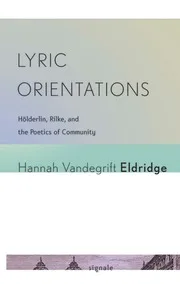
Lyric Orientations - Hölderlin, Rilke, and the Poetics of Community
 82
82

Lyric Orientations - Hölderlin, Rilke, and the Poetics of Community


Ophelia Vance, Mystical Literature Reviewer — 'Lyric Orientations' is a profound revelation, deftly illuminating the esoteric currents that flow through the poetry of Hölderlin and Rilke. It transcends mere literary analysis, revealing how these masters employed language as a hermetic art, capable of forging communal bonds and orienting the soul towards the sublime. The book offers a compelling argument for poetry as a potent force for spiritual and social cohesion, particularly when confronting the existential void. Its insights into the symbolic language of these poets will resonate deeply with practitioners of mystical traditions, offering fresh perspectives on ancient wisdom. An essential read for those who seek the sacred within the spoken and written word.
📝 Description
82
This book examines how Hölderlin and Rilke's poetry offers spiritual orientation.
Published anonymously, 'Lyric Orientations' investigates the connection between lyric poetry and human existence. The author focuses on the works of Friedrich Hölderlin and Rainer Maria Rilke, suggesting their poems function as spiritual guides. The text proposes that their verses hold the means to understand our social and emotional lives, providing comfort and direction within life's uncertainties.
The book argues that language itself possesses an alchemical quality capable of transforming personal experience into insight. It invites readers interested in the power of words to find solace and meaning. This work is for those who see poetry as a force that can shape our understanding of the world and ourselves. It encourages a deeper engagement with symbolism and a new vocabulary for emotional and spiritual matters.
This work aligns with traditions that view language and art as conduits for spiritual insight. It echoes Gnostic or Neoplatonic ideas where hidden knowledge is revealed through symbolic expression. The focus on 'alchemical power' suggests an interest in transformative processes, often found in Hermeticism and alchemy, applied here to the inner life and poetic creation. It positions poetry not merely as aesthetic expression but as a practical method for achieving inner coherence and connection to a larger reality.
💡 Why Read This Book?
Uncover the hidden spiritual architecture within poetry. This book reveals how lyric verse acts as an alchemical agent, transforming isolation into community and mortality into a profound embrace of existence. Ideal for seekers of deeper meaning, literary scholars, and practitioners of esoteric arts who recognize the power of language to shape reality and orient the soul.
⭐ Reader Reviews
Honest opinions from readers who have explored this book.
❓ Frequently Asked Questions
What is the primary focus of 'Lyric Orientations'?
The book explores how lyric poetry, particularly the works of Hölderlin and Rilke, functions as a spiritual and social guide, helping individuals navigate the complexities of mortality and find orientation within the ineffable.
Which poets are central to this study?
The primary focus is on the German-speaking masters Friedrich Hölderlin (1770–1843) and Rainer Maria Rilke (1875–1926), examining their unique contributions to lyric poetry and its potential for societal and personal orientation.
What is the connection to Alchemy & Hermeticism?
The book draws parallels between poetic creation and alchemical transformation, viewing language as a medium that can transmute base experiences into higher forms of understanding and connection, mirroring hermetic principles of correspondence and esoteric knowledge.
Who would benefit most from reading this book?
This book is ideal for those interested in the philosophical and spiritual dimensions of literature, particularly poetry enthusiasts, scholars of German literature, and individuals drawn to mystical and esoteric thought seeking deeper meaning in art.
Does the book offer practical applications of poetic theory?
While primarily analytical, the book implicitly offers practical insights by demonstrating how engaging with profound poetry can foster self-awareness, emotional resilience, and a stronger sense of belonging, thereby aiding in personal and spiritual orientation.
🔮 Key Themes & Symbolism
The Alchemical Power of Lyric Language
This theme explores the transformative potential of poetic language, drawing parallels to alchemical processes where raw elements are transmuted into gold. It examines how Hölderlin and Rilke, through their masterful use of verse, act as conduits for spiritual and emotional alchemy, enabling readers to process existential anxieties and forge deeper connections. The inherent symbolism within their words is presented not merely as literary device, but as potent sigils capable of reorienting the individual and collective consciousness towards greater unity and understanding amidst the ineffable.
Poetry as Spiritual and Social Compass
The exploration focuses on the concept of 'orientation' within the context of mortality and the unknown. It posits that lyric poetry, particularly that of Hölderlin and Rilke, serves as an essential guide, offering a spiritual compass to read through the often-disorienting field of human existence. By engaging with these poets' useful insights, individuals can discover a sense of belonging and purpose, transforming feelings of isolation into a communal embrace. This theme highlights poetry's capacity to act as a sacred map, leading the soul towards deeper self-knowledge and interconnectedness.
Embracing the Ineffable Through Art
This critical thread investigates how poetry confronts the inherent mystery and ineffability of life, death, and consciousness. It showcases how Hölderlin and Rilke, through their evocative imagery and profound philosophical underpinnings, create a space where the inexpressible can be approached and, to some extent, understood. The book argues that by engaging with their work, readers are invited to embrace the unknown not with fear, but with a sense of wonder and profound connection, finding solace and meaning in the very questions that lie beyond easy answers, thus fostering a more resilient and spiritually aware existence.
💬 Memorable Quotes
Direct passages from the work, attributed to the author.
“In the face of the ineffable, language becomes our anchor.”
— Highlighting the power of words to provide stability and meaning when confronted with existential uncertainties and the limits of human comprehension.
“Hölderlin and Rilke: masters of the inner landscape.”
— This emphasizes the profound introspective nature of their poetry, positioning them as guides who illuminate the complex terrains of the human psyche and spirit.
“Community is born from shared attunement to the word.”
— Suggests that collective human connection and understanding are forged through a shared engagement with and resonance to poetic expression.
“The lyric voice, a conduit to the sacred.”
— This interpretation elevates poetry beyond mere communication, framing it as a channel through which individuals can access and experience the divine or transcendent.
💡 Key Ideas
Editorial paraphrase of the work's core concepts — not direct quotes.
Poetry is the art of orienting the soul.
This quote captures the central thesis, suggesting that verse is not merely aesthetic but a functional tool for spiritual and emotional navigation, guiding us through life's profound mysteries.
🌙 Esoteric Significance
Tradition
The book's resonance lies within the broad spectrum of Hermeticism and Neoplatonism, traditions that emphasize the hidden correspondences between the macrocosm and the microcosm, and the power of symbolic language to reveal divine truths. The focus on poetry as a means to orient the soul and connect with the ineffable echoes Neoplatonic ideals of ascent and the pursuit of higher knowledge through contemplation and symbolic understanding. It aligns with the Hermetic principle of 'as above, so below,' suggesting that the inner spiritual landscape mirrored in poetry has direct implications for our social and external realities.
Symbolism
The symbolism explored centers on the poetic word itself as a potent sigil, capable of invoking profound shifts in consciousness. Concepts such as 'orientation' relate to the Hermetic idea of finding one's true spiritual north, a guiding principle amidst worldly chaos. The ineffable is treated not as a void, but as a sacred mystery that poetic language attempts to map, much like ancient alchemists used allegorical imagery to represent profound spiritual truths. The connection between individual consciousness and communal belonging, as articulated through poetry, reflects the esoteric understanding of interconnectedness and the universal spirit.
Modern Relevance
In an era often characterized by information overload, existential anxiety, and social fragmentation, the insights of 'Lyric Orientations' offer a vital re-calibration. The book provides a framework for understanding how profound artistic engagement can serve as a powerful antidote to alienation, fostering empathy and a sense of shared humanity. It speaks to the modern seeker's desire for authentic connection and meaning, suggesting that the ancient wisdom embedded in poetry can still provide a crucial compass for navigating contemporary challenges and rediscovering our place within the larger cosmic order.
👥 Who Should Read This Book
This book beckons to the curious soul, the literary alchemist, and the dedicated scholar. Beginners will find accessible pathways into the profound spiritual dimensions of poetry, discovering how verse can act as a personal guide. Scholars of German literature and comparative studies will appreciate the nuanced analysis of Hölderlin and Rilke, uncovering new layers of meaning. Seekers of esoteric wisdom will find resonance with the book’s exploration of language as a transformative force and poetry as a means of spiritual orientation. Practitioners of contemplative arts will discover how engaging with these poets can deepen their understanding of inner landscapes and communal connection.
📜 Historical Context
The late 18th and early 20th centuries, the eras of Hölderlin and Rilke respectively, were periods of immense philosophical and artistic upheaval in Germany. Hölderlin’s work emerged during the zenith of German Idealism, a movement deeply concerned with the nature of reality, consciousness, and the divine, often seeking unity through art and nature. Rilke, writing in the shadow of Romanticism and at the dawn of Modernism, grappled with themes of alienation, spirituality in a secularizing world, and the search for authentic existence. Both poets, in their distinct ways, responded to a Europe undergoing profound societal and intellectual shifts, questioning traditional structures and seeking new forms of meaning and connection. This context imbues their poetry with a profound urgency and a deep engagement with the human condition, resonating with the esoteric search for hidden truths and spiritual coherence.
📔 Journal Prompts
How does a specific poem by Hölderlin or Rilke offer you a sense of 'orientation' in your own life?
Reflect on a time when language, through poetry or otherwise, helped you navigate a difficult or ineffable experience.
In what ways can the act of reading poetry aloud foster a sense of community, even when experienced alone?
Consider a personal 'in-between' state (e.g., between grief and healing, doubt and faith) and how you might use poetic imagery to describe or process it.
How can you consciously use poetic language in your daily life to cultivate a stronger sense of self and connection to others?
🗂️ Glossary
Ineffable
Beyond description or expression; too great or extreme to be uttered or described in words. In a mystical context, it refers to the inexpressible nature of the divine or ultimate reality.
Orientation
The act of finding one's position or bearings, especially in relation to one's surroundings or circumstances. In this context, it refers to spiritual, emotional, and social grounding provided by poetic engagement.
Lyric Poetry
A form of poetry that expresses personal emotions or feelings, typically spoken in the first person. It is often characterized by its musicality and subjective intensity.
Hermeticism
A religious, philosophical, and esoteric tradition based upon the purported teachings of Hermes Trismegistus. It emphasizes divine knowledge, spiritual transformation, and the interconnectedness of all things.
Sigil
An inscribed or painted symbol considered to have magical power. In esoteric traditions, sigils are often created through intention and charged with specific energies or meanings.
This book appears in 3 collections
🔮 Readers Also Liked
Browse all →








From the “Hermeticism” Collection
View all →





More Free Alchemy & Hermeticism Books
View all →