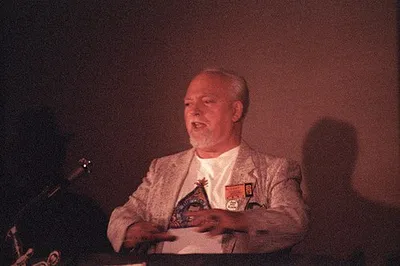
Aleister Crowley, Robert Anton Wilson
Robert Anton Wilson was an American writer exploring consciousness, reality, and conspiracy through fiction and non-fiction.
Robert Anton Wilson (1932-2007) was an American author, futurist, and psychologist known for his explorations of consciousness, reality models, and conspiracy theories. He described his work as an effort to encourage a "generalized agnosticism" by presenting multiple perspectives as models rather than absolute truths. Wilson's career included journalism, notably for Playboy, before he became a prominent countercultural figure. His writings spanned science fiction and non-fiction, delving into topics such as extrasensory perception, metaphysics, paranormal experiences, and "quantum psychology".
Wilson's early life was marked by a childhood bout with polio, the effects of which he experienced throughout his life. He developed an interest in literary modernism, Western philosophy, and science fiction during his high school years. After various jobs, he began his writing career, adopting the middle name "Anton" from his maternal grandfather. He worked as a journalist and advertising copywriter, eventually holding an associate editor position at Playboy. It was during this period that he began to engage with figures like Timothy Leary and William S. Burroughs, and lectured on anarchist and synergetic politics.
His academic pursuits led him to earn degrees in psychology from Paideia University. A significant portion of his literary output focused on the nature of reality, often using fictional narratives and humor to examine complex ideas. He co-authored the influential "Illuminatus! Trilogy", which satirized conspiracy theories and popularized Discordianism. Wilson's work consistently challenged conventional perceptions and encouraged readers to question their own assumptions about the world.
Philosophical and Mystical Exploration
Robert Anton Wilson's literary output was deeply concerned with the nature of reality and human perception. He advocated for a form of "generalized agnosticism," suggesting that individuals should approach all belief systems, including their own, with a degree of skepticism and openness. Wilson viewed different models of reality, whether scientific, religious, or philosophical, as maps rather than the territory itself. His goal was to "break down conditioned associations" and encourage people to see the world through multiple lenses. This approach was often facilitated through his fiction and non-fiction, which explored topics like "quantum psychology," parapsychology, and metaphysics, inviting readers to question the boundaries of the known and the accepted.
The Illuminatus! Trilogy and Discordianism
Co-authored with Robert Shea, "The Illuminatus! Trilogy" (1975) became a seminal work in countercultural literature. Advertised as a "fairy tale for paranoids," the series humorously and philosophically delved into occult symbolism, secret societies, conspiracy theories, and the 1960s counterculture. The books were intended to satirize conspiratorial thinking, drawing material from letters sent to Playboy magazine. Through this work, Wilson and Shea popularized Discordianism, a modern religion and parody religion that humorously worships Eris, the Greek goddess of chaos and discord. The trilogy also introduced concepts like "Operation Mindfuck" and "guerrilla ontology," challenging readers' perceptions of reality and knowledge.
Later Fictional Works and Themes
Following the success of "The Illuminatus! Trilogy," Wilson continued to explore similar themes in his subsequent fictional works. He authored the "Schrödinger's Cat Trilogy," which presented characters in various alternative universes grappling with concepts from quantum mechanics and its associated philosophies. Another series, "The Historical Illuminatus Chronicles," traced characters through different historical periods, further examining the interplay of hidden histories and societal structures. These novels, along with standalone works like "Masks of the Illuminati," often featured recurring characters and thematic continuations from his earlier writings, maintaining his focus on questioning established narratives and exploring the fluidity of reality.
Key Ideas
- Generalized Agnosticism: Encouraging skepticism and openness towards all belief systems.
- Reality as Models: Viewing different perspectives as maps rather than absolute truths.
- Operation Mindfuck: A concept related to challenging conventional reality perceptions.
- Quantum Psychology: Exploring the intersection of quantum mechanics and human consciousness.
Notable Quotes
“attempt to break down conditioned associations, to look at the world in a new way, with many models recognized as models or maps, and no one model elevated to the truth”
“to try to get people into a state of generalized agnosticism, not agnosticism about God alone but agnosticism about everything.”
Books by Aleister Crowley, Robert Anton Wilson
62 free public domain books · Read online or download