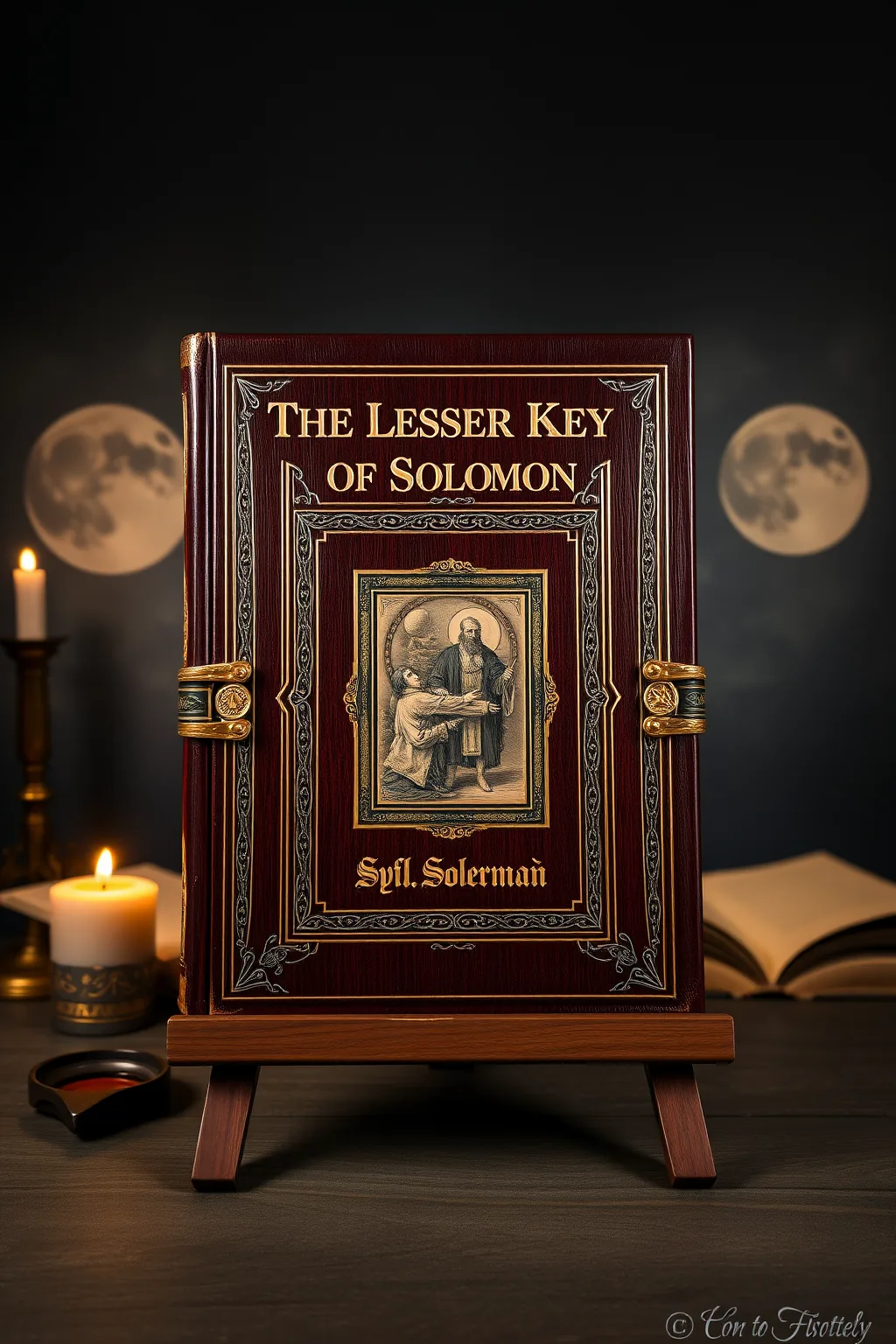
The Lesser Key of Solomon
 76
76

The Lesser Key of Solomon


Isolde Whitaker, Sacred Texts Editor: This 1904 rendition of 'The Lesser Key of Solomon' stands as a monumental achievement in occult publishing. Mathers' scholarly foundation, bolstered by Crowley's characteristic flair and critical essays, provides an unparalleled entry point into goetic magic. The detailed descriptions of spirits and their sigils are meticulously presented, demanding rigorous study. While undeniably challenging, this edition is indispensable for serious practitioners and scholars of Western esotericism seeking to understand the lineage of magical practice. It’s not for the faint of heart, but for those who persevere, the rewards are profound.
📝 Description
76
Published in 1904, 'The Lesser Key of Solomon' details the summoning of 72 spirits.
This edition of 'The Lesser Key of Solomon,' compiled by S.L. MacGregor Mathers and Aleister Crowley, presents a corpus of magical texts. It draws from manuscripts held at the British Museum to detail methods for the invocation and control of 72 distinct infernal entities. The work includes descriptions of their sigils, the appropriate rituals for their appearance, and associated divine correspondences.
Readers will find instructions for complex ceremonial magic, intended for practitioners engaged in the active pursuit of occult knowledge. The text aims to provide a systematic approach to spirit conjuring, rooted in a specific historical and magical tradition. It is a significant source for those interested in the practical application of grimoire magic.
This work belongs to the Western esoteric tradition, specifically the lineage of grimoires that document ceremonial magic. It follows in the footsteps of earlier texts like the 'Goetia,' which also cataloged demons and their properties. The 1904 edition, with Mathers and Crowley's involvement, situates it within the late Victorian and early Edwardian occult revival, a period that saw renewed interest in practical magic and the translation and dissemination of older magical texts.
💡 Why Read This Book?
Embark on a journey into the foundational text of Western ceremonial magic. 'The Lesser Key of Solomon' offers direct access to the goetic system, crucial for understanding demonology and spirit evocation. It's essential for practitioners seeking authentic ritual structures, scholars of occult history, and seekers of hidden knowledge who are ready to engage with ancient magical traditions.
⭐ Reader Reviews
Honest opinions from readers who have explored this book.
❓ Frequently Asked Questions
What is 'The Lesser Key of Solomon'?
It is a 17th-century grimoire on demonology, attributed to King Solomon. This 1904 edition is a scholarly compilation of ancient manuscripts, focusing on the summoning and control of 72 distinct spirits.
Who edited this specific edition?
This significant 1904 edition was edited by S.L. MacGregor Mathers, a prominent occultist, with substantial contributions and commentary from Aleister Crowley, another influential figure in modern occultism.
What is Goetia?
Goetia refers to the branch of ceremonial magic focused on the evocation of demons or spirits, often for knowledge, power, or assistance. 'The Lesser Key' is a primary source for this practice.
Is this book suitable for beginners?
While foundational, 'The Lesser Key of Solomon' is a complex text. Beginners are advised to approach it with caution, perhaps after studying introductory texts on magic and esotericism, and to prioritize safety and ethical practice.
What are the key components of the book?
The book is primarily divided into five parts: Goetia (spirit descriptions and sigils), Theurgia-Goetia (a blend of angelic and demonic spirits), Ars Paulina (angelic invocations), Ars Almadel (angelic summoning), and Ars Notoria (memory and knowledge acquisition techniques).
🔮 Key Themes & Symbolism
The Art of Spirit Evocation
This tome delves deeply into the practice of Goetia, providing detailed accounts of 72 infernal spirits, their sigils, hierarchies, and the precise rituals required for their invocation and command. It explores the intricate relationship between the magician and these entities, focusing on the acquisition of knowledge, worldly power, and the fulfillment of desires through controlled magical operations. The text emphasizes the importance of preparation, purification, and the correct application of divine names and seals to ensure the successful and safe manifestation of these powerful beings.
Esoteric Symbolism and Correspondences
Beyond the practical rituals, 'The Lesser Key of Solomon' is rich with esoteric symbolism and complex systems of correspondence. Each spirit is linked to specific planetary, zodiacal, and elemental forces, revealing a sophisticated magical cosmology. The sigils themselves are potent keys, acting as direct conduits to the essence of each entity. Understanding these interconnected symbols is vital for unlocking the deeper layers of the text and for applying its principles effectively, offering a framework for understanding the universe through its hidden energetic signatures.
The Magician's Path and Willpower
This grimoire serves as a rigorous test of the aspiring magician's willpower, discipline, and understanding of their own inner landscape. The act of commanding spirits requires immense mental fortitude, unwavering focus, and a profound ethical framework. The text implicitly guides the practitioner towards self-mastery, emphasizing that true magical power stems not just from external forces, but from the disciplined cultivation of the magician's own will and spiritual integrity. It is a journey of confronting one's shadow and integrating it into a more potent whole.
💬 Memorable Quotes
Direct passages from the work, attributed to the author.
“The spirit that is named...”
— This phrase typically precedes the naming and description of a specific entity within the grimoire, highlighting the direct invocation and identification required in ritual.
“He appeareth in a comely form.”
— This describes the visual manifestation of an evoked spirit, offering insight into the symbolic language and perceived appearance of these entities in magical practice.
“His seal is to be worn...”
— Refers to the sigil of a spirit, a crucial magical symbol that must be used correctly (worn, drawn, or consecrated) to establish a connection and control.
“He giveth...”
— This introduces the powers, abilities, or knowledge that a particular spirit is said to bestow upon the magician who successfully summons them.
“The conjuration must be performed...”
— This indicates a specific instruction or condition for conducting a ritual, emphasizing the meticulous nature and procedural requirements of ceremonial magic.
🌙 Esoteric Significance
Tradition
This work is a central to the Western Esoteric Tradition, specifically within the branches of ceremonial magic, demonology, and grimoire studies. It is deeply rooted in the Solomonic magical lineage, which purports to contain the secrets of King Solomon for controlling spirits. Its influence extends through various occult orders and individual practitioners, forming a critical link to earlier magical practices and contributing significantly to the development of modern occultism.
Symbolism
The 'Lesser Key' is replete with potent symbolism, most notably the sigils of the 72 spirits. These intricate designs are not mere pictures but are considered magical keys, embodying the essence and power of the entity they represent. The text also employs planetary, zodiacal, and elemental correspondences, tying a complex web of symbolic relationships that reflect a macrocosmic order mirrored in the microcosm of the magician's ritual space. The divine names, geometric figures, and ritual tools all carry profound symbolic weight.
Modern Relevance
Despite its age, 'The Lesser Key of Solomon' remains remarkably relevant for contemporary practitioners and scholars of the occult. It provides a detailed framework for understanding spirit work, magical ethics, and the practical application of complex ritual structures. Its influence can be seen in modern magical systems, psychological interpretations of archetypes, and the ongoing study of historical magical practices. For many, it remains an indispensable guide for exploring the depths of consciousness and the unseen forces of the universe.
👥 Who Should Read This Book
This edition is essential for serious students of Western ceremonial magic, occult history, and demonology. Practitioners seeking to engage with the goetic tradition will find its detailed rituals and spirit descriptions invaluable. Scholars of esotericism will appreciate the scholarly rigor and the historical context provided by the editors. Seekers interested in the deeper currents of spiritual power and the relationship between humanity and the unseen realms will find it a challenging yet profoundly rewarding exploration.
📜 Historical Context
Published in 1904, this edition of 'The Lesser Key of Solomon' emerged during a vibrant period of occult revival in Victorian and Edwardian England. The Hermetic Order of the Golden Dawn, a major influence on both Mathers and Crowley, had established a significant presence, popularizing ceremonial magic and the study of ancient grimoires. This era saw a renewed interest in medieval and Renaissance magical texts, which were often rediscovered, translated, and reinterpreted by occult scholars. The British Museum, a repository of ancient manuscripts, became a crucial source for such endeavors. Mathers and Crowley's collaboration, though sometimes fraught, synthesized scholarly textual analysis with modern magical theory, producing a work that would profoundly shape the trajectory of Western esoteric traditions.
📔 Journal Prompts
Reflect on the concept of 'command' in magic. What does it truly mean to command a spirit, and what ethical considerations does this entail?
Analyze the sigil of a chosen spirit from the Goetia. What visual elements stand out, and what do you intuitively feel they represent?
Consider the hierarchy of spirits described. How might this structure reflect a hidden order or understanding of the cosmos?
Explore the preliminary invocations or prayers. What is their function in preparing the magician and the ritual space?
How does the concept of willpower, as depicted in the demands of this grimoire, relate to your own personal journey of self-mastery?
🗂️ Glossary
Grimoire
A textbook of magic, typically containing spells, rituals, instructions for summoning spirits, and information on magical herbs, astrology, and divination. 'The Lesser Key of Solomon' is a famous example.
Goetia
The practice of evoking and controlling demons or lower spirits, often for personal gain, knowledge, or power. This is the primary focus of the first book within 'The Lesser Key'.
Sigil
A magical symbol, often a unique geometric design, believed to represent a spirit, deity, or intention. It is used in rituals for invocation or enchantment.
Evocation
The act of calling forth or summoning a spirit or entity, usually into a visible manifestation or a specific area of operation, often with the intent of communication or control.
Ceremonial Magic
A formalized system of ritual magic that often involves elaborate preparations, specific incantations, symbolic gestures, and the use of magical tools to achieve spiritual or material ends.
This book appears in 1 collection
🔮 Readers Also Liked
Browse all →







From the “Ceremonial Magic” Collection
View all →






More Free Magic & Ritual Books
View all →