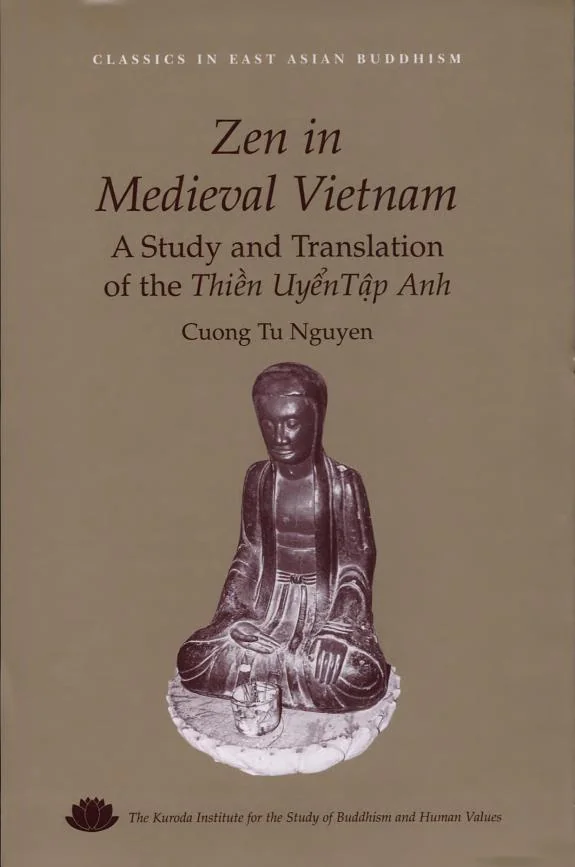
Zen in Medieval Vietnam
 78
78

Zen in Medieval Vietnam
Cuong Tu Nguyen’s "Zen in Medieval Vietnam" is a dense but rewarding scholarly intervention. Its central thesis—that Zen in Vietnam operated less as a distinct, lineage-based tradition and more as an pervasive philosophical and artistic ethos—is a compelling re-framing of Vietnamese Buddhist history. Nguyen’s meticulous translation and analysis of the 14th-century text are exemplary, offering a direct encounter with the primary source that underpins his argument. The work’s strength lies in its sophisticated textual scholarship and its challenging of established historiographical narratives. A limitation, however, is the book's academic density, which may render it less accessible to a general audience. The discussion surrounding the concept of "mind transmission" (yixinchuanxin) as it appears in the translated text, and Nguyen's interpretation of its Vietnamese context, is particularly illuminating, suggesting a more fluid understanding of spiritual lineage. This is essential reading for specialists, offering a vital counterpoint to standard histories of Chan/Zen.
📝 Description
78
Cuong Tu Nguyen's 2000 book argues Zen in medieval Vietnam was an attitude, not a lineage.
Cuong Tu Nguyen's "Zen in Medieval Vietnam" examines Buddhist transmission in 14th-century Vietnam. Instead of tracing a direct "Zen" school, Nguyen suggests that Zen's influence appeared as a philosophical outlook and aesthetic taste. The book is built upon close study of a specific 14th-century Vietnamese text, including its translation.
The work is for scholars of East Asian Buddhism, particularly those focused on Vietnamese religious history or comparative Chan/Zen studies. It also suits advanced students of philosophy and religious studies interested in tradition and transmission. Readers who value detailed textual analysis and a revisionist historical perspective will find it rewarding.
The study is set within medieval Vietnam's intellectual life, a time of considerable Buddhist growth and exchange with Chinese traditions. Nguyen challenges the idea of direct inheritance of Chinese Zen lineages, proposing instead a more integrated cultural expression of Zen principles. The 14th century, a period of active monastic scholarship and art, is analyzed through this specific Zen sensibility.
This book belongs to the study of East Asian mysticism, specifically focusing on Chan (Zen) Buddhism's development beyond its Chinese heartland. It investigates how Buddhist principles, particularly those associated with Zen, took root and transformed within a distinct cultural and historical context. By examining a specific Vietnamese text and challenging established models of transmission, Nguyen contributes to understanding the localized expressions of contemplative traditions and their philosophical underpinnings in medieval Asia.
💡 Why Read This Book?
• Gain a revised understanding of "Zen" in a Vietnamese context, moving beyond a simple lineage model to appreciate its philosophical and artistic expressions, as detailed in the analysis of the 14th-century text. • Explore the concept of spiritual transmission as presented by Nguyen, which challenges traditional notions of direct master-to-disciple succession, particularly relevant after engaging with the translated source material. • Appreciate the intricate relationship between religious practice, philosophical thought, and artistic sentiment in medieval Vietnam, as illuminated by Nguyen's examination of cultural life.
⭐ Reader Reviews
Honest opinions from readers who have explored this book.
❓ Frequently Asked Questions
What is the main argument of Cuong Tu Nguyen's "Zen in Medieval Vietnam"?
Nguyen argues that Zen in 14th-century Vietnam was not a formal, lineage-based tradition like in China or Japan, but rather manifested as a philosophical attitude and aesthetic sentiment integrated into broader religious and cultural life.
What primary text does this book analyze?
The book centers on the study and translation of a significant 14th-century Vietnamese text that discusses the transmission of Buddhist lineages, serving as the core evidence for Nguyen's thesis.
Does this book focus on Zen meditation practices?
While it discusses the philosophical underpinnings that inform meditation, the book's primary focus is on the historical and cultural manifestation of Zen's spirit, rather than a practical guide to meditation techniques.
Is "Zen in Medieval Vietnam" suitable for beginners in Buddhist studies?
Due to its scholarly depth and focus on textual analysis, the book is best suited for those with some background in Buddhist studies or East Asian history, rather than absolute beginners.
When was "Zen in Medieval Vietnam" first published?
The original publication date for Cuong Tu Nguyen's "Zen in Medieval Vietnam" was January 1, 1997.
What does the author mean by 'Zen manifesting as a philosophical attitude'?
It suggests that the principles and spirit of Zen Buddhism influenced Vietnamese thought and worldview, shaping intellectual discourse and ethical considerations, even without a formally established Zen school.
🔮 Key Themes & Symbolism
Transmission Beyond Lineage
Nguyen challenges the conventional understanding of Buddhist transmission, particularly Zen's 'mind-to-mind' or lineage-based succession. He posits that in 14th-century Vietnam, the essence of Zen was conveyed through a shared philosophical outlook and artistic sensibility, rather than a rigidly defined hierarchical structure. This reinterpretation invites a broader view of how spiritual traditions take root and evolve within diverse cultural contexts, emphasizing shared intellectual currents over institutional continuity.
Zen as Philosophical Attitude
The work redefines Zen not solely as a school of practice or doctrine but as an underlying philosophical attitude that permeated Vietnamese religious and cultural life. This perspective suggests that Zen's influence was diffused, shaping a particular way of thinking and approaching the world, evident in various expressions of religious and secular life. It highlights how core Buddhist insights can manifest in subtle, non-institutionalized forms.
Textual Analysis of 14th-Century Source
Central to Nguyen's argument is the detailed study and translation of a specific 14th-century Vietnamese text. This primary source provides the empirical basis for his thesis regarding Zen's unique manifestation. The rigorous textual exegesis allows scholars to engage directly with the historical evidence and follow Nguyen's interpretive process, offering a deep dive into the intellectual world of medieval Vietnamese Buddhism.
Cultural Integration of Buddhist Thought
The book explores how Buddhist philosophy, particularly Zen principles, became integrated into the fabric of Vietnamese society. It moves beyond the monastic sphere to examine how these ideas influenced artistic sentiments and daily religious practices. This highlights a model of religious influence where core tenets are absorbed and expressed through broader cultural forms, demonstrating a dynamic interplay between religion and society.
💬 Memorable Quotes
Direct passages from the work, attributed to the author.
“The author argues Zen never existed as a formal tradition in Vietnam.”
— This statement captures Nguyen's revisionist thesis, suggesting that the term 'Zen' in the Vietnamese context refers not to a distinct school with established lineages, but to a more pervasive philosophical and aesthetic orientation.
“Zen manifests itself in a philosophical attitude and artistic sentiments throughout religious and cultural life.”
— This core idea posits that Zen's influence in Vietnam was expressed through a general worldview and aesthetic appreciation, rather than through specific monastic institutions or direct teacher-student lines, shaping the broader cultural landscape.
“A 14th-century text on the transmission of Zen lineages.”
— This refers to the primary source material analyzed in the book, which, despite its title or subject matter concerning lineage, is used by Nguyen to evidence a different form of transmission in Vietnam.
“The study examines the transmission of the Zen lineages in Vietnam.”
— While the title suggests a focus on transmission, Nguyen's work reinterprets what 'transmission' meant in the Vietnamese context, proposing it was more about the dissemination of Zen's spirit than the institutional passing of authority.
“The author proposes a unique understanding of Zen's historical presence.”
— This highlights that Nguyen's contribution is not merely descriptive but interpretive, offering a novel framework for understanding how Buddhist traditions, specifically Zen, can adapt and express themselves differently in non-canonical settings.
🌙 Esoteric Significance
Tradition
While not strictly adhering to Western esoteric lineages like Hermeticism or Kabbalah, this work engages with the esoteric dimension of Buddhism through its examination of spiritual transmission and the subtle manifestation of core teachings. It aligns with traditions that explore the non-institutional, experiential aspects of enlightenment, often found in Chan/Zen Buddhism's emphasis on direct insight and mind-to-mind communication, albeit reinterpreted in a Vietnamese context.
Symbolism
The book's focus on philosophical attitudes and artistic sentiments implies a rich symbolic undercurrent. While specific symbols aren't detailed in the blurb, the concept of 'transmission' itself can be seen as symbolic of the passing of wisdom. Furthermore, the integration of Zen into 'religious and cultural life' suggests that everyday practices, art forms, and philosophical discussions become carriers of deeper, potentially esoteric meaning, transforming the mundane into vehicles for spiritual insight.
Modern Relevance
Contemporary scholars of Buddhism and religious studies continue to draw upon Nguyen's work for its nuanced approach to cultural adaptation and the definition of religious traditions. Thinkers interested in comparative religion, particularly the diffusion of Buddhist ideas across Asia, find his model of transmission valuable. Practices that emphasize integrated spirituality, where philosophical understanding and aesthetic appreciation are key, can also find resonance with Nguyen's portrayal of Zen's presence in medieval Vietnam.
👥 Who Should Read This Book
• Scholars of Vietnamese and East Asian Buddhism: To engage with a seminal revisionist argument about Zen's historical development and transmission in a non-Chinese context. • Students of comparative religion: To understand how Buddhist traditions can manifest and be transmitted through philosophical attitudes and cultural expressions, not just formal lineages. • Researchers of medieval Vietnamese culture: To gain insight into the intellectual and religious currents that shaped the period, particularly the subtle influence of Buddhist thought on society and art.
📜 Historical Context
Published in 1997, Cuong Tu Nguyen's "Zen in Medieval Vietnam" emerged during a period of increasing academic interest in the distinctiveness of East Asian Buddhist traditions beyond their Chinese origins. The 14th century in Vietnam was a complex era, marked by dynastic changes and a vibrant Buddhist intellectual scene that interacted significantly with the prevailing trends in Song and Yuan dynasty China. Nguyen's work directly challenged the then-dominant historiographical tendency to view Vietnamese Buddhism primarily as an extension of Chinese Chan Buddhism. By focusing on a specific 14th-century text, he offered a counter-narrative, suggesting that Zen's influence was more akin to a pervasive philosophical attitude and artistic sensibility rather than a formalized, institutionally transmitted school. This approach provided a crucial corrective to earlier scholarship, such as that of Paul Pelliot, which often viewed Vietnamese culture through a predominantly Chinese lens, and offered a more nuanced understanding of indigenous religious development.
📔 Journal Prompts
The concept of Zen as a philosophical attitude.
The challenges in defining religious 'transmission' in historical contexts.
How 14th-century Vietnamese artistic sentiments might reflect Buddhist ideas.
The implications of a non-lineage-based spiritual influence.
The role of textual analysis in understanding historical religious movements.
🗂️ Glossary
Zen
In the context of this book, 'Zen' refers not to a specific, formally established school with direct lineage, but to a philosophical attitude and aesthetic sensibility that influenced religious and cultural life in medieval Vietnam.
Transmission
The passing on of spiritual teachings and authority from a master to a disciple. Nguyen re-examines this concept, suggesting it occurred in Vietnam through shared philosophical outlooks and cultural expressions rather than solely through formal lineage.
Lineage
A succession of spiritual teachers and disciples, often with documented proof of descent, crucial for establishing orthodoxy and authority within many Buddhist schools, particularly Chan/Zen.
Philosophical Attitude
A way of thinking, a perspective, or a set of underlying beliefs that shape one's understanding and approach to life, religion, and the world. Nguyen uses this to describe Zen's influence in Vietnam.
Artistic Sentiments
The aesthetic values, emotional responses, and creative expressions characteristic of a particular culture or period. In this book, these are seen as indicators of Zen's pervasive influence in Vietnam.
14th-Century Vietnamese Text
The specific primary source analyzed by Cuong Tu Nguyen, which deals with the transmission of Buddhist lineages and serves as the foundation for his argument about Zen's unique manifestation.
Chan Buddhism
The Chinese origin of what is known as Zen in Japan and Seon in Korea. This book examines its presence and expression in Vietnam, often referred to as Thiền.
This book appears in 1 collection
🔮 Readers Also Liked
Browse all →









From the “Zen Buddhism” Collection
View all →







More Free Occult Philosophy Books
View all →