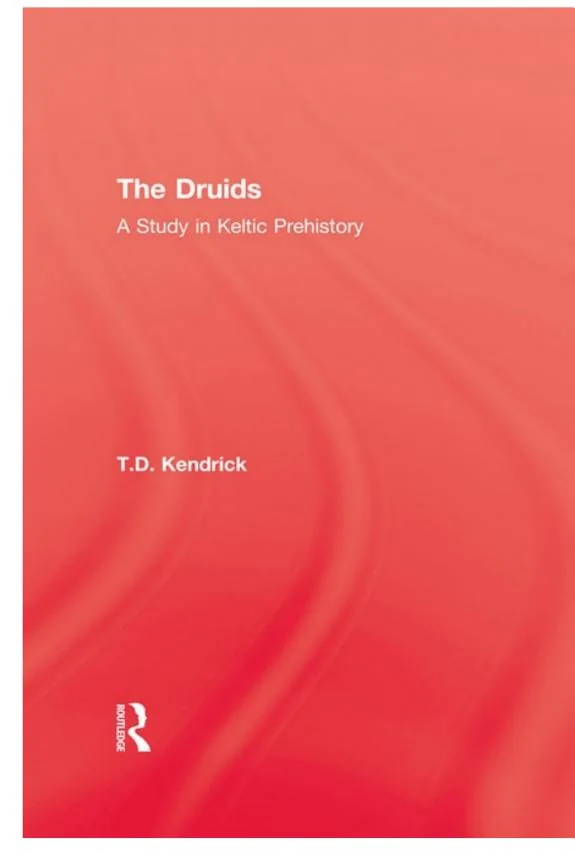
The Druids
 79
79

The Druids
Kendrick's "The Druids" offers a sober, scholarly approach to a subject often obscured by romanticism and conjecture. The author's strength lies in his meticulous sifting of classical sources, particularly those from Roman and Greek writers who had direct, albeit often biased, contact with Druidic cultures. The book successfully situates Druidism within its historical context, demonstrating its importance in pre-Roman Gaul and Britain. A notable passage is the detailed exploration of Druidic initiation, which, while speculative, is grounded in textual analysis. However, the work occasionally feels constrained by the very sources it relies upon; the inherent limitations of external accounts mean that much of the internal Druidic worldview remains elusive. Despite this, Kendrick provides a vital, fact-based foundation for understanding these ancient priests. It is an academic cornerstone for anyone serious about Celtic antiquity.
📝 Description
79
T.D. Kendrick's 2005 book examines the ancient Celtic priestly class, the Druids.
First published in 2005, T.D. Kendrick's The Druids offers a detailed look at the priestly class of ancient Celtic societies. The book follows their presence in Gaul and Britain from centuries before the Common Era, covering their religious practices, roles in society, and leadership structures. Kendrick goes beyond simple history, reconstructing their temples and discussing their probable origins. He uses classical accounts and modern research to build a picture of this civilization that influenced the pre-Roman West. This work is important for understanding Celtic prehistory, addressing questions about the Druids' societal position, their education, and their worldview. It includes original Greek and Latin texts with translations and notes, allowing direct access to primary sources. The book is a valuable resource for scholars of ancient religions, Celtic history, and European spiritual traditions, providing a comprehensive look at the intellectual and spiritual life of early Britain and Gaul.
Kendrick's study places the Druids within the context of ancient European religious systems. While often viewed through the lens of classical historians, this work aims to reconstruct their actual beliefs and practices. It engages with the primary sources that describe them, seeking to understand their spiritual and intellectual contributions to pre-Roman society. The book serves as a reference for understanding a significant pagan tradition that predates later European religious developments, offering insight into the roots of Western spiritual thought.
💡 Why Read This Book?
• Gain a factual understanding of Druidic origins and practices in 1st-century B.C. Gaul and Britain, as detailed in the "Historical Context" section. • Examine the reconstruction of Druidic temples and religious rites, supported by classical sources, offering a tangible glimpse into their sacred spaces. • Access primary source material through the appendix of original Greek and Latin texts, providing direct evidence for scholarly study of Celtic beliefs.
⭐ Reader Reviews
Honest opinions from readers who have explored this book.
❓ Frequently Asked Questions
What is the primary focus of T.D. Kendrick's book "The Druids"?
The book primarily focuses on the study of Celtic Prehistory, specifically exploring the life, religious practices, societal roles, and probable origins of the Druids in ancient Gaul and Britain during the centuries B.C.
When was T.D. Kendrick's "The Druids" first published?
T.D. Kendrick's "The Druids" was first published in 2005, with a later reissue in 2013.
What kind of sources does Kendrick use to describe the Druids?
Kendrick draws upon numerous classical and modern sources to create his picture of Druidic society, including original Greek and Latin texts related to the Druids.
Does the book include visual aids or supplementary texts?
Yes, the book includes useful illustrations to depict aspects of Druidic life and society, along with an appendix featuring original Greek and Latin texts concerning the Druids.
Is "The Druids" suitable for beginners interested in esoteric subjects?
While scholarly, "The Druids" provides a foundational understanding of Celtic religious practices. Beginners interested in the historical and societal context of esoteric traditions might find it informative, though it is written with an academic audience in mind.
What historical period does Kendrick's study of the Druids cover?
Kendrick's study covers the beginnings of the Druids in the first centuries B.C. in Gaul and Britain, exploring their development and practices during that ancient period.
🔮 Key Themes & Symbolism
Druidic Priesthood and Society
Kendrick meticulously reconstructs the role of the Druids as the priestly, intellectual, and judicial class of Celtic society. The work details their hierarchical structure, their influence in Gaul and Britain during the centuries B.C., and their function in maintaining religious and social order. It examines their education, their rites, and their apparent societal authority, offering a grounded perspective on their significance before Roman assimilation.
Origins and Religious Practice
The book addresses the nebulous origins of Druidism, tracing potential influences and the development of their unique religious framework. Kendrick analyzes their sacred rites, their cosmology, and their places of worship, including temples. By drawing on classical informants like Caesar and Strabo, the study attempts to delineate the core tenets of Druidic belief and ritual, even as it acknowledges the inherent difficulties in fully accessing an oral tradition.
Classical Sources and Historical Evidence
A central theme is the critical evaluation of classical texts that mention the Druids. Kendrick navigates the biases and limitations of writers like Posidonius, Cicero, and Tacitus, who often viewed Druidism through a Greco-Roman lens. The work emphasizes the importance of comparative analysis and textual scholarship in piecing together a coherent picture of Druidic life, highlighting the scholarly effort required to interpret fragmented evidence.
Celtic Britain and Gaul
Kendrick situates the Druids firmly within the historical and geographical context of pre-Roman Celtic Europe, focusing on Britain and Gaul. The study explores how Druidic influence varied across these regions and how their practices and beliefs were perceived by external observers. It provides essential background for understanding the cultural field of these territories before significant Roman intervention.
💬 Memorable Quotes
Direct passages from the work, attributed to the author.
“their beginnings in the first centuries B.C. in Gaul and Britain”
— This phrase anchors the study to a specific historical period and geographical location, indicating the book's focus on the formative era of Druidic influence and its presence in key Celtic territories.
“their priests and religious rites”
— Highlights the central role of the Druids as religious officiants and the importance of understanding their ceremonies and spiritual practices as key components of their societal function.
“their temples and probable origins”
— Points to the book's exploration of the physical spaces where Druidic rituals took place and the scholarly investigation into the foundational roots and potential influences of Druidism.
“Drawing on numerous classical and modern sources”
— This indicates the methodological approach of the book, emphasizing its reliance on a broad range of historical accounts and contemporary research to build its narrative and analysis.
“appendix of original Greek and Latin texts”
— Underscores the book's academic rigor by including primary source materials, allowing readers to engage directly with the ancient evidence discussed throughout the text.
🌙 Esoteric Significance
Tradition
While "The Druids" is primarily a work of historical scholarship rather than a text of esoteric practice, it serves as a crucial foundational text for understanding the historical roots of Western esotericism. Its examination of ancient Celtic religious structures and priestly orders provides context for later revivals and interpretations within movements like Neo-Druidism and certain strains of pagan revivalism. It offers a scholarly counterpoint to purely mystical or occult interpretations, grounding esoteric interest in historical inquiry.
Symbolism
The book implicitly touches upon symbols associated with the Druids, such as sacred groves, oak trees, and mistletoe, though its focus is largely historical and ritualistic rather than symbolic interpretation. Kendrick discusses their religious rites and places of worship, suggesting a symbolic connection to nature and the cycles of life and death inherent in Celtic cosmology. The societal structure and priestly roles themselves can be seen as symbolic of a society deeply intertwined with spiritual authority.
Modern Relevance
Contemporary Neo-Druid orders and practitioners of Celtic-inspired witchcraft often reference historical scholarship to inform their modern practices. T.D. Kendrick's work, with its focus on historical reconstruction and source analysis, provides a vital academic baseline for these contemporary traditions. It allows modern adherents to engage with the historical context of their spiritual lineage, even as they build upon or diverge from the ancient practices described.
👥 Who Should Read This Book
• Students of ancient European history and Celtic studies seeking a scholarly overview of Druidic society and religious practices. • Researchers interested in comparative religion and the development of priestly classes in pre-Christian Europe. • Enthusiasts of esoteric traditions looking for a historically grounded understanding of Druidism before modern interpretations.
📜 Historical Context
T.D. Kendrick's "The Druids" emerged in an academic landscape where the study of Celtic antiquity was evolving. Published initially in 2005, it engaged with scholarship on pre-Roman Europe, a period marked by increasing archaeological findings and a re-evaluation of classical ethnographies. The work addressed the enduring fascination with Druidism, often subject to romanticized interpretations. Kendrick’s approach contrasted with earlier, more speculative works by focusing on a rigorous analysis of textual evidence from Greek and Roman authors, such as Julius Caesar's "Commentarii de Bello Gallico." This era saw contemporaries like Barry Cunliffe also contributing significantly to understanding Iron Age Britain and Gaul through archaeological lenses, providing a broader context for Kendrick's textual focus. The book's reception would have been within circles of classical historians and Celtic studies scholars, appreciating its grounded methodology.
📔 Journal Prompts
Druidic temples and their probable origins: What architectural or geographical features might have held symbolic significance?
The influence of classical sources: How might Roman and Greek accounts shape our perception of Druidic rites?
Druidic priests and their societal roles: Reflect on the intersection of spiritual authority and civic life in ancient Gaul.
The beginnings of Druidism in the first centuries B.C.: Consider the environmental and cultural factors contributing to its rise.
Reconstructing Druidic life: What are the biggest challenges in piecing together the practices of an orally transmitted tradition?
🗂️ Glossary
Druids
The priestly, learned, and judicial class in ancient Celtic societies of Gaul, Britain, and Ireland, known for their religious rites, knowledge of nature, and societal influence.
Gaul
An ancient region of Western Europe, encompassing present-day France, Belgium, and parts of Switzerland, Germany, and the Netherlands, historically inhabited by Celtic peoples.
Celtic Prehistory
The period of history in Celtic regions before the widespread adoption of written records, relying heavily on archaeological evidence and classical accounts for reconstruction.
Religious Rites
Formal ceremonies and rituals performed as part of a religious or sacred occasion, central to the practices and beliefs of groups like the Druids.
Classical Sources
Writings from ancient Greece and Rome that provide historical, cultural, and social information about contemporary or preceding civilizations, often used to study pre-Roman societies.
Oral Tradition
The transmission of cultural knowledge, history, and beliefs from one generation to the next by spoken word, characteristic of many ancient societies including Celtic cultures.
B.C.
Abbreviation for 'Before Christ,' denoting the years before the traditional year of Jesus Christ's birth; used here to specify the historical period of early Druidism.
This book appears in 1 collection
🔮 Readers Also Liked
Browse all →









From the “Druidism” Collection
View all →





More Free Occult Philosophy Books
View all →