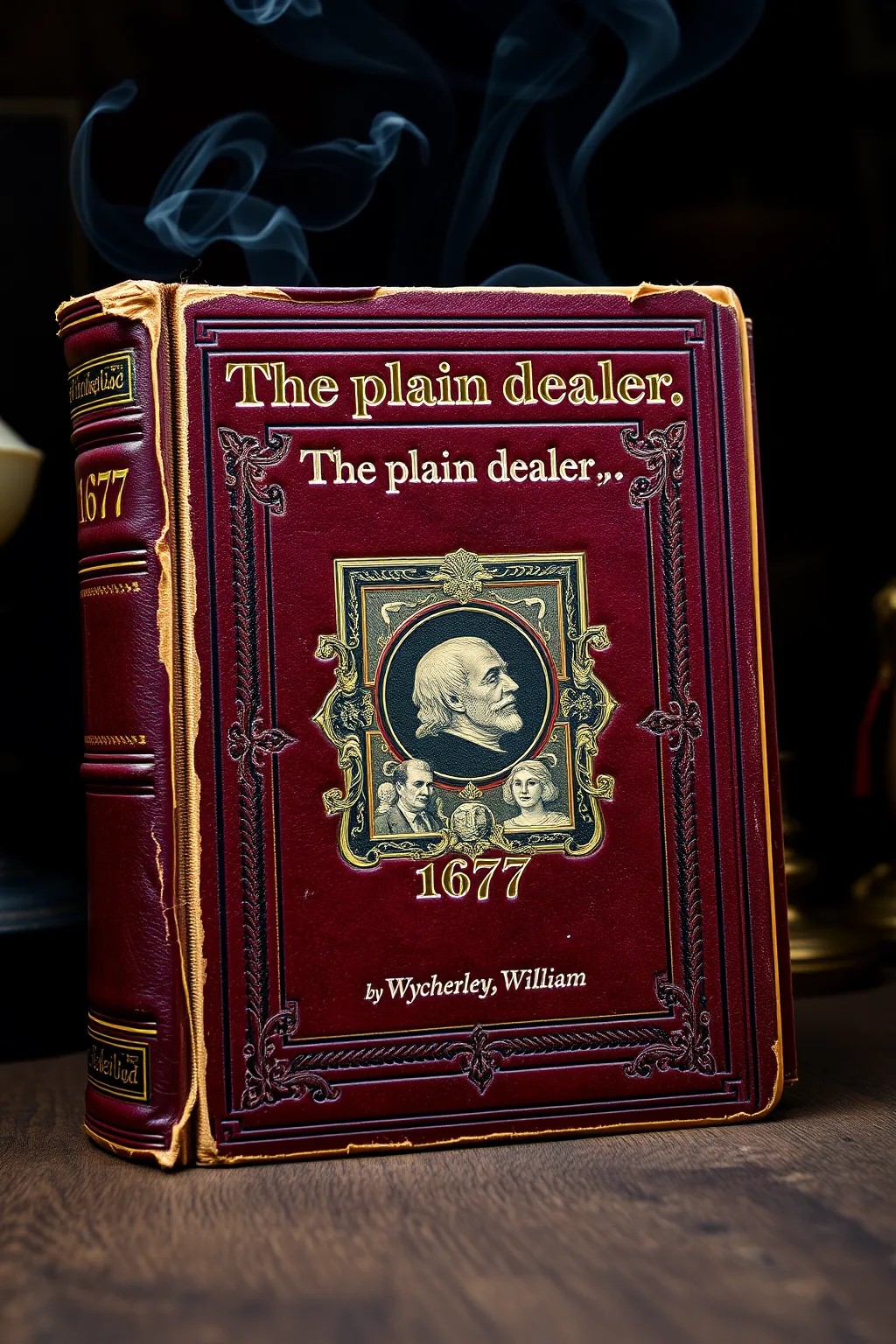
The plain dealer, ... 1677
 77
77

The plain dealer, ... 1677



Celeste Moreau (Divination & Symbolism Reviewer) — William Wycherley's 'The Plain Dealer' (1677) is a remarkably insightful, albeit challenging, work for the modern esoteric scholar. Far from a simple Restoration comedy, it functions as a potent allegory for the hidden currents of influence and manipulation that govern human affairs. Wycherley's sharp wit dissects societal pretenses with an almost alchemical precision, revealing the base metals of ego and ambition beneath gilded facades. The dialogue, rich with double entendre and veiled meanings, rewards close reading, offering glimpses into the unspoken laws of social order and personal power. This is essential reading for those interested in the intersection of social philosophy and occult observation, particularly as it pertains to psychological archetypes and the subtle arts of persuasion. A true treasure for the discerning seeker.
📝 Description
77
William Wycherley's 1677 play, 'The Plain Dealer,' uses sharp wit to expose societal hypocrisy.
Published in 1677, William Wycherley's 'The Plain Dealer' is a comedy of manners that dissects human behavior with a critical eye. The play centers on Manly, a sailor who returns from sea to find London society rife with corruption and pretense. His blunt honesty clashes with the city's artifice, creating dramatic conflict and exposing the vanity and deceit of its inhabitants. Wycherley employs sharp dialogue and complex characters to reveal the often-unpleasant truths beneath polite society's veneer. The play scrutinizes social climbing, false affections, and the pursuit of wealth and status.
Beyond its surface critique, the play invites contemplation on the nature of sincerity and deception. Manly's rigid adherence to plain speaking, while admirable in intent, leads to considerable social friction. Wycherley suggests that true understanding requires looking past outward appearances, a theme explored through various subplots and character interactions. The play challenges audiences to consider the hidden motivations that drive human relationships and the costs of uncompromising integrity in a compromised world.
While not overtly occult, 'The Plain Dealer' engages with esoteric ideas through its focus on hidden knowledge and the uncovering of veiled truths. Wycherley's satire implies a deeper understanding of human psychology and societal mechanics, akin to alchemical processes of transformation or revelation. The play's dissection of appearances and motivations suggests a concern with discerning the underlying 'essences' of character and power, a pursuit common in various wisdom traditions that seek to understand the world beyond its superficial presentation. The emphasis on seeing through artifice aligns with contemplative practices that aim to perceive reality more clearly.
💡 Why Read This Book?
Uncover the veiled truths of human nature and societal illusions. 'The Plain Dealer' offers a potent blend of sharp wit and subtle allegory, revealing hidden currents of power and deception. Ideal for seekers of deeper meaning, scholars of historical philosophy, and practitioners interested in the arcane dynamics of social interaction. Experience a classic work through an esoteric lens.
⭐ Reader Reviews
Honest opinions from readers who have explored this book.
❓ Frequently Asked Questions
What is the primary esoteric theme in 'The Plain Dealer'?
The primary esoteric theme revolves around the unveiling of hidden truths and the manipulation of appearances, mirroring alchemical processes of purification and transformation of the base self into a more enlightened state.
How does this work relate to occult philosophy?
It explores the 'occult' forces of human psychology, ambition, and deceit that operate beneath the surface of social interactions, reflecting a deep understanding of the unseen influences that shape destiny.
Who is the intended audience for this esoteric reading?
The intended audience includes intellectual seekers, scholars of historical philosophy, and practitioners of the subtle arts who appreciate layered meanings and allegorical narratives.
What makes this digitized edition valuable?
This digitized edition makes a rare 1677 text accessible, allowing for in-depth study of Wycherley's work through an esoteric lens, connecting historical context with timeless metaphysical insights.
Does the book contain explicit magical spells or rituals?
No, the book does not contain explicit magical spells or rituals. Its esoteric value lies in its allegorical and philosophical exploration of human nature and societal dynamics, viewed through a lens of hidden knowledge.
🔮 Key Themes & Symbolism
The Alchemy of Appearance vs. Reality
'The Plain Dealer' masterfully dissects the chasm between outward presentation and inner truth, a core concern in occult philosophy. Wycherley's characters embody the alchemical concept of transmutation, where societal roles and personal facades are stripped away to reveal the raw, often base, elements of human motivation. The play acts as a crucible, subjecting individuals to the fires of scrutiny, forcing a confrontation with their authentic selves. This theme appeals to the Hermetic principle of 'As Above, So Below,' suggesting that the same principles of transformation and revelation govern both the microcosm of the individual and the macrocosm of society. It invites readers to ponder the hidden processes that refine or corrupt character, mirroring the alchemist's quest for the philosopher's stone within the human soul.
The Arcane Currents of Influence and Deception
Beneath the witty repartee and social maneuvering, 'The Plain Dealer' looks at the subtle, often unseen, forces that dictate human interaction and power dynamics. Wycherley exposes the 'arcane arts' of deception, manipulation, and strategic dissimulation employed by his characters to work through the complex social labyrinth. This mirrors the esoteric understanding of influence as a force that can be wielded consciously or unconsciously, shaping destinies and orchestrating events from the shadows. The play serves as a cautionary tale, highlighting how a lack of discernment—of recognizing these veiled currents—can lead to downfall. It encourages the reader to develop a keener perception, an almost divinatory skill, in deciphering the true intentions behind spoken words and outward actions, much like an occultist reads omens or the stars.
The Metaphysical Dimensions of Character
Wycherley's characters are not mere social archetypes; they represent fundamental aspects of the human psyche, explored with an almost metaphysical rigor. The 'plain dealer' himself, with his brutal honesty, can be seen as a force of untamed truth, challenging the illusory constructs of polite society. Conversely, the characters driven by vanity and self-interest embody the 'shadow self'—the unacknowledged desires and flaws that, when unchecked, lead to spiritual stagnation. The play's enduring appeal lies in its exploration of these timeless metaphysical dimensions, prompting reflection on the soul's journey, the nature of virtue and vice, and the constant interplay between the conscious and subconscious realms that defines our existence. It invites a contemplation of the inner landscape as a stage for profound, often hidden, transformations.
💬 Memorable Quotes
Direct passages from the work, attributed to the author.
“I am the Plain Dealer.”
— A declaration of unfiltered truth, challenging societal norms and inviting confrontation with reality, a core tenet in many esoteric traditions seeking authenticity.
“The world is a stage, and all the men and women merely players.”
— An echo of the metaphysical view of life as a grand, orchestrated play, where roles and destinies are often preordained or influenced by unseen forces.
“Truth is a bitter physic.”
— Acknowledging that confronting difficult realities, like a harsh medicine, can be painful but ultimately leads to healing and a clearer understanding of oneself and the world.
“Every man has his price.”
— A cynical observation on human fallibility and the susceptibility to temptation, hinting at the hidden vulnerabilities that esoteric wisdom seeks to overcome through self-mastery.
“Deceit is the least of my faults.”
— A paradoxical statement highlighting the pervasive nature of deception, suggesting that even those who claim honesty are often entangled in its web, a common theme in critiques of societal illusions.
🌙 Esoteric Significance
Tradition
While not explicitly espousing a single esoteric tradition, 'The Plain Dealer' resonates deeply with Hermeticism and Neoplatonism. Its exploration of the 'as above, so below' principle, the hidden correspondences between the human psyche and societal structures, and the unveiling of truth from illusion aligns with these philosophies. The characters' journeys can be viewed as allegorical representations of the soul's struggle with its lower appetites and its potential for spiritual ascent, a central theme in many mystical paths.
Symbolism
The play is rich in symbolic representation. The 'plain dealer' himself can be seen as a symbol of primal truth or an alchemical agent of purification. The elaborate social rituals and deceptive masks worn by other characters symbolize the veils of Maya, the illusionary nature of the material world that obscures true reality. The very act of stripping away these pretenses mirrors the alchemical process of separating the pure from the impure, aiming for a refined essence. The settings and character interactions often carry symbolic weight, reflecting deeper psychological and metaphysical truths.
Modern Relevance
In our contemporary world, saturated with curated online personas and the constant negotiation of public versus private selves, 'The Plain Dealer's' dissection of authenticity and deception remains profoundly relevant. Its exploration of hidden motivations and the power dynamics inherent in social interaction offers valuable insights for understanding modern communication, marketing, and interpersonal relationships. The play encourages critical discernment, a vital skill for navigating information overload and recognizing the manufactured realities that often surround us, echoing the esoteric pursuit of inner truth amidst external illusion.
👥 Who Should Read This Book
This digitized edition of 'The Plain Dealer' is a valuable collection for a diverse readership. For **seekers of hidden knowledge**, it offers a unique lens through which to view societal dynamics and human psychology, revealing layers of meaning beyond the surface. **Scholars of historical philosophy and literature** will find it an invaluable primary source for understanding the intellectual currents of the Restoration period and Wycherley's nuanced social critique. **Practitioners** interested in the art of discernment, the psychology of influence, and the symbolic representation of archetypes will find ample material for contemplation and application. Even **beginners** to esoteric thought can engage with its accessible yet profound exploration of truth, deception, and the enduring quest for authenticity in a complex world.
📜 Historical Context
Written in 1677, 'The Plain Dealer' emerged during the vibrant and complex era of the English Restoration. This period, following the Puritanical interregnum, was marked by a resurgence of theatrical arts, libertine philosophies, and a fascination with wit and social commentary. The intellectual climate was a fertile ground for exploring the dichotomy between outward propriety and inward desires, a theme Wycherley masterfully exploits. The scientific revolution was gaining momentum, fostering a spirit of empirical inquiry, yet simultaneously, esoteric traditions, including Hermeticism, alchemy, and astrology, continued to hold sway in intellectual circles. This era saw a curious blend of rationalism and mysticism, where profound philosophical debates often coexisted with an underlying belief in hidden forces and symbolic meanings. Wycherley's work reflects this societal tension, using the guise of social satire to probe deeper questions about human nature and the illusionary nature of reality, aligning with the esoteric currents of the time.
📔 Journal Prompts
In what ways do you, like the characters in 'The Plain Dealer,' wear a 'mask' in social interactions? What are the underlying motivations for these masks?
How does the concept of 'truth as bitter physic' resonate with your own experiences? When has facing a difficult truth led to personal growth?
Analyze a modern social phenomenon (e.g., social media influence, political discourse) through the lens of Wycherley's critique of deception and manipulation.
Consider the 'plain dealer' as an archetypal figure. What are the strengths and weaknesses of embracing radical honesty in today's society?
Reflect on the 'arcane currents' of influence in your own life. How do you perceive and navigate these unseen forces in your relationships and environment?
🗂️ Glossary
Restoration Comedy
A genre of English comedy popular in the late 17th century, known for its witty dialogue, bawdy humor, and satirical portrayals of aristocratic society and its foibles.
Hermeticism
A philosophical and religious tradition based on writings attributed to Hermes Trismegistus, emphasizing divine wisdom, the interconnectedness of all things, and the pursuit of spiritual enlightenment through knowledge and contemplation.
Neoplatonism
A school of philosophy originating in the 3rd century AD, based on the teachings of Plato, but with mystical and transcendental elements, focusing on the concept of 'The One' as the ultimate source of all reality.
Allegory
A literary work or visual representation in which characters, events, and settings represent abstract ideas or moral qualities, conveying a deeper, often spiritual or philosophical, meaning.
Maya
In Hindu and Buddhist philosophy, the concept of illusion or delusion; the power that conceals the true nature of reality and creates the phenomenal world of appearances.
This book appears in 1 collection
🔮 Readers Also Liked
Browse all →








From the “Occultism” Collection
View all →



![The Empire Of '' The City Of London'' [ World Superstate] Citi Bank nwo illuminati freemasons british-israel](/img/thumb/the-empire-of-the-city-of-london-world-superstate-citi-bank-nwo-illuminati-freemasons-british-israel.webp)


More Free Occult Philosophy Books
View all →