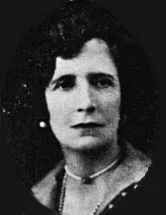
Nesta Helen Webster
Nesta Webster was an English author who revived conspiracy theories linking secret societies to world events.
Nesta Helen Webster, born in 1876, was an English author known for her theories on global conspiracies. She posited that secret societies, including the Illuminati, Freemasons, and a purported Jewish cabal, were orchestrating world events. Webster claimed these groups were occultists aiming for communist world domination and attributed major historical upheavals like the French Revolution, the 1848 Revolutions, World War I, and the Bolshevik Revolution to their machinations.
Her work significantly influenced later conspiracy ideologies, such as those promoted by the John Birch Society and the militia movement. Webster was a proponent of the antisemitic forgery "The Protocols of the Elders of Zion," which she considered an "open question" regarding its authenticity. Before World War II, she was associated with British fascist organizations. Webster's writings often framed world events as a struggle between Christ and Satan, interpreting secret societies as secular manifestations of the Antichrist within a premillennialist framework.
Conspiracy Theories and World Events
Nesta Webster became a prominent figure for reviving and popularizing conspiracy theories, particularly those involving secret societies. She asserted that groups like the Illuminati, Freemasons, and a Jewish cabal were covertly manipulating global affairs. Webster's central thesis was that these organizations, often described as occultist, were plotting to achieve communist world domination. She directly blamed them for instigating significant historical events, including the French Revolution, the 1848 Revolutions, the First World War, and the Bolshevik Revolution. Her writings provided a framework that resonated with and influenced subsequent conspiracy-minded groups and ideologies in the United States and elsewhere.
The Protocols of the Elders of Zion and Anti-Semitism
Webster's engagement with "The Protocols of the Elders of Zion," a notorious antisemitic forgery, was central to her conspiracy narratives. She contributed to a series of articles in the London Morning Post in 1920 that focused on this document, later published as "The Cause of World Unrest." Webster maintained that the authenticity of the Protocols was an "open question," effectively lending credence to its claims of a Jewish plot. This stance positioned her as a leading writer for "The Patriot," an antisemitic publication. Her work, "World Revolution: The Plot Against Civilization," further developed the idea of a "Judeo-Masonic" conspiracy behind international finance and revolutionary movements.
Views on Secret Societies and Political Affiliations
Webster developed a nuanced view of Freemasonry, distinguishing between "Continental Freemasonry," which she deemed subversive and linked to the Illuminati and the French Revolution's excesses, and "British Freemasonry," which she considered a force for order. Her research into secret societies extended to groups like the German Vereinigung Vergewaltigter Völker and Druidenorden, which she alleged had pro-Soviet leanings. Before World War II, Webster was involved with various far-right and fascist organizations in Britain, including the British Fascists and the British Union of Fascists. Her theories often intertwined anti-German sentiments with anti-communism, particularly after the Molotov-Ribbentrop Pact.
Religious and Esoteric Framework
According to historian Markku Ruotsila, Webster's conspiratorial worldview was deeply rooted in her upbringing within the Plymouth Brethren movement and its dispensational premillennialist theology. She conceptualized the Illuminati as a secular embodiment of the Antichrist, viewing world events as part of a cosmic struggle between Christ and Satan. Webster adapted traditional Christian eschatological themes to create her own interpretations, positioning contemporary radical movements within an end-times narrative. Her theories, while drawing on religious frameworks, often repurposed and secularized these concepts to explain perceived global conspiracies.
Key Ideas
- Revival of Illuminati conspiracy theories
- Secret societies (Illuminati, Freemasons, Jewish cabal) as orchestrators of world events
- Attribution of major revolutions and wars to conspiracy
- Influence on anti-communist and militia movements
- Belief in "The Protocols of the Elders of Zion" as a source of information
- Judeo-Masonic conspiracy linking international finance and revolution
- World events as a manifestation of the struggle between Christ and Satan
Notable Quotes
“the lodges of the German Freemasons and Illuminati were thus the source whence emanated all those anarchic schemes which culminated in the Terror, and it was at a great meeting of the Freemasons in Frankfurt-am-Main, three years before the French Revolution began, that the deaths of Louis XVI and Gustavus III of Sweden were first planned.”
“an honourable association”
“supporter of law, order and religion”
“open question”
“From the days of Spartacus-Weishaupt to those of Karl Marx, and down to Trotsky (Russia), Bela Kun (Hungary), Rosa Luxembourg (Germany), and Emma Goldman (United States), this world-wide conspiracy for the overthrow of civilisation and for the reconstitution of society on the basis of arrested development, of envious malevolence, and impossible equality, has been steadily growing. It played, as a modern writer, Mrs. Webster, has so ably shown, a definitely recognisable part in the tragedy of the French Revolution.”
Books by Nesta Helen Webster
2 free public domain books · Read online or download