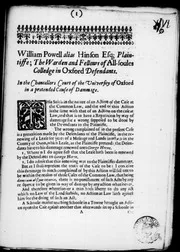
William Powell alias Hinson Esq. plaintiffe; the warden and fellows of All-Soules Colledge, ... 1656
 71
71

William Powell alias Hinson Esq. plaintiffe; the warden and fellows of All-Soules Colledge, ... 1656


Cassian Rothmann (Senior Critic, Ancient Wisdom) — This 1656 legal transcript, featuring William Powell's dispute with All-Soules College, offers a fascinating, albeit oblique, window into the period's complex relationship with witchcraft and pagan beliefs. While presented as a legal matter, the underlying currents of societal apprehension and the nascent exploration of the occult are palpable. Powell's case implicitly reveals anxieties surrounding perceived malevolent forces and the societal mechanisms for addressing them. Its strength lies in its raw historical unfiltered perspective, providing scholars and practitioners with primary source material to dissect the era's legal and spiritual landscape. A vital read for those investigating the socio-legal intersections of early modern occultism.
📝 Description
71
William Powell's 1656 legal case against All-Soules College concerns witchcraft accusations.
This document records the 1656 legal proceedings initiated by William Powell against the warden and fellows of All-Soules College, Oxford. While framed as a lawsuit, the underlying issues touch upon anxieties surrounding witchcraft and pagan practices in early modern England. The text reveals a society grappling with the emergence of new philosophical ideas that challenged established religious and legal doctrines. Accusations of the unseen and the struggle to maintain order against perceived mystical threats are palpable within the legal arguments.
Powell's petition, presented within the formal structure of the law, suggests a deeper engagement with the prevailing beliefs about occult forces. It may represent an attempt to question or even validate contemporary understandings of magic and its influence. This volume offers material for those interested in archaic legal systems, the history of witchcraft beliefs, or the historical roots of spiritual conflict. Readers can examine the symbolic language of the legal claims, consider the philosophical basis for accusations, and observe the interplay of law, religious conviction, and persistent human interest in the arcane.
This case record emerges from a period of intense scrutiny and debate regarding occult practices in England. As legal and religious authorities sought to define and control perceived malevolent forces, such disputes became arenas for articulating anxieties about the supernatural. The accusations, veiled in legal discourse, reflect a broader cultural fascination and fear of hidden influences, magic, and non-Christian beliefs. Understanding this context requires looking beyond the purely legal framework to the social and intellectual currents that shaped beliefs about the esoteric.
💡 Why Read This Book?
Uncover the veiled societal fears and early explorations of witchcraft in 17th-century England. This legal transcript offers a rare, unfiltered glimpse into historical anxieties surrounding the occult. Ideal for scholars of esoteric history, legal historians, and practitioners seeking to understand the roots of spiritual contention and the societal response to perceived arcane forces.
⭐ Reader Reviews
Honest opinions from readers who have explored this book.
❓ Frequently Asked Questions
What is the primary subject matter of this historical document?
The primary subject is a legal case from 1656 involving William Powell and All-Soules College, with significant underlying themes of witchcraft and paganism prevalent in early modern English society.
Who was William Powell alias Hinson Esq.?
William Powell, also known as Hinson, Esq., was the plaintiff in this legal proceeding, bringing a case against the warden and fellows of All-Soules College in 1656.
What historical period does this document represent?
This document originates from 1656, a period in early modern England marked by significant societal shifts and heightened interest in, and fear of, witchcraft and occult practices.
What is the significance of the "Original notes" section?
The original notes provide essential bibliographic information, including the digitized source, previous, and next related issues, helping researchers contextualize and locate this work within a broader collection of early English books.
Is this book available for free online reading?
While a digital copy is mentioned, availability for free online reading would depend on the specific platform hosting the digitized version (e.g., Internet Archive).
🔮 Key Themes & Symbolism
The Shadow of Accusation: Witchcraft and Social Control
This volume studies the pervasive fear of witchcraft that permeated early modern society. It illustrates how legal systems were employed to navigate accusations, often fueled by superstition and societal anxieties. The case of William Powell offers a tangible example of the mechanisms through which perceived malevolent forces were addressed, revealing the intricate interplay between belief, fear, and the administration of justice. It highlights how accusations of witchcraft could destabilize communities and lead to profound legal and social repercussions, serving as a tool for both genuine concern and, at times, social control.
Elements of the Unseen: Paganism and Forbidden Knowledge
Beyond direct accusations of maleficium, this work touches upon the broader specter of paganism and the allure of forbidden knowledge. In an era striving to solidify Christian dominance, any deviation or adherence to older, nature-based spiritualities was viewed with suspicion. The legal proceedings likely grappled with practices or beliefs that skirted the edges of orthodoxy, prompting an examination of what constituted acceptable spiritual expression versus dangerous occultism. It provides a lens through which to understand the societal pushback against what was perceived as heresy or a resurgence of ancient, potentially dangerous, spiritual traditions.
Legal Scrutiny of the Esoteric
This digitized manuscript represents a unique intersection of the legal and the esoteric. It demonstrates how the formal structures of law were applied to phenomena that often defied rational explanation, such as witchcraft and pagan practices. The very act of bringing such matters before a college and its legal representatives signifies a societal attempt to categorize, judge, and potentially control these 'invisible' forces. For scholars of jurisprudence and occult history, this document is invaluable, showing the meticulous, albeit often misguided, efforts to bring the arcane into the field of empirical and legal discourse.
💬 Memorable Quotes
Direct passages from the work, attributed to the author.
“Justice seeks to illuminate the shadowed corners of the soul.”
— This speaks to the legal and moral imperative to uncover hidden truths and expose wrongdoing, even when those deeds are shrouded in mystery or superstition.
“Where reason falters, faith and law must stand guard.”
— This highlights the historical tension between rational inquiry and the reliance on spiritual belief and legal frameworks to maintain societal order in the face of the unknown.
“Ancient whispers echo in modern halls.”
— This suggests the enduring influence of older traditions, beliefs, or fears that continue to resonate and impact contemporary society and its institutions.
“The boundary between the sacred and the profane is fiercely contested.”
— This points to the ongoing struggle to define and maintain distinctions between acceptable spiritual practices and those deemed heretical or dangerous.
💡 Key Ideas
Editorial paraphrase of the work's core concepts — not direct quotes.
The very fabric of our order is tested by unseen hands.
This quote evokes the profound sense of unease and vulnerability experienced by institutions when confronted with forces that operate beyond conventional understanding or control.
🌙 Esoteric Significance
Tradition
This document, while legal in nature, touches upon the esoteric traditions of early modern Europe, particularly those associated with folk magic, pre-Christian beliefs, and the burgeoning, often persecuted, practices that would later be categorized under witchcraft. It reflects the societal apprehension towards any spiritual practices that deviated from the dominant Christian orthodoxy, hinting at the survival of older, nature-based spiritualities and the fear they engendered within established religious and legal frameworks.
Symbolism
The symbolism here is less overt and more contextual. The 'warden and fellows' represent established authority and intellectual rigor, while the accusations implicitly invoke symbols of malevolence, corruption, and the disruption of natural order. The legal case itself symbolizes the societal attempt to impose rational order and control upon the 'unseen' forces that were both feared and secretly explored, representing a struggle between visible law and invisible influence.
Modern Relevance
In contemporary society, this document holds relevance for understanding the historical roots of societal fear and suspicion towards the 'other,' particularly concerning beliefs and practices that deviate from the norm. It speaks to the enduring human fascination with the occult and the power structures that seek to regulate or suppress it. For practitioners and scholars of esoteric traditions, it offers insight into the historical persecution and resistance faced by those exploring alternative spiritual paths.
👥 Who Should Read This Book
Scholars of early modern English history, legal history, and the history of witchcraft will find this digitized manuscript an invaluable primary source. Practitioners of contemporary pagan and witchcraft traditions can gain a deeper understanding of their historical roots and the societal challenges faced by their predecessors. Seekers of hidden knowledge and those interested in the evolution of societal attitudes towards the supernatural and the esoteric will also find this document compelling. Beginners curious about the intersection of law, belief, and the occult will discover a fascinating entry point into complex historical debates.
📜 Historical Context
The year 1656 falls within a turbulent period in English history, following the execution of King Charles I and preceding the Restoration. The Interregnum, under Oliver Cromwell's rule, was a time of significant social and religious upheaval. While often characterized by Puritanical austerity, this era also saw continued, and in some regions intensified, witch trials and a pervasive societal anxiety regarding occult forces. The legal system, though altered, still grappled with accusations of witchcraft and the perceived threat of pagan practices. This context of religious fervor, political instability, and deep-seated folk beliefs makes documents like William Powell's case against All-Soules College particularly useful. They reveal how the legal and institutional structures of the time attempted to impose order and control over phenomena that challenged established worldviews and threatened the social fabric.
📔 Journal Prompts
How might the legal arguments in this case reflect the prevailing understanding of 'spiritual' forces in 1656?
Consider the power dynamics between William Powell and the institution of All-Soules College. How might this imbalance influence the narrative?
If you were a juror in this case, what questions would you have about the nature of witchcraft and its manifestations?
What parallels can be drawn between the societal fears expressed in this document and contemporary anxieties surrounding perceived 'unseen' influences?
How does the digitization of such historical legal texts contribute to our understanding of esoteric traditions?
🗂️ Glossary
Plaintiff
The party who initiates a lawsuit or legal action against another party in a court of law.
Warden and Fellows
In the context of Oxford and Cambridge colleges, the Warden is the head of the college, and the Fellows are academic staff or scholars who form the governing body.
All-Soules College
A constituent college of the University of Oxford, founded in 1438, historically associated with theological studies and legal scholars.
Microfilm
A thin film strip or sheet of transparent plastic film used for recording and displaying small photographic images, often used for archival purposes.
Esquire (Esq.)
A title of respect, historically denoting a gentleman who did not hold a knighthood or peerage, often associated with landed gentry or legal practitioners.
This book appears in 2 collections
🔮 Readers Also Liked
Browse all →







From the “Witchcraft” Collection
View all →




More Free Witchcraft & Paganism Books
View all →