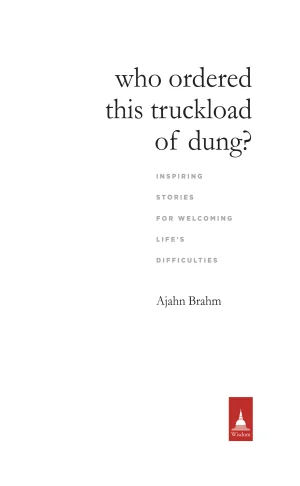
Who Ordered This Truckload of Dung?
 71
71

Who Ordered This Truckload of Dung?
Ajahn Brahm’s "Who Ordered This Truckload of Dung?" arrives with a title that promises levity, and largely delivers. The collection’s strength lies in Brahm’s uncanny ability to distill complex Buddhist principles into digestible, often humorous, parables. His personal anecdotes, like those concerning his monastic life, feel genuinely earned. However, the sheer volume of 108 short pieces can lead to a certain repetitive quality; some reflections, while charming, tread similar ground. A particular passage that stands out is the parable of the man who tries to carry water in a sieve, effectively illustrating the futility of grasping at impermanent things. While the humor is a significant draw, at times it can slightly overshadow the weight of the underlying teachings. Ultimately, the book serves as a gentle, accessible primer on Buddhist-informed living.
📝 Description
71
Ajahn Brahm's 2005 book, 'Who Ordered This Truckload of Dung?', collects 108 accessible Buddhist reflections.
This book presents 108 short pieces by Buddhist monk Ajahn Brahm, first published in 2005. Brahm uses Buddhist teachings, personal stories, and folk tales to discuss life's various aspects. Known for his humor and clear style, he offers practical wisdom for daily challenges and spiritual growth. The work addresses serious topics with a light touch.
It appeals to those interested in Buddhism who may find denser philosophical texts off putting. Readers looking for straightforward advice on emotions like fear, pain, and love, delivered without dogma, will find value. The book also suits individuals seeking inspiration and a more mindful approach to life, regardless of their familiarity with Buddhist ideas.
The early 2000s saw mainstream interest in Eastern spirituality. Ajahn Brahm, a prominent figure in Western Buddhism, became a popular teacher through his accessible writing. His work offered a more approachable alternative to academic Buddhist scholarship, resonating with a generation seeking spiritual answers outside traditional Western religions.
💡 Why Read This Book?
• Gain practical strategies for managing emotional distress, inspired by Ajahn Brahm’s discussion of fear and pain, drawing on his experience as a monk since 1983. • Understand the Buddhist concept of 'dukkha' not as a grim pronouncement, but as a relatable aspect of life explored through the 108 stories. • Cultivate a more mindful and accepting perspective on life's challenges, illuminated by traditional Buddhist folk tales and Brahm's personal reflections.
⭐ Reader Reviews
Honest opinions from readers who have explored this book.
❓ Frequently Asked Questions
What is the significance of the title 'Who Ordered This Truckload of Dung?'
The title is a humorous metaphor for life's unexpected difficulties and suffering. It reflects a Buddhist perspective of accepting challenges without excessive complaint, as illustrated in the book's numerous parables.
Is this book only for Buddhists?
No, the book is written for a general audience interested in practical wisdom and personal growth. Ajahn Brahm uses accessible language and relatable stories, making Buddhist principles understandable to anyone, regardless of their religious background.
How does Ajahn Brahm use humor in his teachings?
Ajahn Brahm employs humor to make profound spiritual concepts more approachable and less intimidating. His light-hearted tone, evident throughout the 108 pieces, helps readers engage with difficult topics like suffering and impermanence with a sense of ease.
What kind of stories are included in the book?
The book features a mix of personal anecdotes from Ajahn Brahm's life as a monk, traditional Buddhist folk tales, and humorous observations on everyday situations. These stories illustrate core Buddhist teachings in a relatable manner.
When was 'Who Ordered This Truckload of Dung?' first published?
The book was first published on August 30, 2005. This places its emergence during a period of increasing interest in mindfulness and Eastern philosophy in the West.
What are the main themes explored in the book?
The primary themes include acceptance of life's difficulties, the nature of suffering (dukkha), the power of perspective, impermanence, and the cultivation of wisdom and compassion through everyday experiences.
🔮 Key Themes & Symbolism
Acceptance of Dukkha
The book reframes 'dukkha,' often translated as suffering, not as something to be eliminated but understood and accepted as an inherent part of existence. Through stories like the titular truckload of dung, Ajahn Brahm illustrates how our resistance to life's inevitable difficulties often causes more pain than the difficulties themselves. This theme encourages readers to shift their perspective from struggling against reality to working skillfully with it, fostering a more peaceful inner state.
The Power of Perspective
A central tenet is that our perception profoundly shapes our experience. Ajahn Brahm uses numerous parables to demonstrate how changing one's viewpoint can transform seemingly insurmountable problems into manageable challenges. This concept is crucial in Buddhist thought, highlighting how mental conditioning influences our emotional responses and overall well-being. The book offers practical ways to cultivate a more positive and resilient outlook.
Humor as a Spiritual Tool
Uniquely, this work positions humor not as mere entertainment but as a vital spiritual practice. Ajahn Brahm's light-hearted approach, evident in his decision to publish 108 pieces, makes profound spiritual concepts accessible and less daunting. By using wit and relatable scenarios, he demonstrates how laughter can dissolve tension, foster connection, and provide clarity, serving as a powerful antidote to the seriousness that often accompanies spiritual seeking.
Impermanence and Non-Attachment
The fleeting nature of all things ('anicca') and the illusion of a permanent self ('anatta') are subtly woven into the narratives. Ajahn Brahm encourages readers to recognize that clinging to temporary joys or possessions leads to dissatisfaction. By understanding impermanence, one can cultivate detachment, reducing the sting of loss and appreciating the present moment more fully, a core practice in many Buddhist traditions.
💬 Memorable Quotes
Direct passages from the work, attributed to the author.
“A monk is supposed to be a master of his mind.”
— This interpretation points to the core Buddhist discipline of mental training. It underscores that spiritual growth involves developing control over one's thoughts and emotions, a theme frequently illustrated through Ajahn Brahm's personal experiences as a monk.
“If you want to know what a person is like, watch how they treat someone who can do nothing for them.”
— This interpretation highlights the book's focus on practical ethics and compassion. It suggests that true character is revealed in interactions where there is no expectation of personal gain, emphasizing kindness and empathy as key virtues.
💡 Key Ideas
Editorial paraphrase of the work's core concepts — not direct quotes.
The Buddha said that life is dukkha. If we don't like the word 'dukkha', we can call it 'disappointment'.
This paraphrase highlights the book's strategy of using accessible language to explain Buddhist concepts. It suggests that 'dukkha' isn't necessarily intense suffering but the pervasive sense of dissatisfaction that arises from unmet expectations, a common human experience.
When you are unhappy, you are the only one who is unhappy. But when you are happy, you make many people happy.
This quote emphasizes the ripple effect of positive emotions. It suggests that cultivating personal happiness isn't selfish but has a beneficial impact on one's community, encouraging the practice of mindfulness and joy as a form of active compassion.
The best way to deal with the inevitable problems of life is to learn to laugh at them.
This paraphrased concept expresses the book's central thesis: humor is a vital tool for spiritual resilience. It suggests that adopting a light-hearted attitude towards adversity can significantly reduce its perceived burden and foster a more positive outlook.
🌙 Esoteric Significance
Tradition
While rooted in Theravada Buddhism, Ajahn Brahm's work subtly incorporates universal principles that resonate with broader esoteric traditions. His emphasis on mind-training, skillful means, and the transformation of suffering aligns with practices found in various contemplative paths, including aspects of Western esotericism that focus on inner alchemy and psychological development. He departs from strict ritualism, focusing instead on the practical application of wisdom for everyday liberation.
Symbolism
The 'truckload of dung' itself serves as a potent symbol for the accumulation of life's difficulties, burdens, and negative karma. Ajahn Brahm uses this seemingly unpleasant image to challenge the reader's aversion, suggesting that confronting and understanding these 'burdens' is key to spiritual progress. Other symbols often implied are the 'sieve' for grasping at impermanence and the 'still pond' for mental tranquility, common motifs in contemplative traditions.
Modern Relevance
Ajahn Brahm's approach continues to be highly relevant in contemporary mindfulness and well-being circles. Therapists and coaches draw on his accessible explanations of cognitive reframing and emotional regulation. His work is often cited in discussions about secular Buddhism and the integration of Eastern wisdom into Western psychological frameworks, making it a touchstone for those seeking practical, non-dogmatic spiritual guidance.
👥 Who Should Read This Book
• Individuals new to Buddhist philosophy seeking an approachable entry point, especially those who appreciate humor and relatable storytelling. • Practitioners of mindfulness and meditation looking for practical techniques to manage stress, anxiety, and emotional reactivity in daily life. • Anyone experiencing life's challenges who desires a shift in perspective, offering gentle guidance on acceptance, resilience, and finding joy amidst difficulties.
📜 Historical Context
Published in 2005, "Who Ordered This Truckload of Dung?" emerged during a period of significant Western engagement with Buddhist philosophy, moving beyond niche academic circles. Ajahn Brahm, ordained in 1977 and trained under respected monks like Ajahn Chah, represented a generation of Westerners bringing Buddhist teachings back to the West in accessible forms. His work contrasted with more scholarly or strictly traditional presentations of Buddhism. While figures like the Dalai Lama were gaining international recognition, Brahm offered a more localized, often humorous, approach. The book found an audience alongside the burgeoning mindfulness movement, influenced by figures like Jon Kabalan, and the popularization of practices like Vipassanā meditation.
📔 Journal Prompts
The truckload of dung as a metaphor for life's challenges.
Reflecting on the 'sieve' analogy for grasping at impermanent joys.
Identifying moments where perspective shift eased personal suffering.
The role of humor in navigating difficult situations, inspired by Ajahn Brahm's style.
Cultivating compassion through recognizing shared experiences of 'dukkha'.
🗂️ Glossary
Dukkha
A central Buddhist concept often translated as suffering, dissatisfaction, or stress. It refers to the inherent unsatisfactoriness of conditioned existence, arising from impermanence and attachment.
Anicca
The Pali word for impermanence. It signifies that all phenomena are in a constant state of flux and change, and nothing is permanent.
Anatta
The doctrine of non-self. It asserts that there is no permanent, unchanging, independent self or soul underlying our existence.
Monk
A person, typically male, who has taken vows to dedicate their life to spiritual practice, often living in a monastic community and adhering to specific rules of conduct.
Parable
A simple story used to illustrate a moral or spiritual lesson, often employing symbolic characters or situations to convey a deeper meaning.
Skillful Means (Upaya)
In Buddhism, methods or strategies used by a teacher to help disciples understand the Dharma and achieve enlightenment, adapted to the disciple's capacity.
Mindfulness
The practice of paying attention to the present moment, intentionally and non-judgmentally. It involves awareness of thoughts, feelings, bodily sensations, and the surrounding environment.
This book appears in 1 collection
🔮 Readers Also Liked
Browse all →









From the “Meditation” Collection
View all →








More Free Occult Philosophy Books
View all →