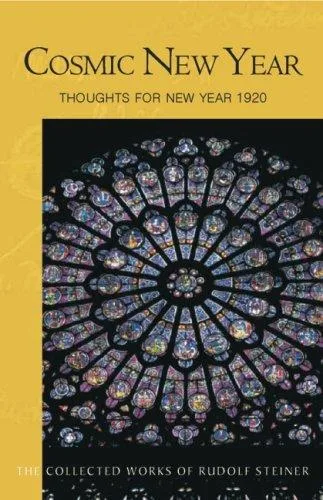
Weltsilvester und Neujahrsgedanken
 75
75

Weltsilvester und Neujahrsgedanken
Rudolf Steiner’s "Weltsilvester und Neujahrsgedanken" offers a distinctive perspective on the cyclical nature of time, presented through a series of lectures. The strength of this work lies in its rigorous attempt to map spiritual realities onto observable temporal shifts, particularly the New Year transition. Steiner connects the mundane experience of a calendar reset with profound cosmic and spiritual impulses, a perspective that demands significant intellectual engagement. However, the density of his thought, characteristic of anthroposophy, can be a barrier. The reliance on a specific esoteric vocabulary requires prior familiarity or dedicated study, making some passages challenging for the uninitiated. A notable section explores the spiritual forces at play during the winter solstice and the New Year, linking them to the human being's capacity for spiritual perception. While dense, the work provides a unique lens for understanding time beyond its mechanical measurement, urging a deeper spiritual awareness of life's rhythms. It is a text for dedicated students of Steiner's extensive body of work.
📝 Description
75
Rudolf Steiner delivered these lectures on New Year's Eve and New Year's Day in 1917.
Rudolf Steiner's "Weltsilvester und Neujahrsgedanken" (World New Year's Eve and New Year's Thoughts) contains lectures given at the close of 1917. These talks are not casual seasonal observations but rather focus on the spiritual forces shaping human life and the cosmos. Steiner connects the yearly calendar to larger cosmic movements. He suggests the New Year offers a specific opportunity for spiritual growth and reflection.
Steiner examines how human awareness relates to spiritual realities beyond the material. He encourages readers to recognize the hidden spiritual processes at work in the world. This collection is for those interested in spiritual science and Steiner's anthroposophical ideas. It will particularly attract readers who ponder the esoteric aspects of time, consciousness, and personal development. Those questioning the deeper significance of holidays or the potential for human evolution will find substance here.
This work emerges from Rudolf Steiner's anthroposophy, a spiritual philosophy he developed in the early 20th century. Anthroposophy views the material world as interconnected with spiritual realities and emphasizes human capacity for spiritual perception and development. Steiner's thought, while rooted in earlier esoteric traditions like Theosophy, sought to create a modern path for spiritual understanding. The lectures here reflect his focus on applying spiritual insights to the understanding of time, consciousness, and humanity's place within the cosmos.
💡 Why Read This Book?
• Gain a unique spiritual-scientific perspective on the turning of the year, understanding the New Year not just as a date but as a period of potent spiritual impulses, as discussed in the lectures. • Explore Rudolf Steiner's specific concept of cosmic rhythms and how they interrelate with human consciousness and evolution, offering insights beyond conventional calendrical observations. • Grasp the anthroposophical view of how spiritual forces actively influence earthly events, particularly during transitional periods like the year's end, as detailed in the text.
⭐ Reader Reviews
Honest opinions from readers who have explored this book.
❓ Frequently Asked Questions
What is the primary focus of Rudolf Steiner's "Weltsilvester und Neujahrsgedanken"?
The book focuses on the spiritual significance of the New Year transition, exploring cosmic rhythms, spiritual impulses, and the evolution of human consciousness during this specific period.
When were the lectures that comprise "Weltsilvester und Neujahrsgedanken" originally given?
The lectures were delivered by Rudolf Steiner around the turn of the year in the early 20th century, though the first publication date was 1986.
Is prior knowledge of anthroposophy required to understand this book?
While not strictly mandatory, familiarity with Rudolf Steiner's anthroposophical concepts and terminology greatly enhances comprehension, as the work employs a specialized esoteric vocabulary.
What is the relationship between the calendar year and spiritual forces according to Steiner in this work?
Steiner posits that the calendar year, particularly its turning points like New Year's Eve and Day, are imbued with specific spiritual forces and impulses that influence human and cosmic development.
What does Steiner mean by 'spiritual impulses' in the context of the New Year?
Spiritual impulses refer to active, non-material forces and influences that Steiner believed emanate from the spiritual world, shaping earthly events and human consciousness, especially during the New Year period.
Can "Weltsilvester und Neujahrsgedanken" be considered a practical guide for self-improvement?
While it offers profound insights for inner development, it is primarily a philosophical and spiritual exploration rather than a step-by-step self-help manual. Its practicality lies in fostering a deeper spiritual understanding of time and existence.
🔮 Key Themes & Symbolism
The Spiritual Nature of Time
Steiner posits that time is not merely a linear progression of moments but possesses a living, spiritual quality. "Weltsilvester und Neujahrsgedanken" explores how the turning points of the year, especially New Year's Eve and Day, are imbued with specific spiritual impulses. These impulses, emanating from the cosmos, actively influence human consciousness and the course of earthly events. The work encourages a perception of time that transcends mechanical measurement, urging readers to recognize its inherent spiritual dynamism and its role in cosmic evolution.
Cosmic Rhythms and Human Consciousness
This collection looks at the intricate connection between celestial movements and the inner life of human beings. Steiner argues that the rhythms of the cosmos are mirrored in human physiological and spiritual processes. The New Year, in particular, is presented as a potent gateway where these cosmic influences are strongly felt. The text guides the reader to understand how attuning oneself to these rhythms can foster spiritual development and a deeper comprehension of one's place within the universal order.
Spiritual Science and the New Year
Fundamentally, , "Weltsilvester und Neujahrsgedanken" is an exposition of spiritual science as developed by Rudolf Steiner. It applies this methodology to the seemingly ordinary phenomenon of the New Year. Steiner elucidates how ordinary events can be understood through a spiritual lens, revealing hidden processes and forces. The lectures serve as an invitation to perceive the spiritual dimensions of existence, encouraging a conscious engagement with the forces of renewal and transformation that the New Year symbolizes.
Evolution of Consciousness
A recurring theme is the ongoing evolution of human consciousness within a cosmic context. Steiner frames the New Year as a crucial juncture in this evolutionary process, offering opportunities for spiritual advancement. The lectures explore how humanity's capacity to perceive and interact with spiritual realities is developing. By understanding the spiritual impulses associated with the year's turning, individuals can consciously participate in their own spiritual growth and contribute to the broader evolution of consciousness.
💬 Memorable Quotes
Direct passages from the work, attributed to the author.
“The New Year brings forces that are not present at other times of the year.”
— This highlights Steiner's central thesis that temporal markers like the New Year are not arbitrary but are imbued with distinct spiritual energies that can be consciously engaged with for inner development.
“We must learn to perceive the spiritual processes that underlie physical events.”
— This statement emphasizes the core aim of spiritual science: to move beyond a purely materialistic understanding and develop the capacity to recognize the unseen spiritual forces and workings that shape the material world.
“The turning of the year connects us to cosmic rhythms.”
— This conveys the idea that human existence is deeply intertwined with the larger cosmic order, and specific points in the calendar serve as powerful interfaces for experiencing this connection.
“Consciousness itself is evolving through these cosmic influences.”
— This points to Steiner's view that human awareness is not static but is actively shaped and advanced by the spiritual and cosmic forces that operate throughout the year, particularly during significant transitional periods.
“The New Year offers a unique moment for spiritual renewal.”
— This suggests that the specific energies present at the year's beginning provide an opportune time for individuals to consciously engage in inner transformation and spiritual growth.
🌙 Esoteric Significance
Tradition
This work is firmly rooted in the Western Esoteric Tradition, specifically within Rudolf Steiner's developed Spiritual Science, known as Anthroposophy. While drawing from Hermetic, Gnostic, and Theosophical concepts, Steiner sought to create a distinct path that integrated spiritual insight with scientific rigor. "Weltsilvester und Neujahrsgedanken" fits within this lineage by exploring the hidden spiritual mechanics of time and the cosmos, offering a unique cosmology and anthropology that departs from earlier esoteric systems through its specific focus on consciousness evolution and karma.
Symbolism
The primary symbolism revolves around the turning of the year itself, representing not just a temporal shift but a gateway for spiritual forces. The New Year symbolizes renewal, rebirth, and the potential for conscious transformation. Steiner also implicitly invokes cosmic symbols related to cyclical time and the influence of celestial bodies and spiritual hierarchies on human destiny. The human being is depicted as a microcosm reflecting the macrocosm, with inner spiritual processes mirroring cosmic events, particularly during this potent transitional period.
Modern Relevance
Anthroposophy, and by extension works like "Weltsilvester und Neujahrsgedanken," continues to influence various contemporary movements. Waldorf education, biodynamic agriculture, and anthroposophical medicine are practical applications. Spiritually, thinkers and practitioners engaged with Western esotericism, integral spirituality, and consciousness studies often turn to Steiner's extensive corpus for his unique perspectives on cosmology, spiritual evolution, and the nature of reality. His detailed cosmology provides a framework for those seeking to understand the spiritual dimensions of life beyond conventional paradigms.
👥 Who Should Read This Book
• Students of Rudolf Steiner's Anthroposophy seeking to deepen their understanding of his cosmology and his specific approach to the spiritual significance of time. • Individuals interested in esoteric interpretations of calendars, cycles, and annual turning points, who wish to explore concepts beyond mainstream calendrical observations. • Seekers of spiritual philosophy who are drawn to detailed explorations of consciousness evolution and the interplay between the human being and cosmic forces during specific temporal junctures.
📜 Historical Context
Rudolf Steiner delivered the lectures that form "Weltsilvester und Neujahrsgedanken" in the early 20th century, a period marked by intense intellectual and spiritual inquiry across Europe. This era saw the rise of movements like Theosophy, with which Steiner was initially associated, and parallel explorations into spiritualism, occultism, and new philosophical ideas about consciousness and time, exemplified by figures like Henri Bergson. Steiner's anthroposophy emerged as a distinct spiritual-scientific path, seeking to bridge the gap between empirical science and spiritual experience. His work offered a counterpoint to prevailing materialistic philosophies and even to some more emotionally-focused spiritual movements of the time. The lectures provided a structured, intellectual approach to understanding spiritual realities, aiming to equip individuals with the faculties to perceive these dimensions. While Steiner had a significant following, his ideas were often met with skepticism from mainstream academic and scientific circles, and his work continued to develop independently of contemporary philosophical trends, though engaging with the era's intellectual currents.
📔 Journal Prompts
The spiritual impulses of the New Year and their perceived effects on personal consciousness.
Reflecting on the cosmic rhythms Steiner describes and their manifestation in daily life.
The role of human consciousness in interacting with the spiritual forces of the turning year.
Considering the potential for spiritual renewal offered by the transition from one year to the next.
Exploring the connection between earthly temporal events and larger spiritual evolutionary processes.
🗂️ Glossary
Spiritual Science (Anthroposophy)
Rudolf Steiner's term for a discipline that seeks to apply the methods and rigor of natural science to the investigation of spiritual phenomena, aiming to bridge the gap between materialism and traditional spirituality.
Spiritual Impulses
Non-material forces and influences believed by Steiner to emanate from the spiritual world, actively shaping earthly events, human consciousness, and cosmic development.
Cosmic Rhythms
The cyclical patterns and movements within the cosmos (e.g., celestial orbits, seasonal changes) that Steiner believed have a direct correspondence with and influence upon human life and spiritual processes.
Evolution of Consciousness
Steiner's concept that human consciousness is not static but is undergoing a continuous development and transformation throughout earthly and cosmic history, influenced by spiritual forces.
Microcosm and Macrocosm
The principle that the human being (microcosm) is a reflection or miniature representation of the universe (macrocosm), with inner spiritual and physical processes mirroring larger cosmic patterns.
Temporal Markers
Specific points in time, such as the turning of the year, which Steiner viewed not merely as chronological divisions but as significant junctures imbued with unique spiritual energies and influences.
Spiritual Renewal
The process of inner transformation and rejuvenation of the spiritual aspect of the human being, which Steiner suggests is particularly facilitated during certain times, like the New Year.
🔮 Readers Also Liked
Browse all →








More by Rudolf Steiner
All books →



More Free Theosophy & Anthroposophy Books
View all →