Thought-forms
 76
76

Thought-forms
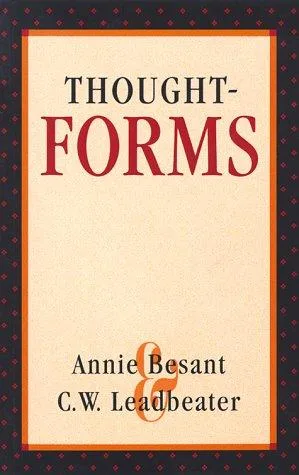
Annie Besant's 'Thought-forms' offers a compelling, if dated, framework for understanding the energetic architecture of consciousness. The sheer detail with which Besant and C.W. Leadbeater describe the colors, shapes, and movements of thought-forms, often drawing from alleged clairvoyant observation, is remarkable. Their assertion that a thought of malice might manifest as a 'jagged, dark-red, writhing worm' is a striking example of their descriptive power. However, the work suffers from a certain rigidity; its classifications, while systematic, can feel overly prescriptive. The text assumes a level of shared esoteric understanding that might prove a barrier for newcomers. Despite these limitations, 'Thought-forms' remains a significant historical document for anyone investigating the visualization of mental states.
📝 Description
76
Annie Wood Besant's 1952 book posits that thoughts have tangible substance and color.
Published in 1952, 'Thought-forms' examines the nature and manifestation of energetic emanations generated by human consciousness. The authors argue that thoughts are not simply fleeting mental events. Instead, they assert that thoughts possess a tangible substance and color, capable of interacting with the environment and affecting both the thinker and others.
This work is for individuals interested in the subtle mechanics of the mind and its repercussions. It will appeal to students of theosophy, occult philosophy, and anyone curious about unseen energetic bodies and their connection to physical reality. The book offers insights for those seeking to improve their mental discipline and grasp the outcomes of their thoughts. It systematically breaks down the appearance and function of these thought-forms, connecting them to concepts of karma and spiritual progression.
This volume emerged from the Theosophical Society, a movement significantly shaped by Helena Blavatsky in the late 19th century. It reflects a period of strong interest in psychical research and esoteric studies. The book draws on Theosophical principles, particularly concerning the astral body and the subtle energetic constructs generated by mental activity. It aims to provide a framework for understanding phenomena previously considered purely religious or folkloric, linking them to a developing philosophical understanding of consciousness and its effects.
💡 Why Read This Book?
• Understand the Theosophical concept of the astral body and its role in manifesting thoughts as tangible energetic forms, as detailed in the chapters describing their substance and color. • Learn to visually identify distinct thought-form patterns associated with specific emotions, such as anger or love, offering a new perspective on mental discipline. • Grasp the historical context of early 20th-century esoteric thought, particularly the Theosophical Society's influence on understanding consciousness beyond the physical.
⭐ Reader Reviews
Honest opinions from readers who have explored this book.
❓ Frequently Asked Questions
What is the primary purpose of the book 'Thought-forms'?
The book aims to explain the nature, appearance, and influence of 'thought-forms' – the energetic emanations generated by human thoughts and emotions, as perceived by clairvoyants.
Who were the main authors or contributors to 'Thought-forms'?
Annie Besant is credited as the author, but the work heavily draws upon the observations and descriptions of C.W. Leadbeater, a prominent figure in the Theosophical Society.
When was 'Thought-forms' first published?
The book was first published in 1952, though its concepts and observations were developed and shared within the Theosophical milieu earlier.
What is the connection between thoughts and colors in this book?
The book posits that specific thoughts and emotions correspond to distinct colors and patterns, with different hues representing varying qualities of mental or emotional energy.
Does 'Thought-forms' discuss the impact of thought-forms on others?
Yes, it elaborates on how thought-forms can affect the environment and individuals, influencing them energetically based on the nature of the thought that created them.
Is this book suitable for beginners in esoteric studies?
It can be, but it assumes some familiarity with Theosophical concepts like the astral body and subtle planes of existence, making it more accessible to those with prior background.
🔮 Key Themes & Symbolism
The Energetic Nature of Thought
This work posits that thoughts are not intangible but possess a form and substance, projecting outward from the thinker. It describes these 'thought-forms' as having specific colors, shapes, and textures, directly corresponding to the mental or emotional state that generated them. The book details how these forms can persist and interact within the subtle environment, influencing both the individual and their surroundings.
Visual Manifestations of Emotion
A central theme is the direct correlation between specific emotions and their visual representation as thought-forms. For instance, feelings of love might appear as soft, flowing forms in warm hues, while anger could manifest as jagged, dark, and aggressive shapes. This systematic cataloging offers a framework for understanding the energetic signature of inner states.
The Astral Body and Clairvoyance
The text relies heavily on the concept of the astral body, an energetic counterpart to the physical body, as the medium through which thought-forms are projected and perceived. It assumes the reader's familiarity with or openness to the idea of clairvoyance, the ability to perceive these subtle forms visually.
Karma and Thought
The book explores how the creation and projection of thought-forms contribute to an individual's karmic patterns. Positive, constructive thoughts are seen to generate beneficial energies, while negative or destructive ones create adverse influences that can return to the thinker or affect others, underscoring the ethical dimension of mental activity.
💬 Memorable Quotes
Direct passages from the work, attributed to the author.
“Thought is itself a thing, and it has form and colour.”
— This core assertion highlights the book's central thesis: that mental activity is not merely abstract but generates tangible, observable energetic constructs with distinct visual characteristics.
“The man who thinks of the welfare of others, or who loves them, or who wishes them well, sends out a beautiful form.”
— This illustrates the positive manifestation of thought-forms, linking altruistic or loving intentions to the creation of aesthetically pleasing and beneficial energetic patterns.
“The colour of the thought-form is determined by the emotion which produced it.”
— This principle explains the systematic color-coding of thought-forms, where specific emotional states are directly translated into particular hues, forming a visual language of inner experience.
“When a man thinks angrily, he sends out a jagged, dark-red, writhing worm.”
— This provides a concrete, albeit stark, example of a negative thought-form, illustrating how intense negative emotions can generate aggressive and unpleasant energetic manifestations.
“We are constantly throwing out thought-forms from ourselves.”
— This emphasizes the continuous and pervasive nature of thought-form generation, suggesting that every individual is constantly emitting these energetic emanations into their environment.
🌙 Esoteric Significance
Tradition
This work is firmly rooted in the Theosophical tradition, which itself synthesizes elements from Eastern religions (Hinduism, Buddhism) and Western esotericism (Hermeticism, Neoplatonism). It elaborates on the Theosophical model of the human constitution, particularly the concept of the astral and mental bodies, and their role in manifestation, extending these ideas into a visual and energetic framework.
Symbolism
Key symbols include the colors of the aura and thought-forms, where specific hues (e.g., red for anger, blue for devotion) represent distinct emotional and mental qualities. Shapes are also symbolic; jagged, writhing forms denote negativity or conflict, while smooth, flowing shapes indicate harmony and positive intent. The book uses these visual elements as a symbolic language for inner states.
Modern Relevance
Contemporary practices in energy healing, mindfulness, and manifestation often echo the principles discussed in 'Thought-forms'. Modern proponents of law of attraction and positive psychology, while perhaps not citing Besant directly, engage with the underlying idea that focused thought and emotion can influence reality and personal well-being.
👥 Who Should Read This Book
• Students of Theosophy seeking to understand the visual mechanics of thought and emotion as described by early 20th-century esotericists. • Individuals interested in the energetic basis of consciousness and the subtle bodies, who wish to explore how mental states might manifest visually. • Practitioners of meditation or mindfulness who want to gain a deeper conceptual understanding of the impact and nature of their own thoughts.
📜 Historical Context
Published in 1952, 'Thought-forms' emerged from the fertile ground of early 20th-century Theosophy, a movement deeply engaged with exploring the unseen dimensions of reality. Annie Besant, a prominent leader within the Theosophical Society, built upon foundational concepts laid out by Helena Blavatsky in works like 'The Secret Doctrine' (1888). This era was marked by widespread interest in psychical phenomena, spiritualism, and alternative philosophies that sought to explain consciousness and existence beyond materialistic paradigms. Contemporaries like Rudolf Steiner, though eventually diverging from mainstream Theosophy, also explored the energetic and symbolic dimensions of human experience during this period. Theosophical ideas, including the existence of subtle bodies and the impact of thought, offered a spiritual framework that contrasted with emerging psychological theories and scientific materialism, providing a distinct alternative for understanding the human psyche.
📔 Journal Prompts
The specific colors associated with different emotions as described in the text.
Manifestations of anger as described by the book's visual lexicon.
The relationship between the astral body and thought projection.
Personal experiences with sending or receiving energetic influences.
The concept of thought-forms contributing to one's karmic path.
🗂️ Glossary
Thought-form
An energetic construct created by a thought or emotion, possessing color, shape, and substance, which emanates from the thinker and can interact with the environment.
Astral Body
A subtle, non-physical body composed of finer matter than the physical, believed to be the vehicle of emotions and desires, and through which thought-forms are projected.
Aura
A field of subtle energy or radiation surrounding a living being, often perceived as colored layers reflecting the individual's physical, emotional, and mental state.
Clairvoyance
The purported psychic ability to perceive objects, events, or people that are not present to the physical senses, often described as seeing into the subtle realms.
Mental Body
A subtle body associated with the higher or abstract thinking faculties, distinct from the astral body which handles emotions and lower desires.
Karma
The principle of cause and effect, where actions (including thoughts and intentions) create consequences that influence future experiences and rebirths.
Theosophy
A spiritual movement founded in the late 19th century, seeking to understand divine wisdom and the underlying principles of the universe through ancient traditions and esoteric knowledge.
🔮 Readers Also Liked
Browse all →






More by Annie Wood Besant
All books →




More Free Theosophy & Anthroposophy Books
View all →