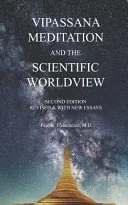
Vipassana Meditation and the Scientific Worldview
 78
78

Vipassana Meditation and the Scientific Worldview
Paul R. Fleischman, M.D., approaches Vipassana meditation not as a purely spiritual pursuit but as a practice deeply aligned with the scientific worldview. He argues compellingly that the universe's inherent order, its 'information-state,' is reflected within our own biological and cognitive structures. A notable strength is Fleischman's ability to articulate complex cosmological and neurological ideas in accessible terms, bridging the gap between empirical science and inner experience. For instance, his discussion on how meditation can attune individuals to the universe's governing laws offers a novel perspective, moving beyond typical mindfulness benefits. However, the work occasionally leans heavily on its central thesis, sometimes presenting its interpretations as established fact rather than emerging hypotheses. Despite this, the book provides a unique framework for understanding contemplative practice within a modern scientific paradigm.
📝 Description
78
Paul R Fleischman's 2020 book connects Vipassana meditation to a structured, information-based universe.
This work posits that the universe is not random but governed by discernible patterns and directives that shape both cosmic events and human consciousness. Fleischman argues these universal laws, termed an 'information-state,' are embedded within our physical and mental makeup. The book is for those curious about the scientific basis of consciousness and meditation, seeking to align spiritual experiences with a rational outlook. It will appeal to meditators interested in the neurobiological and cosmological frameworks behind their practice, as well as scientists examining information theory and universal order.
The central ideas focus on the universe as a system of inherent laws and patterns, the 'information-state.' It presents humans as a 'microcosm' mirroring these universal directives. Vipassana meditation is shown as a method to access and comprehend these internal and external informational structures, connecting subjective awareness to objective reality. The book was published in 2020, an era of scientific advancement in quantum physics and neuroscience that offers new perspectives on consciousness and reality.
This book situates Vipassana meditation within a broader esoteric tradition that views consciousness not as a mere byproduct of matter, but as fundamental to reality. It aligns with philosophical currents that perceive an underlying order or intelligence in the cosmos, often expressed through concepts like universal mind or cosmic consciousness. By linking these ideas to modern scientific frameworks, particularly information theory, it bridges ancient contemplative insights with contemporary rational inquiry, seeking common ground between subjective experience and objective observation.
💡 Why Read This Book?
• Gain an understanding of the 'information-state of the universe' as a framework for existence, challenging notions of randomness and exploring inherent cosmic order, as detailed in the book's initial chapters. • Discover how Vipassana meditation, as presented in the text, can serve as a practical tool to access and comprehend the universal laws governing our minds and bodies, detailed in Fleischman's exploration. • Explore the concept of humans as 'microcosms' and how this perspective, rooted in scientific observation, offers a profound connection to the broader cosmos and its directives, as examined in the book's core arguments.
⭐ Reader Reviews
Honest opinions from readers who have explored this book.
❓ Frequently Asked Questions
What is the 'information-state of the universe' according to Paul R. Fleischman?
Fleischman posits the 'information-state of the universe' as the inherent order, patterns, and directives that govern cosmic and biological systems. It's the underlying structure that organizes energy and matter, influencing everything from stellar formation to human consciousness.
How does Vipassana meditation connect to a scientific worldview in this book?
The book argues that Vipassana meditation allows practitioners to directly perceive the universal patterns and laws that science describes. It's presented as a method to access the internal 'directives and limits' that mirror scientific principles, aligning subjective experience with objective reality.
Who is the author, Paul R. Fleischman, M.D.?
Paul R. Fleischman is a medical doctor who brings a scientific and clinical perspective to his exploration of consciousness and meditation. His background in medicine informs his approach to understanding the mind-body connection within a universal context.
When was 'Vipassana Meditation and the Scientific Worldview' first published?
The book was first published on September 10, 2020. This publication date places it within a contemporary period of increased dialogue between scientific inquiry and contemplative traditions.
What does the book mean by humans being 'microcosms'?
The concept of humans as 'microcosms' suggests that our individual bodies and minds contain and reflect the fundamental laws and structures of the entire universe. We are small-scale versions that embody the same principles governing the cosmos.
Is this book suitable for beginners in meditation?
Yes, the book is suitable for those new to meditation, especially if they have a background or interest in science. It provides a conceptual framework that can deepen the understanding and practice of Vipassana.
🔮 Key Themes & Symbolism
The Information-State
This theme explores the universe not as a random occurrence but as a structured entity governed by fundamental patterns and information. Fleischman posits that this 'information-state' dictates the behavior of matter and energy, forming the basis for scientific laws. The book suggests that our own biology and consciousness are downloaded with these directives, implying a deep interconnectedness between the individual and the cosmos. This perspective challenges purely materialistic or chaotic models of reality, proposing an ordered universe that can be understood through both scientific inquiry and contemplative practice.
Microcosm and Macrocosm
The book revisits the ancient concept of the human being as a 'microcosm' that mirrors the 'macrocosm' of the universe. Fleischman elaborates on how the laws governing stars and galaxies are also present within our physical and mental makeup. This perspective provides a framework for understanding the intimate relationship between our inner world and the external universe. It suggests that by studying ourselves, particularly through practices like Vipassana, we can gain insights into the fundamental principles that shape all existence, linking personal awareness to universal order.
Vipassana as Access
Central to the work is the idea that Vipassana meditation serves as a practical method to access and comprehend the inherent information and laws of the universe. Unlike purely intellectual pursuits, Vipassana offers direct experiential insight into these structures. The book frames meditation not just as a stress-reduction technique but as a profound tool for attuning oneself to the universe's 'directives and limits.' This approach bridges the gap between subjective experience and objective scientific understanding, suggesting that inner observation can reveal truths about outer reality.
Science and Spirituality Alignment
Fleischman's work is a significant contribution to the ongoing dialogue between science and spirituality. It argues that the intrinsic spirituality of science, evident in its discovery of universal patterns, has become increasingly apparent. The book seeks to demonstrate that practices like Vipassana meditation are not antithetical to a scientific worldview but are, in fact, complementary. By showing how contemplative practices can illuminate the very principles science seeks to uncover, it offers a unified perspective on reality and human consciousness.
💬 Memorable Quotes
Direct passages from the work, attributed to the author.
“The universe is not random. It contains patterns and paths.”
— This statement captures the book's core thesis: reality possesses an inherent order. It suggests that scientific laws and contemplative insights are not separate but are different ways of perceiving this underlying structure.
“This is called the information-state of the universe.”
— Fleischman uses this term to describe the inherent organizational principles and data that govern existence. It implies a universe that is fundamentally comprehensible and patterned, accessible through both empirical study and inner awareness.
“We are each microcosms; downloaded into our small selves are a vast array of directives and limits, the laws of science.”
— This powerfully illustrates the connection between the individual and the cosmos. It suggests our very being is imprinted with the universal laws, making self-observation a path to understanding fundamental scientific principles.
“We can gain access to some of the wisdom of the universe.”
— This points to the potential for human consciousness, particularly through practices like Vipassana, to connect with and understand the deeper workings of reality, moving beyond mere superficial knowledge.
“The spirituality intrinsic to science has become obvious.”
— This observation highlights a modern shift in understanding where the elegance, order, and interconnectedness revealed by scientific discovery are seen as having spiritual or awe-inspiring qualities, aligning science and wonder.
🌙 Esoteric Significance
Tradition
This work doesn't strictly adhere to a single esoteric lineage but draws parallels with Hermetic principles of 'As Above, So Below' and the Gnostic concept of inherent divine knowledge within the self. It aligns with modern esoteric thought that seeks to integrate scientific understanding with mystical experience, moving beyond dogma towards empirical observation of both external reality and internal states.
Symbolism
The primary symbolic motif is the 'microcosm' (human) reflecting the 'macrocosm' (universe), a core concept in Hermeticism and Renaissance thought. The 'information-state' itself functions symbolically, representing an underlying order or divine blueprint. The practice of Vipassana meditation acts as a symbolic key, unlocking direct experiential access to this universal information, much like alchemical processes sought to reveal hidden truths.
Modern Relevance
Fleischman's work is highly relevant to contemporary thinkers exploring consciousness studies, integrated spirituality, and the neuroscience of meditation. It informs practices within secular mindfulness movements and appeals to those in fields like quantum mysticism and systems theory who seek a unified understanding of information, consciousness, and the cosmos. Its ideas resonate with modern interpretations of perennial philosophy.
👥 Who Should Read This Book
• Scientists and researchers interested in the intersection of consciousness, information theory, and contemplative practices, seeking a framework that integrates subjective experience with empirical data. • Advanced practitioners of Vipassana meditation looking to deepen their understanding of the practice's philosophical and cosmological implications beyond standard Buddhist interpretations. • Students of comparative spirituality and philosophy of mind who are exploring models that reconcile scientific materialism with non-dual or holistic worldviews.
📜 Historical Context
Published in 2020, Paul R. Fleischman's 'Vipassana Meditation and the Scientific Worldview' emerged during a period of intense cross-disciplinary exploration. The late 20th and early 21st centuries saw significant advancements in neuroscience, quantum physics, and information theory, prompting renewed interest in the nature of consciousness and reality. This era was marked by thinkers like Daniel Dennett, who explored consciousness from a philosophical and scientific standpoint, and researchers in contemplative science, such as Richard Davidson, who investigated the neurological effects of meditation. Fleischman's work positions itself within this dialogue, offering a synthesis that challenges the perceived dichotomy between empirical science and subjective spiritual experience. While not directly engaging with specific censorship events, the book navigates a landscape where ideas bridging science and spirituality have sometimes been met with skepticism from both traditional scientific circles and certain spiritual factions.
📔 Journal Prompts
The 'information-state of the universe' as described by Fleischman – what personal experiences align with this concept?
Reflecting on the 'microcosm' idea, how do the laws of science manifest in your own biological and mental processes?
Consider the 'directives and limits' mentioned; how might Vipassana practice illuminate these internal guidelines?
Fleischman suggests spirituality intrinsic to science. Where have you observed this in scientific discovery or natural phenomena?
Accessing universal wisdom: What are your personal methods for gaining insight into deeper truths about existence?
🗂️ Glossary
Information-state of the universe
The underlying order, patterns, and fundamental laws that govern the cosmos, dictating the behavior of energy and matter. It suggests a non-random, structured reality.
Microcosm
The concept that the human being (or a smaller system) contains and reflects the principles and structure of the larger universe (macrocosm).
Macrocosm
The universe as a whole, considered as a great entity or system, in contrast to the microcosm.
Directives and Limits
The inherent rules and boundaries, akin to scientific laws, that govern physical and mental existence, as imprinted within individual beings.
Vipassana Meditation
A traditional Buddhist meditation practice, often translated as 'insight meditation,' focused on developing clear awareness of present-moment reality.
Spirituality intrinsic to science
The idea that scientific discovery, particularly its revelation of order, complexity, and interconnectedness in the universe, possesses inherent qualities that can evoke awe and wonder, akin to spiritual experiences.
Downloaded into our small selves
A metaphor suggesting that the fundamental laws and information of the universe are intrinsically encoded within our biological and cognitive makeup from birth.
This book appears in 1 collection
🔮 Readers Also Liked
Browse all →








From the “Vipassana” Collection
View all →






More Free Occult Philosophy Books
View all →