From Power Over Creation to the Power of Creation: Cornelius Castoriadis on Democratic Cultural Creation and the Case of Hollywood
 82
82

From Power Over Creation to the Power of Creation: Cornelius Castoriadis on Democratic Cultural Creation and the Case of Hollywood


Sophia Crane (Associate Editor) — "Holman masterfully bridges the material machinations of Hollywood with the profound philosophical insights of Castoriadis, revealing a potent critique of modern cultural production. He illuminates how systems of 'power over' can stifle the very 'power of creation' that defines human autonomy. This is not merely an academic exercise; it is a call to esoteric awakening, urging readers to recognize the hidden spiritual dimensions of societal structures and the potential for radical self-transformation. Essential reading for anyone seeking to understand the unseen forces shaping our collective consciousness and to reclaim our innate creative sovereignty."
📝 Description
82
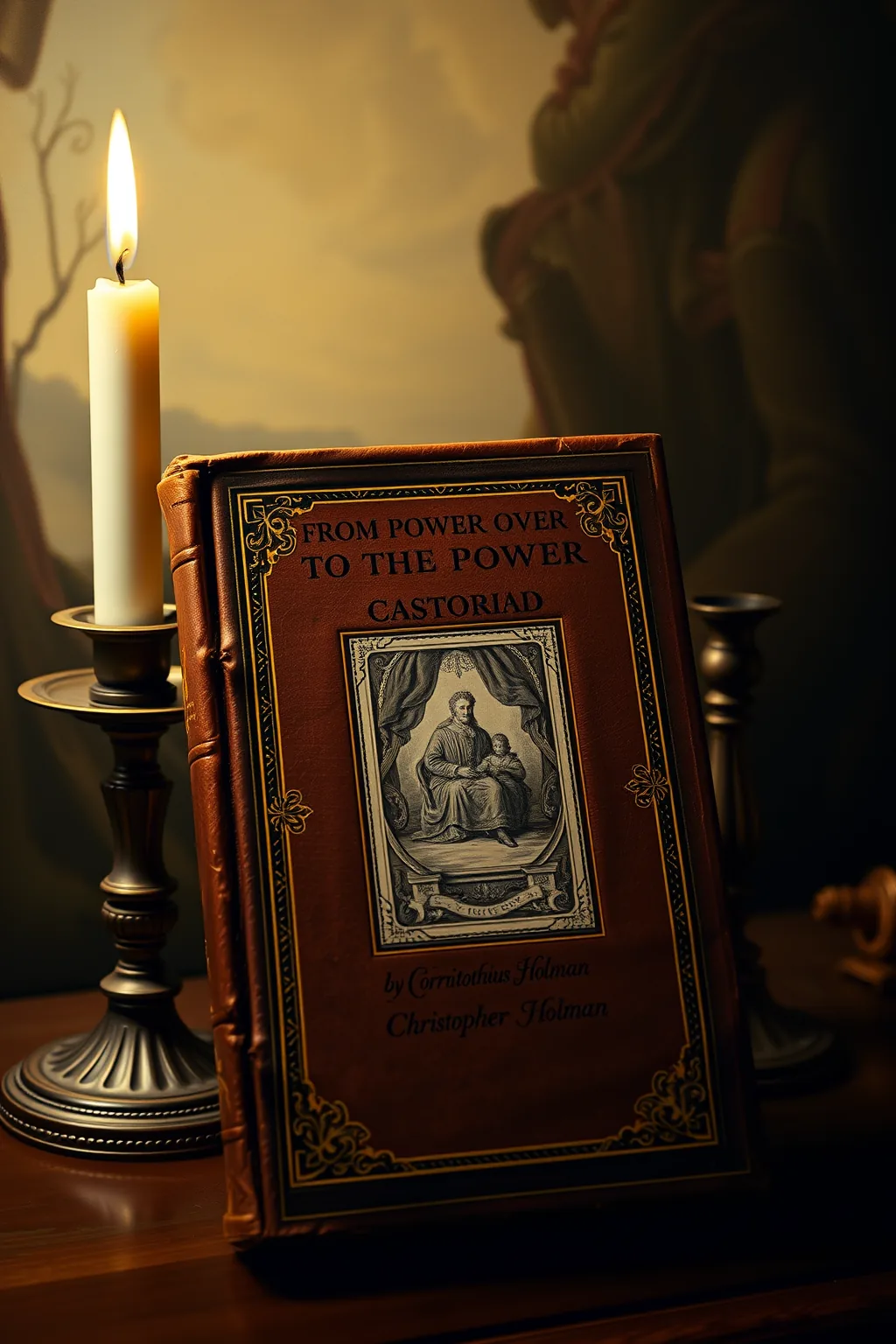
Christopher Holman's 2023 book examines Cornelius Castoriadis's ideas on democratic creation through the lens of Hollywood.
In "From Power Over Creation to the Power of Creation," Christopher Holman analyzes the philosophy of Cornelius Castoriadis, focusing on his theories of autonomous societal self-creation. Holman applies these concepts to contemporary culture, using Hollywood as a primary example of how mass-produced entertainment can reflect or obscure a society's generative capacity. The book questions whether modern societies, exemplified by the film industry's manufactured narratives, have lost touch with their ability to create authentic meaning and social forms.
Holman argues that Castoriadis's work offers a framework for understanding how societies establish their own laws, institutions, and significations. He contrasts the idea of power *over* creation, which implies external control or predetermined structures, with the power *of* creation, which emphasizes the radical, ongoing capacity of a society to invent itself. The book suggests that a critical examination of cultural products like films can reveal underlying societal inertia or, conversely, the potential for genuine collective invention and self-determination.
This work engages with traditions that examine the social construction of reality and the hidden mechanisms of cultural production. It draws on philosophical thought that views societal norms and values not as fixed or divinely ordained, but as ongoing human creations. The "esoteric" aspect lies in its focus on the underlying principles of collective imagination and the potential for societal self-transformation, often overlooked in mainstream analyses of culture and power. It positions Castoriadis's critique as a tool for recognizing and potentially altering the symbolic orders that shape human experience.
✍️ Author
Christopher Holman
Here is a list of notable people associated with Bard College in Annandale-on-Hudson, New York. It includes graduates, attendees, and faculty of the college. == Alumni == === Arts === ==== Dance ==== Arthur Aviles, dancer and choreographer ==== Film…
💡 Why Read This Book?
Uncover the hidden levers of cultural control and reclaim your innate creative power. This work offers a profound lens through which to examine mass media's influence and the philosophy of autonomous self-creation. Ideal for seekers of truth, scholars of esoteric thought, and practitioners dedicated to manifesting genuine societal transformation.
⭐ Reader Reviews
Honest opinions from readers who have explored this book.
❓ Frequently Asked Questions
What is the core philosophical idea of Cornelius Castoriadis explored in this book?
The book centers on Castoriadis's concept of radical autonomy and the social-historical creation of meaning and institutions, emphasizing humanity's capacity for self-creation rather than being determined by external forces or pre-existing structures.
How does Hollywood serve as a case study in this analysis?
Hollywood is presented as a prime example of capitalist institutions producing mass culture, which can paradoxically disempower individuals and hinder authentic creative expression, contrasting with Castoriadis's ideal of democratic cultural creation.
What is the distinction between 'Power Over Creation' and 'The Power of Creation'?
'Power Over Creation' refers to external control and domination, often seen in institutionalized systems. 'The Power of Creation' signifies authentic, autonomous self-generation and the generative capacity inherent in human society.
What esoteric or mystical elements are present in this work?
The work delves into the mystical underpinnings of societal creation, the symbolic language of mass culture, and the hidden potential for spiritual liberation through autonomous cultural acts, framing creation as a sacred, transformative process.
Who is the intended audience for this book?
This book is for readers interested in critical theory, radical democracy, philosophy of culture, esoteric studies, and those seeking to understand the interplay between power, creation, and societal transformation.
🔮 Key Themes & Symbolism
Radical Autonomy and Self-Creation
This theme unravels Castoriadis's foundational idea that societies are not governed by predetermined laws or essences, but are instead self-creating entities that establish their own meanings, values, and institutions. It explores the profound implication of this for individual and collective freedom, highlighting the inherent potential within humanity to shape its own destiny and to move beyond imposed structures towards genuine self-governance.
The Alchemy of Mass Culture
Here, the analysis turns to the symbolic range of mass culture, particularly exemplified by Hollywood. This section investigates how industrially produced narratives and aesthetics can act as a form of societal alchemy, transforming potent creative energies into passive consumption. It explores the hidden mechanisms by which such culture can foster a sense of powerlessness and illusion, masking the deeper wellsprings of individual and collective generative power.
Democratic Cultural Genesis
This theme posits a vision of cultural creation rooted in democratic principles and authentic human expression. It contrasts the generative, evolving nature of a truly autonomous culture with the static, controlled output of capitalist enterprises. The discussion illuminates the conditions necessary for a society to engage in its own continuous, self-determined cultural evolution, fostering a wide range of meaning and shared reality.
💬 Memorable Quotes
Direct passages from the work, attributed to the author.
“The spectacle is the opiate of the masses.”
— Echoing critical theorists, this highlights how mass-produced cultural narratives can lull individuals into a state of passive acceptance, obscuring deeper truths and hindering genuine engagement with reality.
“Autonomy is the radical freedom to create oneself.”
— This emphasizes the core tenet of Castoriadis's philosophy: that true freedom lies not in a lack of constraint, but in the active, ongoing capacity of individuals and societies to define their own essence and direction.
“Hollywood crafts dreams, but rarely unleashes true potential.”
— This poignant observation critiques the superficiality of mass-produced entertainment, suggesting it offers fleeting illusions rather than facilitating the profound, transformative power of authentic human creativity.
“To create is to defy the abyss of the void.”
— This philosophical statement imbues the act of creation with a profound existential significance, positioning it as humanity's fundamental response to the inherent uncertainty and meaninglessness of existence.
💡 Key Ideas
Editorial paraphrase of the work's core concepts — not direct quotes.
Being is not a given, but a perpetual creation.
This quote expresses the dynamic, ever-evolving nature of existence as envisioned by Castoriadis, suggesting that reality is not static but is continuously brought into being through the act of creation itself.
🌙 Esoteric Significance
Tradition
This work draws from traditions that emphasize the power of human consciousness and collective will to shape reality, akin to concepts found in Gnosticism (the Demiurge vs. true creation), Hermeticism (as above, so below; the power of thought), and certain strands of philosophical idealism. It speaks to an inner alchemy, transforming passive reception into active generative force.
Symbolism
Hollywood, in this context, becomes a potent symbol of manufactured reality, its glittering facade masking the underlying mechanisms of control. The 'power of creation' itself is the ultimate symbol of divine spark within humanity, the capacity for self-transcendence and the ongoing, sacred act of bringing forth new forms of being and meaning from the potentiality of existence.
Modern Relevance
In an age saturated with digital media and algorithmic culture, Castoriadis's critique of mass-produced narratives and his call for autonomous creation are more vital than ever. The text offers a framework for discerning authentic expression from manufactured consent, empowering individuals to recognize and harness their own creative potential amidst the overwhelming noise of contemporary society.
👥 Who Should Read This Book
This book is a profound resource for the Intellectual Alchemist, seeking to transmute base societal structures into forms of genuine liberation. The Philosophical Seeker will find here a deep exploration of autonomy and the genesis of meaning. Scholars of Critical Theory and Cultural Studies will appreciate the rigorous application of Castoriadis's thought. Practitioners of conscious creation and societal transformation will discover potent insights into reclaiming our collective power from the grip of external control.
📜 Historical Context
Emerging from the post-war intellectual milieu, Cornelius Castoriadis developed his theories in dialogue with existentialism, Marxism, and psychoanalysis, offering a radical critique of Soviet bureaucracy and Western capitalist societies. The latter half of the 20th century was marked by increasing globalization, the rise of mass media, and a growing awareness of the power of cultural narratives to shape consciousness. Castoriadis's work, particularly his focus on autonomy and the social-historical creation of meaning, resonated with counter-cultural movements and critical theorists grappling with questions of power, alienation, and the potential for liberation. His ideas provide a crucial framework for understanding contemporary cultural phenomena, including the pervasive influence of industries like Hollywood, within a broader philosophical and political context.
📔 Journal Prompts
Reflect on a piece of mass media that has influenced your perception of reality. How does it align with or diverge from Castoriadis's concept of 'power over creation'?
In what ways can your own daily life be seen as an act of 'democratic cultural creation'?
Consider the symbolic language of your favorite films or cultural artifacts. What deeper meanings or hidden messages do they convey?
How can you actively cultivate your 'power of creation' in your personal and professional life?
What are the most significant societal 'givens' you perceive, and how might they be re-imagined or transformed through collective autonomous action?
🗂️ Glossary
Autonomy
The capacity of an individual or society to govern itself, to create its own laws and meanings, and to act independently of external determination or imposed structures.
Social-Historical Being
The concept that human existence and societal structures are not predetermined but are continuously shaped and created through collective human action and historical processes.
Mass Culture
Cultural products and practices that are standardized, commodified, and disseminated on a large scale, often by capitalist institutions, with the potential to homogenize thought and experience.
Creation (Social-Historical)
The ongoing process by which societies invent their own institutions, meanings, values, and forms of life, rather than inheriting them as fixed entities.
Spectacle
In this context, refers to the pervasive presence of mediated images and representations that can dominate social life and obscure direct experience or critical engagement.
This book appears in 2 collections
🔮 Readers Also Liked
Browse all →






From the “Occultism” Collection
View all →



More Free Occult Philosophy Books
View all →