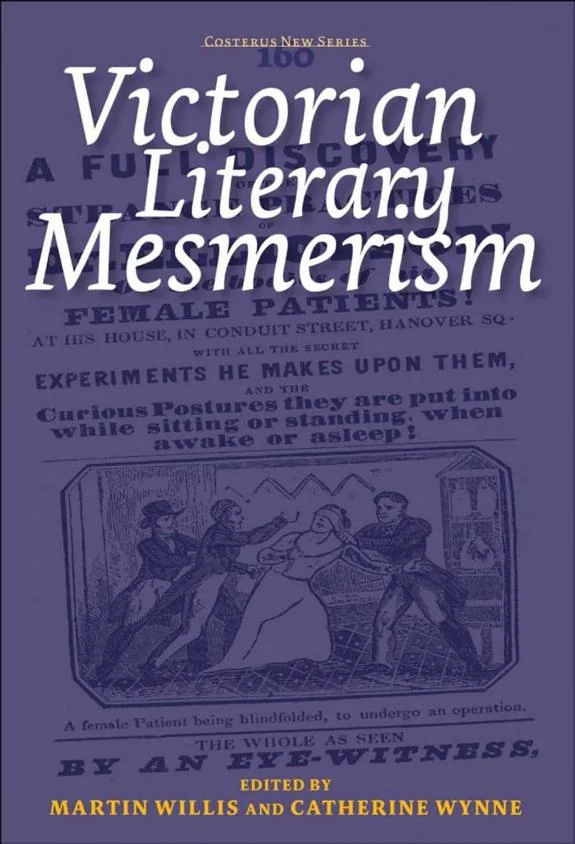
Victorian Literary Mesmerism
 73
73

Victorian Literary Mesmerism
Martin Willis and Catherine Wynne's *Victorian Literary Mesmerism* offers a robust exploration into a fascinating, often overlooked, facet of 19th-century culture. The collection excels in its interdisciplinary approach, skillfully bridging literary analysis with the history of science and occultism. A particular strength lies in the nuanced readings of canonical authors, revealing how deeply mesmeric concepts were embedded in their narratives. For instance, the essay on Arthur Conan Doyle's use of 'magnetic' ideas at the fin de siècle provides a sharp counterpoint to common interpretations of his work.
However, the sheer breadth of the collection, while ambitious, occasionally leads to a sense of fragmentation. Some essays feel more like introductions to a topic than deeply developed arguments, leaving the reader wishing for more sustained engagement. Despite this minor limitation, the volume remains a valuable resource for understanding the cultural work performed by mesmeric discourse. It demonstrates that these 'occult' ideas were not peripheral but central to the Victorian imagination.
📝 Description
73
Victorian Literary Mesmerism gathers eleven essays on mesmerism's impact on 19th-century writing.
This collection examines how mesmerism, a late 18th-century practice, shaped British literature during the Victorian era. The essays go beyond surface-level connections, detailing the complex relationship between quasi-scientific theories of mesmerism and their appearance in fiction and poetry. The book traces the development of mesmeric ideas from Romanticism to the fin de siècle.
It is suited for academics and students of Victorian literature, the history of science, and occult studies. Readers interested in how pseudoscientific movements affected culture and art, and how authors used, changed, or criticized these ideas, will find value here. The volume includes specific analyses of authors such as George Eliot, Elizabeth Gaskell, and Arthur Conan Doyle, placing literary mesmerism within the 19th century's wide interest in psychic phenomena, spiritualism, and alternative medicine.
Mesmerism, originating with Franz Mesmer in the late 1700s, became a significant cultural and intellectual force in the 19th century. This period saw widespread fascination with psychic phenomena, spiritualism, and unconventional healing methods. The practice's influence extended beyond scientific circles into popular culture and artistic expression. This book revisits that legacy, demonstrating how mesmeric concepts deeply permeated the literary consciousness of the Victorian age, appearing even in the works of prominent writers like Charles Dickens.
💡 Why Read This Book?
• Gain specific insights into how mesmerism influenced authors like George Eliot and Elizabeth Gaskell, understanding its direct impact on narrative structure and character development in their 19th-century works. • Explore the evolution of concepts like animal magnetism and psychic influence, tracing their transition from quasi-scientific theories to literary devices by the fin de siècle. • Understand Arthur Conan Doyle's engagement with 'magnetic' ideas, offering a fresh perspective on his contributions beyond Sherlock Holmes.
⭐ Reader Reviews
Honest opinions from readers who have explored this book.
❓ Frequently Asked Questions
What is Victorian Literary Mesmerism about?
This book explores the connections between mesmerism, a popular 19th-century practice involving hypnotic suggestion, and literature of the Victorian era. It examines how authors incorporated ideas of animal magnetism and psychic influence into their stories.
Which authors are discussed in Victorian Literary Mesmerism?
The collection features essays on prominent Victorian authors including George Eliot, Elizabeth Gaskell, and Arthur Conan Doyle, analyzing their engagement with mesmeric themes.
When was Victorian Literary Mesmerism first published?
The book *Victorian Literary Mesmerism*, edited by Martin Willis and Catherine Wynne, was first published in 2006.
What is mesmerism?
Mesmerism, also known as animal magnetism, was a practice popularized in the late 18th century by Franz Mesmer. It involved using suggestion and touch to induce a trance-like state, believed to have healing properties.
How did mesmerism influence Victorian literature?
Mesmerism influenced Victorian literature by providing authors with new narrative devices, character archetypes, and thematic material related to consciousness, influence, and the supernatural, as explored in the book.
Is this book suitable for beginners in occult studies?
While academic in tone, the book provides historical context for mesmerism's influence, making it accessible to those interested in the intersection of occult ideas and 19th-century culture, even without prior deep knowledge.
🔮 Key Themes & Symbolism
Mesmerism and Narrative Form
This theme examines how the concepts and practices of mesmerism, including animal magnetism and psychic suggestion, were not merely thematic elements but actively shaped the narrative structures and plot devices in Victorian literature. The essays demonstrate how authors used mesmeric tropes to explore altered states of consciousness, hidden influences between characters, and the uncanny, often blurring the lines between psychological realism and supernatural phenomena. It highlights how these quasi-scientific ideas provided a framework for understanding human interaction and the hidden forces at play in society.
The Literary Construction of Influence
The collection examines how Victorian writers used literary representations of mesmerism to explore the nature of influence itself – social, psychological, and even political. It investigates how characters' minds could be manipulated or guided, reflecting anxieties about power dynamics and autonomy in an era of rapid social change. The essays analyze how authors like George Eliot and Elizabeth Gaskell depicted these influences, often critiquing or reinterpreting the popular understanding of mesmeric control.
Fin de Siècle Magnetic Ideas
This theme focuses on the late Victorian period, where mesmeric ideas underwent a transformation, often merging with spiritualism, the occult revival, and emerging psychological theories. The essays explore how authors like Arthur Conan Doyle engaged with these 'magnetic' concepts, adapting them for detective fiction and supernatural tales. It highlights the enduring legacy of mesmerism in shaping popular notions of the mind, telepathy, and hidden energies at the close of the 19th century.
Genre and Mesmeric Tropes
The essays in this collection illustrate how mesmeric themes transcended specific literary genres, appearing in gothic novels, social realism, and early detective fiction. This section explores how the language and imagery of mesmerism provided a flexible toolkit for authors to explore psychological depth, mystery, and the limits of empirical knowledge. It underscores the broad cultural penetration of mesmeric ideas, influencing how stories were told across the literary spectrum.
💬 Memorable Quotes
Direct passages from the work, attributed to the author.
“The collection examines the impact of literature on quasi-scientific writings of the early 1800s.”
— This highlights a crucial aspect of the book: its bidirectional approach. It doesn't just see literature as a passive recipient of scientific ideas, but actively shows how literary forms and narratives might have influenced the very development and popularization of mesmeric theories.
“Essays on George Eliot and Elizabeth Gaskell sit alongside considerations of Arthur Conan Doyle's use of ‘magnetic' ideas.”
— This points to the interdisciplinary and chronological breadth of the collection. It demonstrates a commitment to examining mesmeric themes not just in one specific author or period, but across different literary styles and eras within the Victorian age.
“The scope is complex and ambitious, leaping across generic, disciplinary, and cultural boundaries.”
— This emphasizes the collection's scholarly rigor and its aim to provide a comprehensive overview. It suggests that the book avoids narrow interpretations, instead embracing a wide-ranging analysis of mesmerism's cultural and literary significance.
“The essays explore the intersections between mesmerism and nineteenth-century literature.”
— This is the core thesis of the book. It signals that the focus is not solely on literary works that *mention* mesmerism, but on how the movement's ideas, practices, and cultural reception were intrinsically linked to the literary output of the period.
“The collection offers eleven interdisciplinary essays.”
— This fact underscores the academic nature of the work. The use of multiple authors and perspectives from different fields ensures a complex understanding of literary mesmerism, moving beyond a single viewpoint.
🌙 Esoteric Significance
Tradition
While mesmerism itself is not a formal esoteric tradition like Hermeticism or Theosophy, *Victorian Literary Mesmerism* engages with its roots in pre-modern vitalism and animistic philosophies. It connects to a broader lineage of Western esoteric thought concerned with unseen forces, vital energies (like the Qi or Prana found in Eastern traditions), and the manipulation of consciousness. The work fits within the Hermetic principle of 'As Above, So Below,' by exploring how macrocosmic ideas of hidden universal forces were mirrored in microcosm within the individual human psyche as depicted in literature.
Symbolism
Key symbols explored include the 'magnetic fluid,' representing an unseen, pervasive energy that could be channeled for healing or control, echoing alchemical concepts of prima materia or universal solvent. Somnambulism, or the mesmeric sleep, symbolizes a state of heightened intuition and access to deeper truths, akin to initiatory states in mystery traditions or the Gnostic concept of gnosis. The hypnotist or 'magnetizer' figure represents the intermediary or magician, capable of bridging the conscious and unconscious realms.
Modern Relevance
Contemporary fields such as depth psychology (particularly Jungian analysis), consciousness studies, and even certain branches of performance art and modern occultism draw upon the legacy explored in this book. The fascination with altered states of consciousness, the power of suggestion in therapy and marketing, and the exploration of psychic phenomena continue to resonate. Thinkers and practitioners interested in the history of altered states, the cultural construction of the mind, and the roots of modern hypnosis find this work essential for understanding the Victorian origins of these enduring interests.
👥 Who Should Read This Book
• Students of Victorian Literature seeking to understand the influence of pseudoscientific movements on narrative and character. • Researchers in the History of Science interested in the cultural reception and literary engagement with early theories of psychology and consciousness. • Practitioners and scholars of Western Esotericism interested in the historical development of concepts like animal magnetism, psychic influence, and altered states.
📜 Historical Context
The 19th century was a fertile ground for exploring the boundaries of consciousness and the human mind, fueled by the rise of mesmerism and later spiritualism. Franz Mesmer’s theories of animal magnetism, originating in the late 18th century, gained significant traction, influencing both scientific circles and popular culture. By the Victorian era, mesmerism had permeated literature, offering new frameworks for understanding psychological states, social control, and the uncanny. This collection arrives in a landscape where figures like Ada Lovelace were already contemplating the potential of analytical engines, showcasing a broader Victorian fascination with complex systems and hidden forces. The reception of mesmeric ideas was varied, often met with skepticism from established science but embraced by those seeking alternative explanations for phenomena. Authors like Charles Dickens, though not a direct subject here, also touched upon similar themes of influence and mesmerism in their works, indicating its widespread cultural resonance.
📔 Journal Prompts
The concept of 'animal magnetism' as depicted by authors like Arthur Conan Doyle.
Literary representations of somnambulism and their relation to consciousness.
The influence of mesmeric ideas on character development in George Eliot's novels.
The cultural impact of mesmerism on Victorian society as reflected in literature.
How literary engagement with mesmerism evolved from the early 1800s to the fin de siècle.
🗂️ Glossary
Mesmerism
A practice popularized by Franz Mesmer in the late 18th century, involving the use of suggestion and touch to induce a trance-like state, often referred to as 'animal magnetism,' believed to have therapeutic effects.
Animal Magnetism
The theoretical fluid or force proposed by Franz Mesmer, believed to be transferable between individuals, particularly from a mesmerist to a patient, to influence health and consciousness.
Somnambulism
A state of sleepwalking or trance achieved during a mesmeric session, characterized by heightened sensitivity, clairvoyance, or responsiveness to the mesmerist's commands.
Psychic Influence
The idea that one person's mind or will could affect another's, often explored in mesmeric literature as a form of subtle, unseen control or connection between individuals.
Fin de Siècle
Literally 'end of the century,' referring to the cultural, artistic, and intellectual climate of the final decade of the 19th century, often associated with decadence, spiritualism, and aestheticism.
Quasi-scientific
Appearing to be scientific but lacking rigorous methodology, empirical evidence, or acceptance by the mainstream scientific community; often used to describe early theories of mesmerism.
Vitalism
The doctrine that living organisms are fundamentally different from non-living entities because they contain some non-physical element or are governed by different principles than inanimate things, often related to a 'life force' or vital energy.
This book appears in 1 collection
🔮 Readers Also Liked
Browse all →








From the “Mesmerism” Collection
View all →


More Free Occult Philosophy Books
View all →