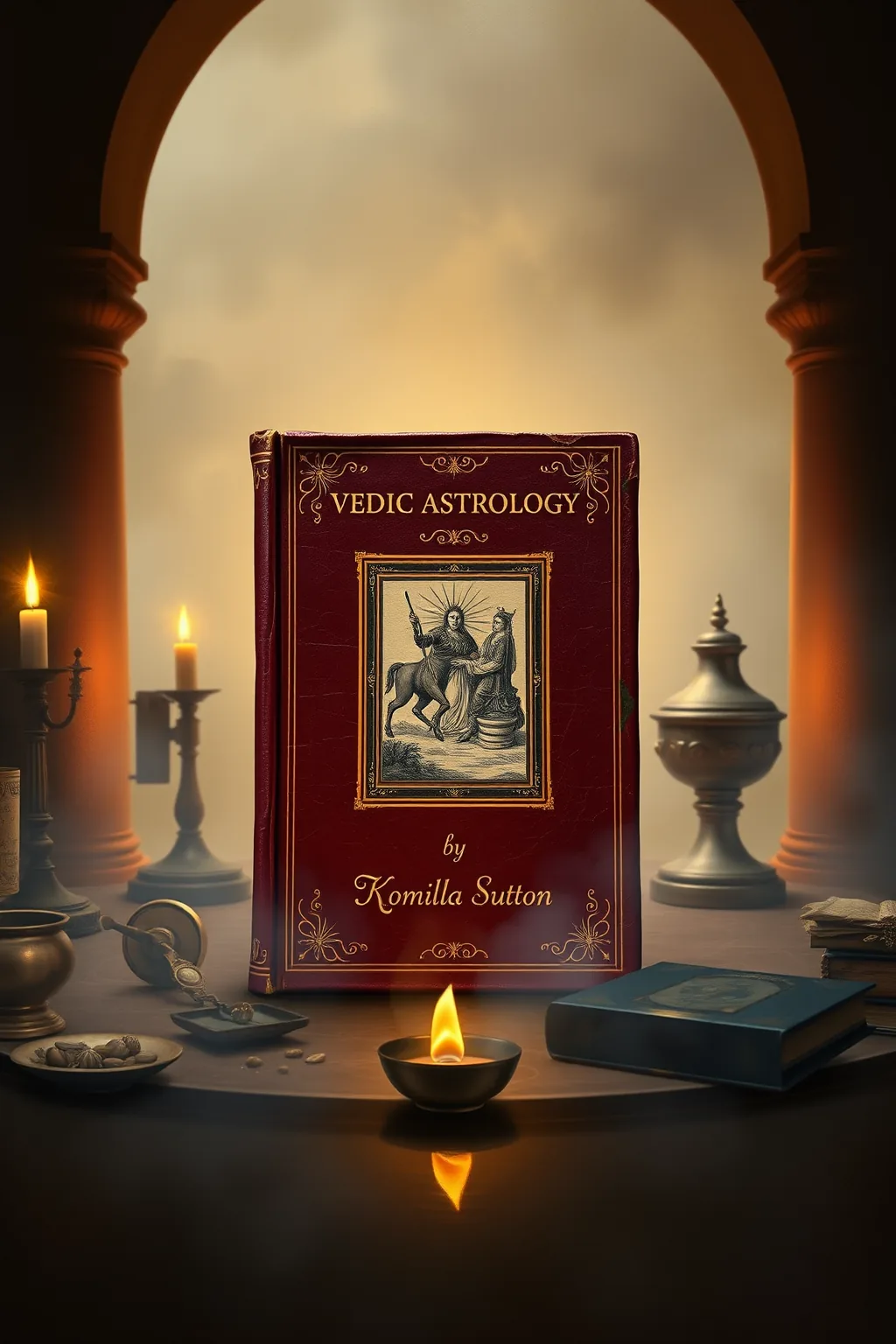
Vedic Astrology
 72
72

Vedic Astrology
Komilla Sutton's Vedic Astrology provides a clear, structured entry point into Jyotish. Its strength lies in its methodical presentation of foundational concepts, moving logically from the planets and signs to the more intricate Nakshatras and divisional charts. The initial chapters, particularly those explaining the Grahas and Rashis, are exceptionally well-handled for newcomers. However, the book occasionally feels more like a technical manual than a philosophical exploration. While it explains *how* to read a chart, it sometimes lacks deeper engagement with the *why* behind the Vedic worldview. A notable passage is the detailed explanation of the Nakshatras, which are presented with their deities and symbolic meanings, offering a glimpse into their rich mythological underpinnings. Despite this, a more robust discussion on the ethical considerations or the philosophical underpinnings of Jyotish would have elevated its standing. Sutton's work is a solid, practical guide for learning the mechanics of Vedic astrology.
📝 Description
72
Komilla Sutton's Vedic Astrology, published in 2000, introduces the Indian system of Jyotish.
This book presents Jyotish, the traditional Indian system of astrology, moving beyond simple sun-sign readings. It provides a structured way to understand how celestial bodies influence human lives. Sutton guides readers from basic principles to interpreting complex birth charts. The work is suitable for students of esoteric studies, especially those interested in comparative astrology or Eastern spiritual frameworks. It is also useful for individuals with no prior knowledge of Jyotish, as well as experienced Western astrologers seeking a different viewpoint.
Jyotish's origins span millennia. Sutton's 2000 publication appeared as global interest in Eastern philosophies grew. It offered an accessible English-language resource for a system often seen as difficult and culturally specific. The book met a growing demand for alternatives or supplements to Western astrology, which had gained popularity through figures like Dane Rudhyar.
The book covers essential Jyotish concepts like the zodiacal signs (rashis) and planetary rulers (grahas). It explains the birth chart (kundali), highlighting the ascendant (lagna) and the Moon's placement. Readers will learn about planetary strengths, aspects (drishti), and divisional charts (vargas) for specific life areas. The interaction of these elements forms the basis for astrological interpretation within the Jyotish system.
Vedic Astrology, or Jyotish, is an ancient system of divination originating in India, deeply intertwined with Vedic cosmology and philosophy. It is considered one of the Vedangas, or limbs of the Vedas, providing insights into karma and destiny through celestial patterns. Unlike Western astrology, which primarily uses the tropical zodiac, Jyotish employs the sidereal zodiac, aligning with fixed stars. Its complex system of planetary periods (dashas) and lunar mansions (nakshatras) allows for detailed predictive analysis and understanding of life's unfolding.
💡 Why Read This Book?
• Learn the fundamental principles of Jyotish, including the unique Vedic zodiac and the significance of the Nakshatras, offering a distinct astrological perspective unavailable in purely Western systems. • Understand the structure and interpretation of the Vedic birth chart (kundali), focusing on the Ascendant (Lagna) and planetary positions, providing a framework for personal analysis. • Gain insight into the concept of planetary periods (dashas), a predictive technique central to Vedic astrology, enabling a more nuanced understanding of life's timing and cycles.
⭐ Reader Reviews
Honest opinions from readers who have explored this book.
❓ Frequently Asked Questions
What is the primary difference between Vedic astrology and Western astrology?
Vedic astrology (Jyotish) uses a sidereal zodiac, which aligns with the fixed stars, while Western astrology typically uses a tropical zodiac, based on the seasons. This difference in zodiacal calculation leads to distinct chart interpretations and planetary positions.
What are the 'Grahas' in Vedic astrology?
The Grahas are the nine celestial bodies considered significant in Vedic astrology: the Sun, Moon, Mars, Mercury, Jupiter, Venus, Saturn, and the two lunar nodes, Rahu and Ketu. They are seen as active forces influencing destiny.
How are the Nakshatras different from zodiacal signs?
The Nakshatras, or lunar mansions, are 27 divisions of the ecliptic, each spanning 13 degrees and 20 minutes. While zodiacal signs cover 30 degrees, Nakshatras offer a more detailed layer of interpretation based on lunar influence and mythology.
When was Komilla Sutton's Vedic Astrology first published?
Komilla Sutton's 'Vedic Astrology' was first published in the year 2000, making it a relatively modern yet comprehensive introduction to the ancient practice.
Is this book suitable for someone completely new to astrology?
Yes, the book is designed as an introductory text. It systematically explains core concepts like the planets (Grahas), signs (Rashis), and the birth chart (Kundali) for beginners.
What is the significance of the Ascendant (Lagna) in a Vedic chart?
The Ascendant, or Lagna, represents the sign rising on the eastern horizon at the moment of birth. It is considered the most crucial point in the Vedic chart, defining the self, physical appearance, and overall life direction.
🔮 Key Themes & Symbolism
Planetary Influences (Grahas)
The work meticulously details the nine Grahas, the celestial bodies central to Jyotish. Each planet is presented not just as an astronomical entity but as a potent force with specific characteristics, rulerships, and psychological influences. Sutton explains how the Grahas interact within the birth chart, their strengths and weaknesses (dignities), and their manifestation through the planetary periods known as Dashas. This systematic approach allows readers to understand the dynamic interplay of these cosmic energies shaping individual destinies and life events.
Zodiacal Divisions (Rashis & Nakshatras)
Central to Vedic Astrology is the distinction between the 12 Rashis (zodiacal signs) and the 27 Nakshatras (lunar mansions). The book elucidates how these two systems, while related, offer different layers of interpretive depth. The Rashis provide the broad archetypal energies, while the Nakshatras, with their specific deities and symbolism, offer finer nuances to understanding planetary placements and the lunar cycle's impact on the psyche. This dual framework is crucial for accurate Jyotish readings.
The Birth Chart (Kundali)
Sutton provides a thorough grounding in the construction and interpretation of the Vedic birth chart, or Kundali. Emphasis is placed on the Ascendant (Lagna) as the primary point of self-definition and the Moon's position as representing the mind and emotions. The book systematically explains how to analyze the houses (bhavas), planetary aspects (drishti), and yogas (planetary combinations) within the Kundali, presenting it as a unique blueprint of an individual's karmic predispositions and potential life trajectory.
Predictive Techniques (Dashas)
A significant component of Vedic Astrology involves predictive methods, primarily the Dasha systems. Sutton introduces readers to the Vimshottari Dasha, the most commonly used system, which allocates specific periods of planetary rulership throughout a lifetime. Understanding Dashas is presented as key to timing events and recognizing cycles of influence, offering a structured approach to forecasting potential challenges and opportunities based on the birth chart's configuration.
💬 Memorable Quotes
Direct passages from the work, attributed to the author.
“The Ascendant, or Lagna, is the most important point in the chart, representing the self.”
— This highlights the foundational role of the rising sign in Vedic astrology, framing it as the core identity and physical manifestation of the individual, dictating the house placements for all other planets.
“Each Nakshatra has a ruling deity and specific symbolism.”
— This points to the intricate, mythological layer of Vedic astrology, suggesting that the 27 lunar mansions are not just divisions of space but conduits for divine energies with unique characteristics.
“Planetary periods, or Dashas, reveal the timing of events.”
— This emphasizes the practical, predictive power of Vedic astrology, specifically the Dasha systems, which are presented as essential tools for understanding when specific karmic influences are likely to manifest in a person's life.
“The Moon represents the mind and emotions in the horoscope.”
— This interpretation underscores the emotional and psychological significance attributed to the Moon in Jyotish, linking its placement and condition to an individual's inner world and intuitive faculties.
“Divisional charts (Vargas) provide deeper analysis of specific life areas.”
— This indicates the layered complexity of Vedic chart interpretation, where additional charts derived from the main birth chart offer specialized insights into domains like career, family, or spirituality.
🌙 Esoteric Significance
Tradition
Vedic Astrology, or Jyotish, is a pillar of the Vedic tradition, deeply intertwined with Hindu philosophy, cosmology, and concepts of karma and dharma. It is considered a Vedanga, one of the 'limbs' of the Vedas, intended to aid in understanding and aligning with cosmic order. Sutton's work fits within this lineage by presenting the technical framework of Jyotish, adhering to its classical principles while making them accessible. It departs from purely materialistic interpretations by emphasizing the subtle energies and spiritual implications inherent in celestial patterns, aligning with the broader esoteric goal of self-understanding and spiritual evolution.
Symbolism
Key symbols in Vedic astrology include the planets (Grahas), often depicted with specific colors, forms, and associated deities reflecting their energetic qualities. The Nakshatras, or lunar mansions, are rich with symbolism derived from Hindu mythology, such as the 'divine seed' represented by Ashwini or the 'wealth' associated with Krittika. The Kundali (birth chart) itself is a symbolic map of the cosmos at the moment of birth, with houses representing different spheres of life and their rulers indicating the forces at play.
Modern Relevance
Contemporary practitioners of Vedic astrology, including many modern astrologers and spiritual counselors, draw directly from foundational texts like Sutton's. The work remains relevant for individuals seeking a more deterministic or karma-focused astrological system compared to the psychological focus often found in Western astrology. Furthermore, its structured approach appeals to academics and students of comparative religion exploring diverse divination systems. The emphasis on planetary periods (Dashas) continues to be a vital tool for predictive astrology across various traditions.
👥 Who Should Read This Book
• Students of comparative astrology seeking to understand the differences and similarities between Western and Vedic systems, gaining a broader perspective on astrological interpretation. • Individuals interested in Eastern spiritual traditions and philosophy who wish to explore how celestial mechanics are understood within a karmic framework. • Aspiring astrologers looking for a clear, step-by-step guide to the technical foundations of Jyotish, including chart calculation and basic interpretation principles.
📜 Historical Context
Komilla Sutton's 'Vedic Astrology' emerged in 2000, a period marked by a burgeoning interest in Eastern spiritual traditions and esoteric knowledge within Western audiences. The late 20th century saw a significant increase in the availability of translated texts and Western interpretations of Hindu philosophy and practices. Jyotish, with its ancient roots dating back to Vedic civilization, presented a sophisticated system distinct from the more widely popularized Western astrological frameworks. While figures like B.V. Raman had been instrumental in introducing Jyotish to the West decades earlier, Sutton's work offered a more contemporary and structured pedagogical approach. It catered to a growing readership seeking alternative or complementary systems to the tropical astrology prevalent in Europe and North America, engaging with the intellectual currents of comparative religion and cross-cultural spirituality that characterized the era.
📔 Journal Prompts
The Ascendant's role in defining the self.
The relationship between a planet's dignity and its expression.
Reflecting on the symbolism of the Nakshatra ruling your Moon.
How planetary periods (Dashas) might correlate with life phases.
The significance of the 7th house for relationships within the Kundali.
🗂️ Glossary
Jyotish
The traditional Indian system of astrology, often translated as 'science of light.' It is a complex system used for understanding cosmic influences on human life and destiny.
Graha
Literally 'seizer' or 'planet' in Vedic astrology. Refers to the nine celestial bodies (Sun, Moon, Mars, Mercury, Jupiter, Venus, Saturn, Rahu, Ketu) considered to exert significant influence.
Rashi
The 12 zodiacal signs used in Vedic astrology, similar in name but calculated differently (sidereal) than in Western astrology. Each Rashi spans 30 degrees.
Nakshatra
Lunar mansions; 27 divisions of the ecliptic, each spanning 13 degrees and 20 minutes. They offer a more detailed layer of astrological interpretation, particularly concerning the Moon's placement.
Lagna
The Ascendant; the zodiacal sign rising on the eastern horizon at the precise moment and location of birth. It is considered the most important point in the birth chart.
Dasha
A system of planetary periods used in Vedic astrology to predict the timing of events and the unfolding of karmic influences throughout a lifetime. Vimshottari Dasha is the most common.
Kundali
The Vedic birth chart, a diagram representing the positions of the planets and houses at the time of an individual's birth, used for astrological interpretation and prediction.
🔮 Readers Also Liked
Browse all →






More by Komilla Sutton
All books →



More Free Astrology & Cosmology Books
View all →