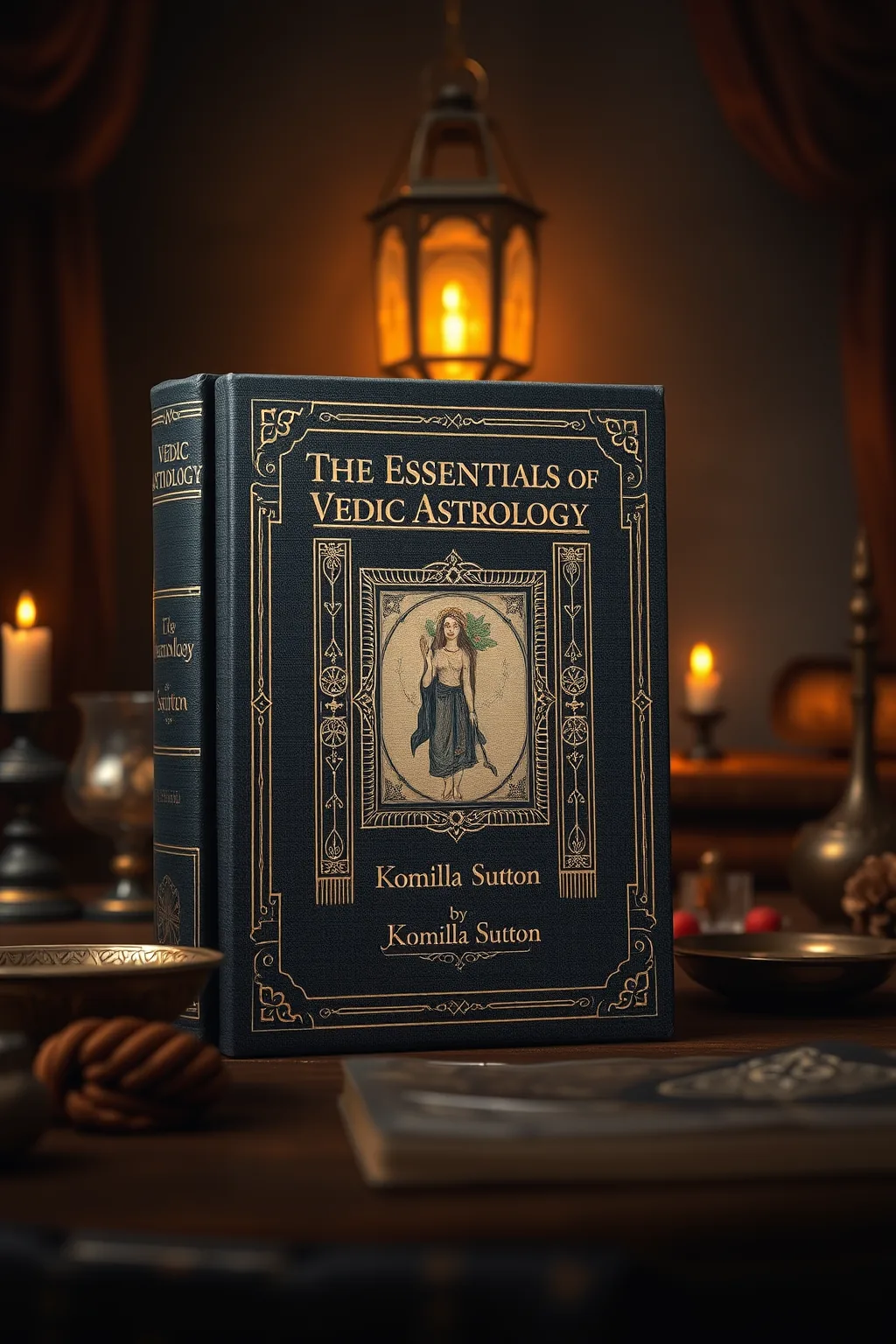
The Essentials of Vedic Astrology
 81
81

The Essentials of Vedic Astrology
Komilla Sutton’s *The Essentials of Vedic Astrology* functions as a competent primer on Jyotish, a system often perceived as more intricate than its Western cousin. Sutton’s strength lies in her clarity, particularly when explaining the Nakshatras, the 27 lunar mansions that form a crucial layer of interpretation in Vedic charts. Her explanation of the Vimshottari Dasha system, a predictive technique based on planetary periods, is especially well-articulated for a beginner’s text. A limitation, however, is the book’s tendency to present the information in a somewhat dry, encyclopedic manner. While factual, it occasionally lacks the evocative language that might draw a reader deeply into the mystical dimensions often associated with Vedic traditions. For instance, the discussion of planetary dignities is precise but could benefit from more illustrative examples of how these manifest in a life. Nevertheless, for practitioners seeking a solid, fact-based introduction to the mechanics of Vedic astrology, Sutton provides a reliable foundation.
📝 Description
81
Komilla Sutton's The Essentials of Vedic Astrology introduces Jyotish, an ancient Indian astrological system.
This book explains the core principles of Jyotish, the Indian system of astrology, contrasting it with Western methods. Sutton details the specific zodiacal divisions, planetary influences, and house systems used in Vedic astrology. The text aims to make this complex spiritual science accessible, serving as a guide for those new to Jyotish and for Western astrologers seeking to broaden their understanding.
It is structured for both complete beginners curious about a different astrological paradigm and for experienced Western astrologers considering a move into Vedic techniques. The instruction provides the necessary conceptual framework for newcomers while also offering comparative insights for those already familiar with astrological concepts. The goal is to provide a clear entry point into the Jyotish system.
Jyotish, or Vedic astrology, emerged from the Vedic period of India and is one of the oldest known systems of divination. Its roots are connected to the Vedas, ancient Sanskrit texts that include rituals and philosophical insights. Unlike Western astrology, which has Hellenistic origins, Vedic astrology developed separately. It has maintained a strong link to spiritual practices and the concept of karma. This tradition continues to endure as a method for cosmic interpretation.
💡 Why Read This Book?
• Gain a foundational understanding of the sidereal zodiac, a key differentiator from the tropical system, enabling you to construct and interpret charts with a distinctly Vedic orientation. • Learn about the Nakshatras, the 27 lunar mansions, and their unique symbolic meanings, offering a more nuanced layer of astrological interpretation than typically found in Western texts. • Grasp the basics of the Dasha system, specifically the Vimshottari Dasha, a sophisticated predictive tool for understanding planetary periods and their influence on life events, as detailed in Chapter 7.
⭐ Reader Reviews
Honest opinions from readers who have explored this book.
❓ Frequently Asked Questions
What is the primary difference between Vedic astrology and Western astrology?
Vedic astrology, or Jyotish, uses the sidereal zodiac, which aligns with the actual constellations in the sky, while Western astrology primarily uses the tropical zodiac, based on the seasons. This fundamental difference affects planetary placements and interpretations.
Who is Komilla Sutton and what is her background in Vedic astrology?
Komilla Sutton is a globally recognized Vedic astrologer and teacher, known for her accessible approach. She has authored several books on the subject and conducts webinars, making this ancient system understandable to a wide audience.
When was 'The Essentials of Vedic Astrology' first published?
The book 'The Essentials of Vedic Astrology' by Komilla Sutton was first published in June 2021.
Is this book suitable for absolute beginners with no prior astrology knowledge?
Yes, the book is specifically designed to be accessible to beginners. It explains core concepts from the ground up, making it a good starting point for those new to Jyotish or astrology in general.
What are Nakshatras and why are they important in Vedic astrology?
Nakshatras are the 27 lunar mansions that divide the ecliptic in Vedic astrology. They add a significant layer of detail and symbolic meaning to chart interpretation, offering insights beyond the 12 zodiac signs alone.
Does the book cover predictive techniques?
Yes, 'The Essentials of Vedic Astrology' introduces key predictive techniques, most notably the Dasha system, which refers to planetary periods that indicate timing and influence over different phases of life.
🔮 Key Themes & Symbolism
Sidereal vs. Tropical Zodiacs
The work meticulously details the distinction between the sidereal zodiac, which is fixed and aligns with the astronomical constellations, and the tropical zodiac, based on the seasons. Sutton emphasizes that the sidereal framework is fundamental to Vedic astrology (Jyotish), influencing planetary degrees and interpretations. Understanding this divergence is presented as crucial for grasping the unique calculations and predictive capabilities of the Vedic system, moving beyond familiar Western astrological frameworks.
The Nakshatras
A central theme is the exploration of the Nakshatras, the 27 lunar mansions that divide the ecliptic into smaller, more detailed segments than the 12 zodiac signs. Each Nakshatra possesses its own deity, symbolism, and inherent qualities, providing a rich interpretive layer. Sutton guides readers through the characteristics of each Nakshatra, illustrating how they refine the understanding of a planet's placement and influence in a birth chart.
Planetary Periods (Dashas)
The book introduces the concept of Dashas, which are specific time periods ruled by planets. The Vimshottari Dasha system, a prominent method for astrological timing and prediction, is explained in detail. This system maps out the progression of planetary influences throughout a person's life, offering a framework for understanding when particular life events are likely to manifest or when specific energies will be prominent.
Karma and Spiritual Connection
Sutton consistently links astrological interpretation to the concept of karma and spiritual development. The birth chart is presented not merely as a predictive tool but as a map of one's karmic patterns and spiritual lessons. The book suggests that understanding one's astrological configuration can facilitate self-awareness and guide individuals toward fulfilling their spiritual potential within the Hindu philosophical context.
💬 Memorable Quotes
Direct passages from the work, attributed to the author.
“Vedic astrology is intimately linked to spiritual practices.”
— This statement highlights the foundational difference between Jyotish and many Western astrological approaches. It suggests that for Vedic astrologers, the practice is not solely about personality analysis or prediction, but is inherently tied to a spiritual path and understanding.
“The Dasha system offers a method for timing life events.”
— This interpretation conveys the predictive power of Vedic astrology's time cycles. It signifies that the system provides a structured way to understand when specific influences are likely to become active in a person's life, moving beyond static chart analysis.
“The sidereal zodiac aligns with the fixed stars.”
— This essential distinction emphasizes the astronomical basis of the Vedic zodiac. It contrasts with the seasonal basis of the tropical zodiac used in Western astrology, explaining a core technical difference in chart calculation.
“Jyotish provides a map of karmic patterns.”
— This concept underscores the philosophical underpinnings of Vedic astrology. It frames the birth chart as a reflection of past actions (karma) and suggests that astrological study can offer insights into one's destiny and spiritual journey.
💡 Key Ideas
Editorial paraphrase of the work's core concepts — not direct quotes.
The Nakshatras add a layer of depth to planetary interpretation.
This paraphrased concept points to the unique contribution of the 27 lunar mansions in Vedic astrology. It implies that understanding a planet's placement solely by its sign is insufficient; its position within a specific Nakshatra provides crucial, nuanced information.
🌙 Esoteric Significance
Tradition
Vedic astrology, or Jyotish, is intrinsically linked to the Vedic tradition of Hinduism, one of the world's oldest continuously practiced religions. It is considered a 'Vedanga'—a limb or auxiliary discipline of the Vedas—intended to aid in understanding cosmic rhythms and their influence on human life. This connection imbues Jyotish with a deep spiritual purpose, viewing astrological configurations as manifestations of karma and divine order, rather than purely deterministic forces.
Symbolism
Key symbols in Vedic astrology include the Nakshatras (lunar mansions), each with unique animal, deity, and element associations, offering nuanced interpretations of planetary placements. The Navagrahas, the nine celestial bodies (Sun, Moon, Mars, Mercury, Jupiter, Venus, Saturn, Rahu, and Ketu), represent fundamental cosmic forces and karmic influences. The concept of 'Graha Dasha,' or planetary periods, symbolizes the unfolding of karmic destiny over time, with each Dasha marking a distinct phase of influence.
Modern Relevance
Contemporary practitioners and thinkers in fields ranging from comparative religion to consciousness studies often draw upon Vedic astrological principles. Its emphasis on karma, dharma, and spiritual evolution appeals to modern spiritual seekers. Schools and online platforms now offer extensive Jyotish education, mirroring the global interest spurred by authors like Komilla Sutton, who bridge ancient knowledge with contemporary accessibility. It informs practices seeking to align personal life with cosmic cycles for growth.
👥 Who Should Read This Book
• Beginners curious about astrological systems beyond the familiar Western framework, seeking a clear introduction to the foundational principles of Jyotish. • Western astrologers looking to expand their interpretive toolkit by understanding the unique concepts of the sidereal zodiac, Nakshatras, and Dasha systems. • Individuals interested in the intersection of astrology, spirituality, and karma, wishing to explore how ancient Indian cosmology offers a framework for understanding life's patterns.
📜 Historical Context
Emerging from ancient India, Vedic astrology, or Jyotish, is deeply rooted in the Vedic period and its philosophical traditions, predating the Hellenistic developments that shaped Western astrology. Its formalization occurred over centuries, with key texts like the Brihat Parashara Hora Shastra becoming foundational. Unlike its Western counterpart, which saw a significant shift with the advent of psychological astrology in the 20th century, Vedic astrology has largely maintained its spiritual and karmic orientation. While Western astrology was influenced by figures like Ptolemy and later by humanistic psychologists like Dane Rudhyar, Vedic astrology continued to be studied and practiced within its cultural and spiritual milieu. Komilla Sutton's work, published in 2021, arrives in an era where interest in both systems is high, allowing for comparative study and a re-evaluation of astrological traditions in a global context. The book addresses a contemporary audience seeking to understand this ancient science.
📔 Journal Prompts
The Nakshatra placement of your Moon, detailing its associated deity and symbolism.
Your personal experience of a current planetary Dasha period, noting any significant events or feelings.
The difference between your Sun sign in the tropical zodiac and its position in the sidereal zodiac.
The role of karma as presented in the book and its connection to your own life experiences.
The Navagrahas and their perceived influence on your daily life and emotional state.
🗂️ Glossary
Jyotish
The traditional Sanskrit name for Vedic astrology, meaning 'science of light.' It is an ancient system of astrology originating in India, deeply connected to Hindu philosophy and cosmology.
Sidereal Zodiac
An astrological zodiac that uses the actual positions of constellations in the sky. It is fixed and based on astronomical observation, forming the basis for Vedic astrological calculations.
Tropical Zodiac
An astrological zodiac based on the seasons, with the Vernal Equinox (around March 20th) marking 0 degrees of Aries. This is the primary system used in Western astrology.
Nakshatra
One of the 27 lunar mansions or divisions of the ecliptic in Vedic astrology. Each Nakshatra has specific characteristics, deities, and symbolism that refine astrological interpretation.
Dasha System
A system of planetary periods used in Vedic astrology for timing events and understanding the progression of influences throughout a person's life. The Vimshottari Dasha is the most common.
Navagrahas
The 'nine planets' or celestial bodies that are central to Vedic astrological calculations and interpretations. They include the Sun, Moon, Mars, Mercury, Jupiter, Venus, Saturn, and the lunar nodes Rahu and Ketu.
Rahu and Ketu
The lunar nodes, representing the points where the Moon's orbit intersects the ecliptic. In Vedic astrology, they are considered shadowy planets with significant karmic implications.
![[ Stephen Arroyo] Astrology](/img/thumb/stephen-arroyo-astrology.webp)