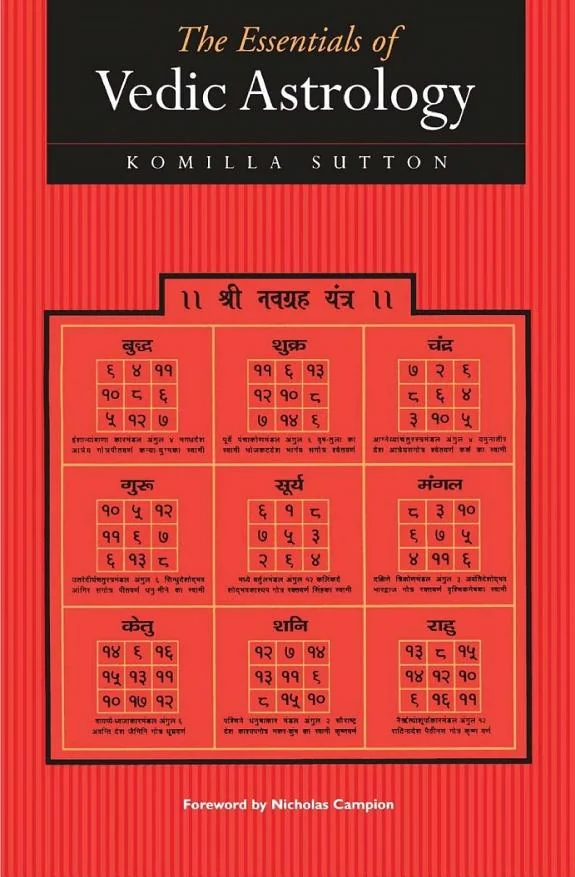
Essentials of Vedic Astrology
 81
81

Essentials of Vedic Astrology
Komilla Sutton’s "Essentials of Vedic Astrology" offers a focused and detailed exposition on the Lunar Nodes, a topic often given cursory treatment. Her strength lies in the systematic breakdown of the Nodes’ influence across signs and houses, linking them directly to spiritual growth. The book’s original publication date, January 20, 1999, situates it as a key text from a period when Vedic astrology was becoming more accessible in the West. A passage discussing the South Node’s manifestation as a sense of lack or spiritual detachment, particularly in certain signs, is particularly insightful. However, for readers entirely new to Jyotish, the density of information might present a steep learning curve, as it assumes some foundational knowledge. The work is a valuable, if demanding, exploration of a crucial astrological axis.
📝 Description
81
Komilla Sutton's 1999 book examines the Lunar Nodes in Vedic astrology.
Komilla Sutton's "Essentials of Vedic Astrology" details the Lunar Nodes, Rahu and Ketu, within the Jyotish system. Published in 1999, the book presents a structured way to understand how these nodes affect spiritual growth across different areas of life. It goes beyond basic astrology, looking at the deeper karmic and evolutionary meanings of nodal positions. This work acts as a guide for those wanting to understand the Nodes' place in personal destiny and spiritual development.
The text is useful for students and practitioners of Vedic astrology who want to improve their knowledge of the nodal axis. Its ideas also connect with yoga and Ayurveda, as these practices often touch upon astrological ideas about karma and spiritual progress. Readers interested in comparing spiritual studies or esoteric subjects will find the explanations of the Nodes' influence on spiritual existence helpful. The book is for people ready to engage with complex astrological ideas.
Published in 1999, "Essentials of Vedic Astrology" appeared as Western esoteric circles saw renewed interest in Eastern spiritual traditions. Vedic astrology, or Jyotish, has ancient origins, but its structured study in the West grew significantly in the late 20th century. Sutton's book focused on a specific, often challenging, part of Jyotish, adding to the growing Western literature on the subject. It offered a different perspective on natal chart analysis compared to other popular methods of the time.
💡 Why Read This Book?
• Gain a nuanced understanding of the Lunar Nodes (Rahu and Ketu) as karmic indicators, detailing their specific effects based on sign and house placements as outlined in Sutton's analysis. • Explore the connection between Vedic astrology, yoga, and Ayurveda, understanding how the nodal axis, as discussed in the book, relates to spiritual progression within these interconnected disciplines. • Benefit from an in-depth perspective on the Nodes' influence on spiritual existence, a concept central to the book's original 1999 publication, offering interpretive tools beyond standard astrological texts.
⭐ Reader Reviews
Honest opinions from readers who have explored this book.
❓ Frequently Asked Questions
What is the primary focus of Komilla Sutton's "Essentials of Vedic Astrology"?
The book's primary focus is the detailed study and application of the Lunar Nodes (Rahu and Ketu) within Vedic astrology, exploring their karmic and spiritual implications based on sign and house placements.
Who is Komilla Sutton, the author?
Komilla Sutton is a respected teacher and practitioner of Vedic astrology with a global following, known for her work on the Nodes and other Jyotish principles.
When was "Essentials of Vedic Astrology" first published?
The book was first published on January 20, 1999.
What esoteric disciplines are mentioned as being particularly relevant to this book?
The book is highlighted as being particularly helpful for students of Vedic astrology, yoga, and Ayurveda, due to the interconnectedness of these practices with karmic and spiritual development.
What specific astrological elements does the book emphasize regarding the Lunar Nodes?
It emphasizes the influence of the Lunar Nodes by their sign and house placement, and how they affect every level of spiritual existence, drawing on Sutton's extensive experience.
What is the significance of the Lunar Nodes in Vedic astrology, according to this book?
In Vedic astrology, the Lunar Nodes are seen as crucial indicators of karma and destiny, representing past life patterns and future evolutionary paths.
🔮 Key Themes & Symbolism
Karmic Axis of the Nodes
The book posits the Lunar Nodes, Rahu (North Node) and Ketu (South Node), as the primary axis dictating karmic patterns and spiritual evolution. Sutton details how the placement of this axis by sign and house reveals an individual's past life burdens and future aspirations. For instance, a South Node in Aries might indicate a past life of impulsive action, while a North Node in Libra suggests a present need for balance and relationship. This framework provides a lens for understanding inherent challenges and potentials for growth.
Spiritual Evolution Through Placement
Sutton meticulously maps how the Nodes affect "every level of our spiritual existence." This involves analyzing not just the Nodes themselves but also their dispositors and the nakshatras they occupy. The interpretation extends beyond simple predictions, focusing on how understanding these placements can guide individuals toward greater self-awareness and spiritual maturity. The book emphasizes that working with the nodal energies, rather than being controlled by them, is key to navigating one's life path.
Interdisciplinary Esoteric Connections
While centered on Jyotish, "Essentials of Vedic Astrology" explicitly bridges concepts with yoga and Ayurveda. The Lunar Nodes are presented as correlating with energetic pathways and karmic imprints relevant to yogic practices and Ayurvedic principles of balance. This interdisciplinary approach underscores the holistic nature of Vedic thought, suggesting that understanding the Nodes can offer insights applicable to physical health (Ayurveda) and mental/spiritual discipline (yoga).
The Nodes as Evolutionary Guides
Rather than viewing the Nodes as purely malefic or benefic, Sutton frames them as evolutionary catalysts. The South Node represents what has been mastered or is being released, while the North Node indicates the direction of growth and learning. This perspective encourages readers to see the challenges presented by their nodal placements not as insurmountable obstacles, but as essential lessons for spiritual development. The book guides the reader to integrate these energies for a more fulfilling existence.
💬 Memorable Quotes
Direct passages from the work, attributed to the author.
“The Nodes affect every level of our spiritual existence.”
— This core statement highlights the book's focus on the profound, multi-dimensional impact of Rahu and Ketu. It suggests that these points in the birth chart are not merely predictive markers but fundamental drivers of one's spiritual journey and evolution.
“The author has used her experience of working with the nodal axis...”
— This phrase from the original blurb emphasizes the practical, experience-based approach Sutton takes. It implies the content is not purely theoretical but grounded in real-world astrological consultations and observations.
“Students of astrology, yoga and ayurveda will find this book particularly helpful.”
— This indicates the book's broad appeal within esoteric and spiritual studies. It suggests that the principles discussed regarding the Lunar Nodes have cross-disciplinary relevance, offering value to practitioners in related fields.
“The most comprehensive book to date on the use and understanding of the Lunar Nodes in Vedic astrology.”
— This statement positions the work as a definitive resource at the time of its publication. It signals that the book aims to provide an exhaustive exploration of the topic, setting a high standard for detail and scope.
💡 Key Ideas
Editorial paraphrase of the work's core concepts — not direct quotes.
Understanding how, by sign and placement, they affect every level of our spiritual existence.
This paraphrased concept underscores the book's analytical method. It explains that the interpretation of the Nodes is contingent on their specific placement within the astrological chart, linking celestial positions to profound inner states.
🌙 Esoteric Significance
Tradition
This work is firmly rooted in the tradition of Vedic astrology (Jyotish), one of the world's oldest continuously practiced forms of astrology. It draws upon the philosophical underpinnings of Hinduism, particularly concepts of karma, reincarnation, and spiritual evolution (moksha). While Jyotish itself is an ancient system, Sutton's interpretation of the Lunar Nodes, with its emphasis on psychological and spiritual development, aligns with modern esoteric trends that seek to integrate ancient wisdom with contemporary self-understanding.
Symbolism
The primary symbols are the Lunar Nodes themselves: Rahu (North Node) and Ketu (South Node). Rahu, often symbolized as a dragon's head, represents insatiable desire, worldly ambition, and the path forward, often associated with materialism and illusion. Ketu, the dragon's tail, symbolizes detachment, spiritual wisdom gained from past experiences, and the tendency to relinquish worldly matters. Their axis represents the core karmic tension and evolutionary direction within an individual's chart.
Modern Relevance
Sutton's work on the Lunar Nodes continues to be relevant for contemporary astrologers, spiritual counselors, and students of consciousness. It speaks to modern psychological approaches that explore shadow work and integration, viewing the Nodes as representations of core life lessons and karmic conditioning. Thinkers in transpersonal psychology and spiritual development often reference Vedic concepts like karma, making Sutton's detailed astrological mapping of these principles highly applicable to current discussions on purpose and self-realization.
👥 Who Should Read This Book
• Students of Vedic astrology seeking an in-depth understanding of the Lunar Nodes and their karmic implications, moving beyond introductory texts. • Practitioners of yoga and Ayurveda interested in the astrological underpinnings of spiritual and physical well-being, exploring how nodal placements relate to these disciplines. • Esoteric scholars and practitioners looking for detailed analyses of astrological archetypes and their role in spiritual evolution, particularly those interested in the Jyotish system.
📜 Historical Context
Komilla Sutton's "Essentials of Vedic Astrology," published in 1999, arrived during a significant period of Western engagement with Jyotish. The late 20th century saw a burgeoning interest in Eastern spiritual systems, with Vedic astrology gaining traction beyond niche circles. This era was characterized by scholars and practitioners translating ancient texts and developing accessible interpretations. Sutton's work focused on a specific, yet crucial, component of the natal chart – the Lunar Nodes – offering a detailed analysis that contrasted with more general Jyotish introductions. It emerged in a landscape populated by authors like B.V. Raman, who had long been a foundational figure in popularizing Vedic astrology globally, and K.S. Krishnamurti, whose KP system offered a distinct interpretive methodology. Sutton's detailed approach to the Nodes provided a valuable contribution, differentiating itself by its depth on this particular subject.
📔 Journal Prompts
The Rahu-Ketu axis in your chart: how does its sign placement reflect your core karmic tension?
Reflecting on Ketu's influence: what spiritual wisdom are you being asked to embody?
Understanding Rahu's pull: what worldly desires are currently driving your spiritual path?
The dispositor planets of Rahu and Ketu: how do their conditions mirror the nodal axis dynamics?
Connecting nodal placements to yoga and Ayurveda: what practices might help balance this axis?
🗂️ Glossary
Vedic Astrology
Also known as Jyotish, this is the traditional Hindu system of astrology, which uses a sidereal zodiac and focuses on karma, destiny, and spiritual progression.
Lunar Nodes
The two points where the Moon's orbit intersects the ecliptic (the Sun's apparent path). In Vedic astrology, these are Rahu (North Node) and Ketu (South Node), considered significant karmic indicators.
Rahu
The North Node of the Moon. It represents insatiable desire, worldly ambition, illusion, and the direction of future learning and growth.
Ketu
The South Node of the Moon. It represents past karma, detachment, spiritual wisdom, letting go, and subconscious patterns.
Sign Placement
The zodiac sign (e.g., Aries, Taurus) in which a planet or point, such as the Lunar Nodes, is located in a birth chart.
House Placement
The astrological house (one of twelve divisions of the sky) in which a planet or point is located, indicating the area of life affected.
Dispositor
The planet that rules the sign in which another planet or point resides. The condition of the dispositor significantly influences the interpretation of the planet it rules.
This book appears in 1 collection
🔮 Readers Also Liked
Browse all →







From the “Vedic Astrology” Collection
View all →








More Free Astrology & Cosmology Books
View all →![[Medical and astrological texts : in English].](/img/thumb/medical-and-astrological-texts-in-english.webp)