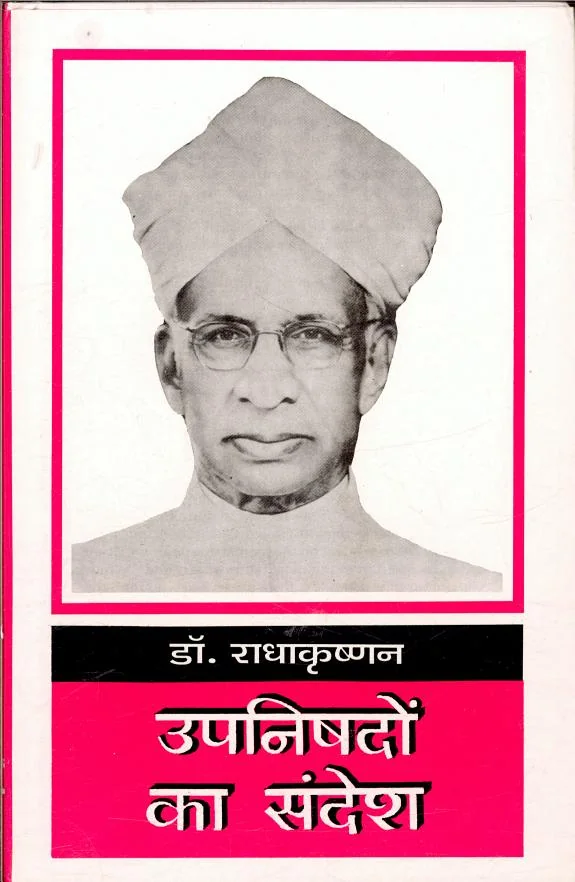
Upnishadon ka sandesh
 80
80

Upnishadon ka sandesh
Sarvepalli Radhakrishnan's 'Upnishadon ka sandesh' offers a lucid entry into the Upanishadic world, moving beyond dense Sanskrit scholarship to present core ideas with remarkable clarity. Radhakrishnan's particular strength lies in his ability to frame these ancient dialogues within a philosophical context understandable to Western-trained minds, a skill honed throughout his prolific career. He skillfully unpacks the intricate relationship between Atman and Brahman, explaining how the perceived separation of self from the universal is the central illusion to overcome. A notable passage details the concept of Maya, not as mere illusion but as the phenomenal world's complex interplay of form and name, which obscures the underlying unity. While the translation provides an excellent overview, some readers might find the inherent depth of certain Upanishadic passages slightly simplified for accessibility. Nevertheless, for anyone beginning their exploration of these foundational texts, this work provides a well-reasoned and invaluable guide.
📝 Description
80
First published in Hindi in 2004, 'Upnishadon ka sandesh' translates Sarvepalli Radhakrishnan's introduction to the Upanishads.
This Hindi translation makes Sarvepalli Radhakrishnan's accessible introduction to the Upanishads available to a wider audience. Originally conceived for English readers, Radhakrishnan's work sought to explain the core philosophical and spiritual ideas within these ancient Indian texts. He aimed to clarify concepts that have influenced Indian thought for centuries, presenting them in a way modern readers can understand.
The book is structured for those who want a clear, scholarly overview of the Upanishadic tradition. Students of religion, philosophy, and Eastern spirituality will find it useful for grasping foundational Hindu philosophy. It also speaks to individuals interested in the origins of meditation and ethical systems found in ancient Indian thought.
The Upanishads represent a significant body of Sanskrit texts from ancient India, forming the theoretical basis for Hinduism. They explore themes of consciousness, the nature of the universe, and the relationship between the individual soul and the ultimate reality. Radhakrishnan's interpretation, as presented here in Hindi, aims to articulate these complex metaphysical ideas, connecting them to practices like meditation and the pursuit of self-knowledge, placing them within the broader tradition of Indian spiritual inquiry.
💡 Why Read This Book?
• Gain an understanding of Brahman and Atman, the central metaphysical concepts of the Upanishads, as explained by Sarvepalli Radhakrishnan, a leading interpreter of Indian philosophy. • Learn about the concept of Moksha and the paths to liberation as presented in the Upanishads, offering practical frameworks for spiritual inquiry. • Explore the historical roots of major Indian philosophical schools, understanding how the Upanishads, dating back to the 8th century BCE, influenced subsequent thought.
⭐ Reader Reviews
Honest opinions from readers who have explored this book.
❓ Frequently Asked Questions
What is the primary purpose of 'Upnishadon ka sandesh'?
This Hindi translation of Sarvepalli Radhakrishnan's work serves as an introduction to the core principles and philosophical concepts of the ancient Indian Upanishads, making them accessible to a broader audience.
Who was Sarvepalli Radhakrishnan?
Sarvepalli Radhakrishnan (1888-1975) was a distinguished Indian philosopher, academic, and statesman who served as the second President of India. He was a renowned interpreter of Indian philosophy for the West.
When was Radhakrishnan's original introduction to the Upanishads first published?
Sarvepalli Radhakrishnan's original introduction to the Upanishads, which this book translates, was first published in 2004, though his extensive work on the subject spans decades prior.
What are some key concepts discussed in the book?
The book explores fundamental Upanishadic ideas such as Brahman (ultimate reality), Atman (the self), the identity of Atman and Brahman, karma, reincarnation, and the pursuit of moksha (liberation).
Is this book suitable for beginners in philosophy?
Yes, the book is designed to be an accessible introduction, explaining complex philosophical and spiritual ideas from the Upanishads in a clear and understandable manner for those new to the subject.
What is the significance of the Upanishads in Indian thought?
The Upanishads are foundational texts of Hinduism, offering profound philosophical insights into the nature of reality, consciousness, and the human condition, influencing spiritual and ethical traditions for millennia.
🔮 Key Themes & Symbolism
The Nature of Reality
The text examines the Upanishadic conception of Brahman as the singular, unmanifested absolute reality underlying all existence. It explores how the phenomenal world, with its apparent multiplicity, is understood as a manifestation or projection of this ultimate unity. Radhakrishnan guides the reader to contemplate the distinction between the empirical world and the transcendental ground of being, a central inquiry in Vedantic philosophy.
The Self and Its Realization
Central to the Upanishadic message is the concept of Atman, the true self, often described as pure consciousness. The work elucidates the profound identity between Atman and Brahman, suggesting that self-knowledge is the key to understanding ultimate reality. The pursuit of this realization involves transcending egoic identification and recognizing the eternal, unchanging nature of the soul.
Pathways to Liberation
The book examines the Upanishadic discourse on moksha, liberation from the cycle of birth, death, and rebirth (samsara). It presents the philosophical underpinnings of karma and its role in shaping experience, alongside the methods and insights offered by the Upanishads for achieving spiritual freedom, often through wisdom (jnana) and detachment.
Ethical Dimensions
Beyond metaphysical speculation, the Upanishads, as interpreted by Radhakrishnan, emphasize the ethical implications of understanding cosmic unity. The text touches upon the cultivation of virtues like truthfulness (satya), non-violence (ahimsa), and self-control as integral to the spiritual journey, reflecting the interconnectedness of all beings.
💬 Memorable Quotes
Direct passages from the work, attributed to the author.
“The ultimate truth is that the individual soul is identical with the universal spirit.”
— This interpretation highlights the core Advaita Vedanta tenet that the individual consciousness (Atman) is not separate from the supreme cosmic consciousness (Brahman), a fundamental insight for spiritual realization.
“True liberation comes from the knowledge of the Self, not from external actions alone.”
— This interpretation emphasizes the Upanishadic focus on internal realization and wisdom (jnana) as the primary means to achieve moksha, transcending the limitations imposed by the cycle of karma generated by actions.
“The quest for meaning is an inward journey toward the source of consciousness.”
— This concept suggests that the profound questions about existence and purpose are best answered by introspection and exploring the nature of one's own consciousness, which is seen as divine or universal.
“Understanding the impermanence of worldly things leads to detachment.”
— This interpretation points to the Upanishadic understanding that recognizing the transient nature of material possessions and experiences fosters a necessary detachment, paving the way for spiritual freedom.
💡 Key Ideas
Editorial paraphrase of the work's core concepts — not direct quotes.
The world we perceive is a play of names and forms, obscuring the underlying unity.
This paraphrased concept refers to Maya, the Upanishadic idea that the empirical reality, while real, is a phenomenal appearance that can veil the singular, ultimate truth of Brahman from our ordinary perception.
🌙 Esoteric Significance
Tradition
The Upanishads are foundational texts for the entire Vedantic tradition, which is a major school within Hindu philosophy. While not typically categorized under Western esoteric lineages like Hermeticism or Kabbalah, Vedantic thought shares common ground with esoteric philosophies worldwide concerning the nature of ultimate reality, the illusory nature of the mundane world, and the pursuit of inner transformation.
Symbolism
Key symbols include the syllable 'Om' (Aum), representing the primordial sound and the totality of existence, encompassing past, present, and future. The concept of the 'lotus of the heart' symbolizes the spiritual center within an individual, a locus of consciousness from which spiritual awakening can occur. The 'chariot metaphor' from the Katha Upanishad uses the body as a chariot, intellect as the driver, and senses as horses to illustrate the control needed for spiritual progress.
Modern Relevance
Contemporary thinkers and spiritual practitioners across various disciplines continue to draw inspiration from the Upanishads. Movements focused on mindfulness, consciousness studies, and integral yoga often reference Upanishadic concepts of self-realization and the unity of existence. Philosophers and spiritual leaders exploring non-dualism and the nature of consciousness frequently engage with Radhakrishnan's interpretations as a bridge to these ancient texts.
👥 Who Should Read This Book
• Students of comparative philosophy and world religions seeking a foundational understanding of Hindu metaphysical thought. • Individuals interested in the origins of meditation and contemplative practices, exploring the philosophical basis for inner peace and self-awareness. • Scholars and practitioners of Eastern spirituality looking for a clear, authoritative introduction to the Upanishadic worldview, presented by a leading Indian philosopher.
📜 Historical Context
The Upanishads emerged in India during the late Vedic period, roughly between the 8th and 4th centuries BCE, a time of significant intellectual ferment and philosophical inquiry. They represent a shift from the ritualistic focus of earlier Vedic texts towards metaphysical and spiritual contemplation. Sarvepalli Radhakrishnan, writing in the 20th century, was deeply engaged with figures like Swami Vivekananda and the broader Neo-Vedanta movement, which sought to present Indian philosophy in modern, accessible terms. His work on the Upanishads, first published in English, aimed to articulate their sophisticated concepts to a global audience, often in dialogue with Western philosophical traditions. While not facing direct censorship, Radhakrishnan's interpretations were part of a larger intellectual project to establish the philosophical rigor of Indian thought, countering colonial-era dismissals and engaging with contemporary academic discourse.
📔 Journal Prompts
The concept of Brahman and its relation to everyday phenomena.
Reflecting on the meaning of Atman as the true self.
Exploring the implications of karma for personal responsibility.
Contemplating the goal of Moksha beyond worldly desires.
The Upanishadic understanding of Maya and perceived reality.
🗂️ Glossary
Brahman
The ultimate, unchanging reality that is the source and substratum of all existence. It is the supreme cosmic spirit, often described as formless, infinite, and eternal.
Atman
The individual soul or self, understood as the true, inner essence of a living being. In many Upanishadic schools, Atman is identified with Brahman.
Maya
A concept referring to the illusory power or cosmic illusion that conceals the true nature of reality (Brahman) and creates the appearance of a diverse, phenomenal world.
Moksha
Liberation from the cycle of birth, death, and rebirth (samsara). It is the ultimate spiritual goal, characterized by freedom, enlightenment, and union with the divine.
Karma
The law of cause and effect, where actions (karma) in this life and past lives determine future experiences and the nature of rebirth.
Samsara
The continuous cycle of birth, death, and reincarnation, driven by karma and ignorance. It is a state of suffering from which liberation (moksha) is sought.
Jnana
Knowledge, particularly spiritual or philosophical knowledge. The path of jnana emphasizes wisdom and intellectual understanding as a means to liberation.
This book appears in 1 collection
🔮 Readers Also Liked
Browse all →









From the “Upanishads” Collection
View all →







More Free Occult Philosophy Books
View all →