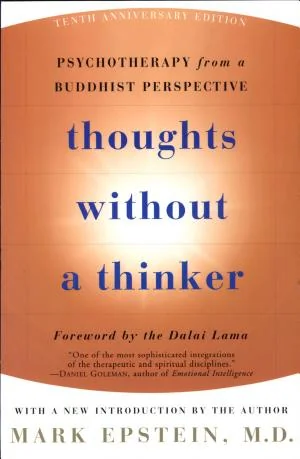
Thoughts without a thinker
 71
71

Thoughts without a thinker
Mark Epstein's "Thoughts without a Thinker" provides a sophisticated and often arresting examination of how Buddhist thought can reframe our understanding of the psyche. Epstein, a practicing psychiatrist, skillfully avoids the pitfalls of mere spiritual tourism, instead offering a deeply informed psychological reading of Buddhist doctrines. His strength lies in his ability to articulate complex ideas with clarity, particularly when discussing the ego's role in constructing suffering. A passage that stands out is his analysis of the ego's protective mechanisms, which he likens to a precarious fortress guarding a fragile core. However, the book's intellectual rigor occasionally creates a distance; some readers might yearn for more direct experiential guidance. Despite this, "Thoughts without a Thinker" offers a compelling intellectual bridge between ancient wisdom and modern therapeutic approaches, making a strong case for the psychological relevance of contemplative traditions.
📝 Description
71
Mark Epstein's 2001 book, "Thoughts without a Thinker," examines Buddhist ideas through a psychological lens.
Published in 2001, Mark Epstein's "Thoughts without a Thinker" investigates the connections between Buddhist philosophy and Western psychology. The book considers how Buddhist concepts, such as mindfulness and the nature of consciousness, can offer new perspectives on current psychological understandings. It is not a guide for self-improvement, but rather a philosophical exploration of the mind and its potential freedom from distress.
This work is for readers interested in comparative philosophy, particularly those who appreciate the integration of Eastern spiritual traditions with secular psychological thought. It suits individuals with some knowledge of Buddhist ideas or those seeking a deeper intellectual grasp of meditation practices. Psychologists, therapists, and scholars of religion or philosophy will also find its arguments stimulating.
Epstein's work sits within a tradition of Western thinkers engaging with Buddhist thought, particularly Tibetan Buddhism. This engagement seeks to translate or find parallels between contemplative insights and modern psychological frameworks. The book reflects a broader turn in the late 20th and early 21st centuries where concepts like meditation and mindfulness gained traction beyond purely religious contexts, influencing fields like neuroscience and psychotherapy.
💡 Why Read This Book?
• Gain a nuanced understanding of the ego's construction and its role in psychological distress, drawing parallels between Buddhist concepts of 'no-self' and Western ego psychology, as explored in chapters discussing the ego's defensive structures. • Explore the practical implications of Buddhist mindfulness for psychotherapy, learning how concepts like non-dual awareness, introduced in the context of meditative practice, can inform therapeutic interventions. • Reframe your perception of consciousness and selfhood by engaging with Epstein's interpretation of Buddhist concepts, particularly the idea that the mind can observe itself without a fixed 'thinker' behind it, as discussed in the book's core arguments.
⭐ Reader Reviews
Honest opinions from readers who have explored this book.
❓ Frequently Asked Questions
What is the central argument of Mark Epstein's "Thoughts without a Thinker"?
The book argues that Buddhist concepts, particularly regarding the nature of the self and ego, offer profound insights that can enrich and challenge Western psychological models, suggesting a path to mental liberation.
When was "Thoughts without a Thinker" first published?
Mark Epstein's "Thoughts without a Thinker" was first published in 2001.
Does the book provide practical advice for meditation?
While it discusses meditative concepts and their psychological implications, "Thoughts without a Thinker" is primarily a philosophical and psychological exploration rather than a how-to guide for meditation practice.
What is the relationship between Buddhism and psychology in this book?
Epstein examines how Buddhist teachings on consciousness, ego, and suffering can be integrated with and offer new perspectives on contemporary Western psychological theories and therapeutic approaches.
Who would benefit most from reading "Thoughts without a Thinker"?
Individuals interested in comparative philosophy, psychology, Buddhist studies, and the intersection of Eastern spiritual traditions with Western thought would find this book particularly valuable.
Does the book present Buddhism as a religion or a psychology?
Epstein presents Buddhist principles through a psychological lens, focusing on their implications for understanding the mind and alleviating suffering, rather than as a religious dogma.
🔮 Key Themes & Symbolism
The Ego and Its Illusions
Epstein critically dissects the Western concept of the ego, contrasting it with the Buddhist notion of 'anatta' or no-self. He posits that the ego, far from being a stable entity, is a constructed narrative that often perpetuates suffering through its defensive mechanisms and attachment to a fixed identity. The work explores how the perceived solidity of the ego can be deconstructed through introspective practices, leading to a less burdened and more authentic experience of existence. This theme is central to understanding how Buddhist philosophy offers a radical critique of selfhood.
Consciousness and Observation
A core theme is the nature of consciousness itself and the capacity of the mind to observe its own workings. Epstein engages with Buddhist ideas of awareness that are not tied to a specific 'thinker,' suggesting that a disidentified observational capacity can be cultivated. This perspective challenges the Cartesian notion of a singular, unified subject performing all mental acts. The book looks at how this detached observation, facilitated by practices like mindfulness, can lead to a greater understanding of mental processes and a reduction in reactive patterns.
Suffering and Liberation
The book connects the Buddhist understanding of suffering ('dukkha') directly to the psychological constructs of the ego and the mind's tendency towards grasping and aversion. Epstein proposes that liberation from suffering is not about eradicating the mind but about understanding its mechanisms and freeing oneself from the ego's limitations. This liberation is presented as a psychological state achievable through insight into the impermanent and interdependent nature of reality, as taught in Buddhist traditions.
Integration of East and West
A significant aspect of "Thoughts without a Thinker" is its role in bridging Buddhist philosophy with Western psychology. Epstein, as a psychiatrist, draws explicit parallels and contrasts between the two domains, showing how concepts like ego dissolution, mindfulness, and the nature of reality in Buddhism can inform and challenge established psychological theories. This integration aims to provide a richer, more comprehensive framework for understanding the human psyche and its potential for healing and growth.
💬 Memorable Quotes
Direct passages from the work, attributed to the author.
“The ego is not a solid entity but a process.”
— This statement expresses Epstein's central thesis, challenging the Western notion of a fixed self. It suggests that our sense of 'I' is a dynamic, constructed experience, aligning with Buddhist ideas of impermanence and the illusory nature of the ego.
“Mindfulness allows us to observe thoughts without being swept away by them.”
— This highlights the practical application of Buddhist contemplative techniques within a psychological framework. It describes how cultivating awareness can create a crucial distance, enabling a less reactive relationship with one's own mental content.
“The goal is not to eliminate the ego, but to understand its function.”
— This interpretation of Buddhist aims suggests a path of insight rather than annihilation. It implies that by comprehending the ego's role in constructing our experience, we can loosen its grip without resorting to radical suppression.
“Suffering arises from attachment to a false sense of self.”
— This directly links psychological distress to the ego's insistence on its own reality and permanence. It points to the Buddhist understanding that our clinging to a solid self is a primary source of dissatisfaction and pain.
“The mind has a natural capacity for insight and self-awareness.”
— This optimistic view suggests that inherent within human consciousness is the potential for understanding and liberation. It underpins the idea that through proper attention and inquiry, we can access deeper truths about ourselves and reality.
🌙 Esoteric Significance
Tradition
While not strictly adhering to a single esoteric lineage, "Thoughts without a Thinker" draws heavily from Buddhist philosophy, particularly Mahayana traditions that emphasize emptiness (sunyata) and the nature of consciousness. It engages with concepts that have been explored within esoteric circles for centuries, such as the illusory nature of the manifest self and the potential for transcending ordinary perception. Epstein's work can be seen as translating these profound contemplative insights into a language accessible to a Western psychological audience, thereby acting as a bridge for those interested in the practical, psychological dimensions of Eastern wisdom traditions.
Symbolism
The book implicitly engages with the symbol of the 'mirror' – the mind's capacity to reflect reality without distortion, a concept central to many contemplative traditions. It also touches upon the symbolism of the 'path' or 'journey,' not as a physical movement but as an internal process of deconstructing the ego and realizing a more liberated state of being. The 'fortress' metaphor used to describe the ego's defenses represents a symbolic barrier to authentic experience, which the work aims to dismantle through insight.
Modern Relevance
Epstein's work remains highly relevant today, influencing contemporary fields like contemplative neuroscience, mindfulness-based cognitive therapy (MBCT), and acceptance and commitment therapy (ACT). Modern psychologists and therapists continue to draw on his insights for understanding the ego, the nature of consciousness, and the therapeutic potential of meditative states. Thinkers exploring the philosophical underpinnings of psychedelic-assisted therapies also find resonance in his deconstruction of egoic boundaries and the nature of selfhood.
👥 Who Should Read This Book
• Psychologists and therapists seeking to integrate Buddhist principles into their clinical practice and theoretical understanding of the psyche. • Students of comparative philosophy and religion interested in the dialogue between Eastern thought and Western psychological models. • Individuals on a personal growth path who are curious about the psychological underpinnings of mindfulness and the nature of self beyond the conventional ego.
📜 Historical Context
Mark Epstein's "Thoughts without a Thinker," published in 2001, emerged during a period of burgeoning interest in the intersection of Eastern contemplative traditions and Western psychology. The late 20th century witnessed a growing acceptance of practices like mindfulness, spurred by figures such as the Dalai Lama and the increasing scientific investigation into meditation's effects. Epstein, a psychiatrist, was part of a wave of thinkers who sought to bridge these worlds, offering psychological interpretations of Buddhist concepts. This occurred against a backdrop where alternative therapies and Eastern philosophies were gaining traction, sometimes in opposition to or as supplements for mainstream psychoanalytic and behavioral approaches. The work contributed to a discourse that included contemporary thinkers exploring consciousness and the self, such as Daniel Siegel, who was also developing frameworks for understanding the mind from a neurobiological and contemplative perspective. The reception was generally positive among those open to cross-cultural psychological exploration.
📔 Journal Prompts
The ego's defensive mechanisms: How do they manifest in your daily life?
The concept of 'no-self': Reflect on moments when your sense of a fixed 'I' felt less pronounced.
Observational awareness: Describe an experience where you noticed thoughts arising without identifying with them.
The interplay of suffering and attachment: Connect a personal experience of distress to a specific attachment.
Bridging Eastern and Western thought: How can Buddhist concepts deepen your understanding of Western psychology?
🗂️ Glossary
Ego
In Western psychology, the part of the mind that mediates between the conscious and the unconscious and is responsible for reality testing. In Epstein's context, it's also the constructed sense of self that can be a source of suffering.
No-Self (Anatta)
A core Buddhist doctrine stating that there is no permanent, unchanging, independent self or soul. It challenges the notion of a fixed ego.
Mindfulness
A mental state achieved by focusing one's awareness on the present moment, while calmly acknowledging and accepting one's feelings, thoughts, and bodily sensations. Central to Buddhist practice and increasingly in therapy.
Dukkha
A fundamental concept in Buddhism, often translated as 'suffering,' 'stress,' or 'unsatisfactoriness.' It refers to the inherent unsatisfactoriness of conditioned existence.
Consciousness
The state of being aware of and responsive to one's surroundings. Epstein explores its nature from both Buddhist and psychological perspectives, questioning the idea of a singular 'thinker'.
Ego Dissolution
A state where the sense of self is temporarily lost or diminished, often experienced during deep meditation or certain altered states, leading to a feeling of oneness or boundarylessness.
Attachment
In Buddhist and psychological contexts, the clinging or desire for things to be a certain way, often rooted in the ego's need for security and identity, and a major cause of suffering.
🔮 Readers Also Liked
Browse all →









More by Mark Epstein
All books →

More Free Occult Philosophy Books
View all →