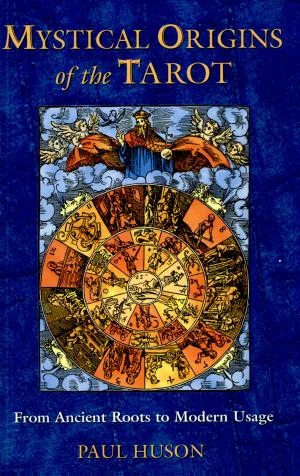
Mystical Origins of the Tarot
 76
76

Mystical Origins of the Tarot
Paul Huson's "Mystical Origins of the Tarot" offers a bold, if contentious, re-evaluation of the cards' historical lineage. His assertion that the Minor Arcana's roots lie in ancient Persia, specifically linking symbols to Zoroastrian and pre-Islamic Persian culture, is meticulously argued and visually supported. This contrasts sharply with more common theories pointing to Egypt or the East. The exploration of the Major Arcana's connection to medieval European mystery plays is particularly compelling, providing a fresh lens on the archetypal figures. However, Huson's singular focus on these specific origins, while detailed, might overlook the syncretic nature of esoteric traditions, which often absorb influences from multiple cultures. The work's strength lies in its rigorous, illustration-heavy scholarship on Persian and medieval sources, but its limitation is a potential overemphasis on these singular lines of descent. A passage discussing the symbolism of the Four of Wands, connecting it to Persian agricultural festivals, exemplifies this detailed approach. Huson's "Mystical Origins of the Tarot" is a significant, if debatable, contribution to Tarot scholarship.
📝 Description
76
Paul Huson's 2004 book traces Tarot symbolism to ancient Persia and medieval drama.
Paul Huson's "Mystical Origins of the Tarot" proposes a dual genesis for the Tarot deck. He argues that the Minor Arcana's imagery arises from ancient Persian traditions, specifically Zoroastrianism and pre-Islamic Persian culture. This perspective challenges common theories that place the Tarot's roots elsewhere.
Huson then turns his attention to the Major Arcana, suggesting their iconography is drawn from medieval European theatrical forms. He connects the Trump cards' visual motifs to mystery, miracle, and morality plays, highlighting their allegorical and theatrical qualities. The book relies heavily on visual evidence and symbolic correspondences to support its claims about the Tarot's layered history and transmission of meaning.
This work engages with the historical study of Western esotericism, particularly the origins of divination systems. It situates the Tarot within a lineage of symbolic transmission, contrasting its proposed dual origin in ancient Persian culture and medieval European theatre with more common theories linking it to Eastern traditions or earlier occult systems. Huson emphasizes visual and cultural, rather than purely textual, influences.
💡 Why Read This Book?
• Discover an alternative historical framework for the Tarot, moving beyond common theories to explore potential roots in ancient Persian culture and symbolism. • Understand the visual language of the Tarot through a new perspective, linking the Major Arcana's imagery to the dramatic traditions of medieval European mystery and morality plays. • Gain a deeper appreciation for the historical and cultural forces that may have shaped the Tarot's development, enhancing your own card interpretation with a more nuanced historical context.
⭐ Reader Reviews
Honest opinions from readers who have explored this book.
❓ Frequently Asked Questions
What is Paul Huson's main argument about the origins of the Tarot cards?
Huson argues that the Minor Arcana have their origins in ancient Persia, possibly linked to Zoroastrian symbolism, while the Major Arcana's imagery stems from medieval European mystery, miracle, and morality plays.
When was "Mystical Origins of the Tarot" first published?
The book "Mystical Origins of the Tarot" by Paul Huson was first published on May 26, 2004.
Does the book focus on divination or the history of the Tarot?
The book primarily focuses on the historical origins and development of the Tarot, examining the cultural and symbolic roots of its cards rather than their use in divination.
What historical periods does Huson connect the Tarot to?
Huson connects the Tarot to two distinct periods: ancient Persia for the Minor Arcana and the medieval world of Europe for the Major Arcana.
What kind of evidence does Huson use to support his theories?
Huson relies heavily on visual analysis of Tarot card imagery and historical research into Persian culture, Zoroastrianism, and medieval European theatrical traditions.
How does this book differ from other Tarot origin theories?
Unlike theories that suggest Egyptian, Chinese, or Indian origins, Huson proposes a dual origin rooted specifically in ancient Persia and medieval European drama.
🔮 Key Themes & Symbolism
Persian Esoteric Connections
Huson posits that the symbolism within the Minor Arcana of the Tarot can be traced back to ancient Persia, potentially drawing from Zoroastrian cosmology and cultural practices predating the Islamic era. This theme challenges common assumptions about the Tarot's origins, directing attention to the rich spiritual and artistic heritage of Persia. The book explores how specific motifs and numerical sequences might reflect ancient Persian philosophical ideas or societal structures, offering a unique interpretive lens for students of esoteric history.
Medieval European Performance Arts
The work proposes that the iconic imagery of the Major Arcana's Trump cards finds its source in the dramatic traditions of medieval Europe, specifically mystery, miracle, and morality plays. This connection suggests that the archetypal figures and narratives represented by the Major Arcana were deeply embedded in the public consciousness through theatrical performances. Huson analyzes how the visual language and allegorical content of these plays may have directly influenced the design and symbolic meaning of cards like The Fool, The Magician, or The Emperor.
Visual and Symbolic Transmission
A central theme is the transmission of esoteric knowledge and symbolism through visual means rather than solely through written texts. Huson emphasizes how the illustrated nature of the Tarot facilitates the transfer of meaning across cultures and historical periods. The book highlights the importance of iconography, examining how specific symbols, their arrangement, and their stylistic presentation convey complex ideas and potentially hidden meanings to those who can interpret them.
Historiography of Esotericism
Huson's work serves as an example of critical historiography within the field of esoteric studies. By questioning established theories and presenting meticulously researched alternative hypotheses, he encourages a more rigorous examination of historical claims. The book engages with scholarly debates surrounding the Tarot's origins, demonstrating how historical context and a critical approach to sources are vital for understanding esoteric traditions.
💬 Memorable Quotes
Direct passages from the work, attributed to the author.
“The origins of the tarot have been lost in the mists of time.”
— This statement from the original blurb sets the stage for Huson's ambitious project, acknowledging the mystery surrounding the Tarot's inception and the necessity of deep historical investigation to uncover its roots.
“Huson has expertly tracked each symbol of the Minor Arcana to roots in ancient Persia.”
— This highlights the core thesis regarding the Minor Arcana, emphasizing Huson's detailed research and his specific attribution of these cards' origins to Persian culture and symbolism.
“The Major Arcana Trump card images to the medieval world of mystery, miracle, and morality plays.”
— This captures the book's argument concerning the Major Arcana, linking their visual narratives to the theatrical and religious performances prevalent in medieval Europe.
“A number of tarot historians have questioned the use of the tarot as a...”
— This incomplete sentence from the blurb suggests the book addresses controversies or debates within Tarot scholarship, likely concerning its authenticity, purpose, or historical accuracy.
💡 Key Ideas
Editorial paraphrase of the work's core concepts — not direct quotes.
The work meticulously examines each card, proposing connections to Zoroastrianism and the culture of Persia before its Islamic conquest.
This paraphrased concept emphasizes Huson's detailed analytical approach and the specific historical and religious context he uses to explain the Minor Arcana's origins.
🌙 Esoteric Significance
Tradition
Huson's work engages with the broad Western Esoteric Tradition, but specifically seeks to anchor the Tarot's origins in historical, rather than purely metaphysical or syncretic, frameworks. It doesn't strictly adhere to a single lineage like Hermeticism or Kabbalah but rather reconstructs a potential historical genesis from distinct cultural and artistic sources – ancient Persia and medieval European theatre. This approach offers a unique perspective that bypasses typical esoteric lineages to propose a more material and cultural origin for the archetypal imagery.
Symbolism
The book explores the symbolism of the Minor Arcana through the lens of ancient Persian culture, potentially connecting elements to Zoroastrian concepts of duality, cosmic order, or agricultural cycles. For the Major Arcana, symbolism is linked to the allegorical figures and narratives found in medieval mystery and morality plays, suggesting that the archetypes represented on these cards were familiar theatrical characters and moral lessons from that era. This focus on visual and performance-based symbolism offers a departure from purely textual or philosophical interpretations.
Modern Relevance
Contemporary Tarot practitioners and scholars interested in historical accuracy and alternative origin theories find Huson's work valuable. It provides a counterpoint to more widely accepted Italian Renaissance origins and encourages critical engagement with the visual and cultural context of the cards. Schools of divination or esoteric study that prioritize historical grounding and diverse cultural influences might incorporate Huson's research into their curriculum or personal study.
👥 Who Should Read This Book
• Tarot enthusiasts seeking to explore less conventional historical theories about the cards' origins, moving beyond established narratives. • Students of comparative mythology and religious studies interested in the potential cross-cultural transmission of archetypal imagery. • Researchers of Western Esotericism looking for detailed, illustration-heavy arguments that challenge prevailing historical accounts of Tarot development.
📜 Historical Context
Published in 2004, Paul Huson's "Mystical Origins of the Tarot" entered a field of Tarot scholarship already rich with diverse theories, many positing Egyptian or Kabbalistic roots. The late 20th and early 21st centuries saw a surge in academic interest in esoteric traditions, alongside a continued popular fascination with divination tools like the Tarot. Huson's work emerged within this milieu, seeking to provide a more grounded, historically specific origin story than many of its predecessors. It notably departed from earlier, more speculative works that often relied on Theosophical or occultist interpretations. Key contemporaries in Tarot historical research include figures like Michael Dummett, whose extensive works often focused on the Italian Renaissance origins of playing cards and Tarot, representing a more mainstream historical perspective that Huson's book directly challenged. The reception of such revisionist historical claims in esoteric studies often involves debate, with some scholars appreciating the rigorous research while others critique perceived oversimplification or selective evidence.
📔 Journal Prompts
How might a Persian cultural lens alter your interpretation of the Minor Arcana?
Which medieval European play do you think most strongly influenced a Major Arcana card's imagery?
Compare Huson's Persian origin theory to other proposed Tarot origins you know.
What visual elements on a Tarot card strike you as potentially theatrical?
Reflect on the role of visual art versus text in transmitting esoteric knowledge.
🗂️ Glossary
Minor Arcana
The four suits (Wands, Cups, Swords, Pentacles) of the Tarot deck, traditionally comprising 56 cards, often seen as representing daily life and worldly matters.
Major Arcana
The 22 Trump cards of the Tarot deck, featuring archetypal figures and concepts (e.g., The Fool, The Magician, The World), often interpreted as representing spiritual lessons or significant life events.
Zoroastrianism
An ancient Persian religion founded by Zoroaster, emphasizing a dualistic cosmology of good versus evil and a single supreme deity, Ahura Mazda.
Mystery Plays
Medieval European theatrical works based on biblical stories, often performed by guilds in public spaces.
Morality Plays
Allegorical medieval European dramas that depicted the struggle between personified virtues and vices for the soul of a central character.
Iconography
The visual images and symbols used in a work of art or the study or interpretation of these.
Esoteric
Intended for or likely to be understood by only a small number of people with a specialized knowledge or interest; arcane.
This book appears in 1 collection
🔮 Readers Also Liked
Browse all →








From the “Tarot” Collection
View all →









More Free Occult Philosophy Books
View all →