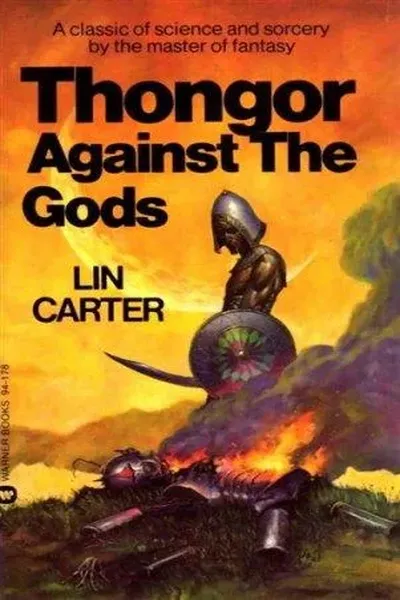
Thongor in the city of magicians

 74
74

Thongor in the city of magicians
Lin Carter’s "Thongor in the City of Magicians" delivers precisely the sort of lurid, action-packed adventure expected from the sword-and-sorcery tradition it emulates. The depiction of the City of Magicians, a place teeming with serpentine plots and volatile enchantments, provides a compelling backdrop for Thongor’s struggles. Carter excels at creating an atmosphere of exotic danger, where every shadowed alley could conceal a sorcerer or a monstrous guardian. However, the prose, while functional, occasionally leans into the predictable, and Thongor himself, while a capable protagonist, lacks the nuanced internal conflict that elevates some genre figures. The climactic confrontation within the city’s arcane heart is a strong point, showcasing Carter’s talent for visceral set pieces. Ultimately, it's a solid, if not revolutionary, entry into the genre that satisfies its specific pulp-fantasy aims.
📝 Description
74
Lin Carter's "Thongor in the City of Magicians" plunges readers into a lost continent in 1968.
Published in 1968, Lin Carter's "Thongor in the City of Magicians" transports readers to the lost continent of Lemuria. The story follows Thongor, a barbarian warrior, as he navigates the treacherous City of Magicians. This city thrives on sorcery and political maneuvering, where arcane knowledge is a form of currency. The novel acts as a clear homage to the sword-and-sorcery stories popular in mid-20th century pulp magazines.
This book is best suited for fans of classic sword-and-sorcery. Readers who prefer direct heroic adventures, exotic locales, and straightforward conflicts between good and evil will find it most engaging. Those looking for complex plots or deep philosophical discussions might find it less appealing. The narrative embraces a pulpy sensibility with a focus on action and adventure.
The novel arrived in 1968, a time when sword-and-sorcery narratives saw renewed interest, partly due to Robert E. Howard's Conan stories being reprinted. Lin Carter was a significant figure in the genre's ongoing development, alongside authors like Michael Moorcock. The book reflects the period's interest in ancient civilizations, forgotten lands, and the dynamic between brute force and mystical power.
The 'Lost Continent' trope, exemplified by Lemuria here, draws from late 19th and early 20th-century occult and pseudoscientific theories. These theories posited advanced, ancient civilizations that predated recorded history, often with mystical or psychic abilities. The City of Magicians itself embodies the corrupting influence of forbidden knowledge and the decay of complex societies, a common theme in pulp fantasy that echoed contemporary anxieties about scientific progress and ancient mysteries. This fits within a tradition of fantasy that uses speculative ancient history to explore darker aspects of human ambition and power.
💡 Why Read This Book?
• Gain an understanding of mid-20th century sword-and-sorcery tropes, exemplified by the lost continent of Lemuria and its decadent cities, offering a specific lens into fantasy's evolution. • Experience the direct, action-oriented narrative style favored by Lin Carter, distinct from more modern, introspective fantasy, allowing for a focus on external conflict and heroic deeds. • Explore the recurring theme of the barbarian versus the sorcerer, a central conflict in "Thongor in the City of Magicians," providing insight into archetypal struggles within the genre.
⭐ Reader Reviews
Honest opinions from readers who have explored this book.
❓ Frequently Asked Questions
When was "Thongor in the City of Magicians" first published?
The book was first published in 1968, placing it firmly within the late-era pulp fantasy revival.
What is Lemuria in the context of this book?
Lemuria is presented as a lost continent, the setting for Thongor's adventures, featuring ancient civilizations and remnants of powerful magic.
Who is the main protagonist of the story?
The protagonist is Thongor, a barbarian warrior from Lemuria, known for his strength and direct approach to conflict.
What are the primary themes explored in "Thongor in the City of Magicians"?
Key themes include the clash between primal strength and arcane power, the perils of decadent civilizations, and the exploration of exotic, dangerous locales.
Is this book part of a series?
Yes, "Thongor in the City of Magicians" is part of a series of novels featuring the character Thongor by Lin Carter.
What kind of tone does the book have?
The tone is characteristic of classic sword-and-sorcery: adventurous, action-packed, and set in a world of magic and peril.
🔮 Key Themes & Symbolism
Barbarian Prowess vs. Sorcerous Wiles
The narrative frequently pits Thongor's raw, physical strength and direct combat skills against the subtle, often treacherous, magic wielded by the sorcerers of the City of Magicians. This dichotomy is central, highlighting the perceived conflict between natural, uncorrupted power and the corrupting influence of forbidden knowledge and arcane manipulation. Thongor often finds himself outmatched intellectually or magically, forcing him to rely on his cunning and martial prowess to overcome magically-empowered adversaries and work through the city's dangerous political landscape.
Lost Civilizations and Decadent Empires
Lemuria, the setting for Thongor's adventures, is depicted as a continent of fallen empires and ancient, forgotten powers. The City of Magicians itself embodies the trope of a once-great civilization now steeped in decadence and arcane corruption. This theme reflects a common fascination in mid-20th-century fantasy for exploring the ruins of past glories and the lingering, dangerous legacies of advanced, often magically-inclined, societies. The decay serves as a stark contrast to Thongor's more primal, less corrupted origins.
The Allure and Peril of Forbidden Knowledge
The City of Magicians is a nexus of arcane secrets and dangerous enchantments. The book explores how this knowledge, while powerful, often leads to moral compromise and destructive ambition among its practitioners. Thongor, as an outsider, views this sorcery with a mixture of awe and deep suspicion, recognizing its potential for both creation and annihilation. The narrative questions whether such power can ever be truly controlled or if it inevitably corrupts its wielders, a common cautionary theme in tales of magic.
Exotic Settings and Pulp Adventure
The book thrives on its creation of an exotic, perilous world filled with strange creatures, hidden temples, and treacherous political machinations. The City of Magicians is rendered with a vivid, almost lurid, detail characteristic of pulp fiction. This focus on a richly imagined, albeit dangerous, external environment is a hallmark of the sword-and-sorcery genre, providing a stage for thrilling encounters and a sense of grand, heroic adventure far removed from the mundane world.
💬 Memorable Quotes
Direct passages from the work, attributed to the author.
“The City of Magicians pulsed with a power both ancient and corrupt.”
— This interpretation points to the dual nature of the city's magic – it is immensely old and potent, yet also deeply tainted by the decadence and moral failings of its inhabitants.
“He was a creature of the wild, untamed by the gilded cages of civilization.”
— This captures Thongor's outsider status; he is a force of nature amidst the complex, often decadent, political and magical structures of the city.
“Behind the opulent facade lay webs of intrigue spun by unseen hands.”
— This emphasizes the deceptive nature of the City of Magicians, where surface beauty and power mask hidden dangers and manipulative plots driven by its sorcerous rulers.
“His axe was his argument in the halls of arcane debate.”
— This is an interpretation conveying that when faced with complex magical or political arguments, Thongor's solution is often direct physical action, characteristic of his barbarian mindset.
💡 Key Ideas
Editorial paraphrase of the work's core concepts — not direct quotes.
Thongor faced the sorcerers not with spells, but with steel.
This paraphrased concept highlights the core conflict: Thongor's reliance on his martial skills and courage versus the magical abilities of his opponents, emphasizing his barbarian directness against arcane manipulation.
🌙 Esoteric Significance
Tradition
While "Thongor in the City of Magicians" doesn't align with a specific, formalized esoteric tradition like Kabbalah or Theosophy, it draws heavily on archetypal themes common in Western esotericism, particularly the conflict between primal, natural forces and corrupted, artificial magical power. It echoes Gnostic dualism in its portrayal of a flawed, decadent world ruled by powerful, often malevolent, entities (the magicians) contrasted with a purer, albeit less sophisticated, force (Thongor). The lost continent of Lemuria itself functions as a mythical space where ancient, potent magic once flourished, a recurring motif in esoteric lore.
Symbolism
The City of Magicians itself symbolizes decadent civilization and the corrupting potential of unchecked arcane knowledge. Its labyrinthine structure can represent the complex, often deceptive, pathways of magical pursuit. Thongor, as a barbarian, symbolizes primal strength, natural instinct, and a form of untainted power, contrasting with the artificiality and moral decay of the city. The magical artifacts and enchantments within the city represent forbidden knowledge and the seductive, dangerous allure of power beyond natural limits.
Modern Relevance
Modern fantasy authors and game designers continue to draw inspiration from the archetypal conflicts and settings popularized by Lin Carter and his contemporaries. The 'barbarian vs. sorcerer' trope, the 'lost world' narrative, and the depiction of magically decadent cities remain staples in fantasy literature and role-playing games. Contemporary works exploring the dangers of unchecked power, the corruption of advanced societies, or the clash between primal forces and civilization often echo the foundational ideas presented in books like "Thongor in the City of Magicians."
👥 Who Should Read This Book
• Fans of classic 1960s and 1970s sword-and-sorcery fiction seeking authentic pulp adventure narratives. • Readers interested in the evolution of the fantasy genre, particularly the stylistic contributions of Lin Carter and his contemporaries. • Enthusiasts of tales featuring strong, action-oriented protagonists confronting exotic dangers and arcane mysteries in lost-world settings.
📜 Historical Context
Published in 1968, "Thongor in the City of Magicians" emerged during a period when Lin Carter was actively contributing to the revival and expansion of the sword-and-sorcery genre. This era saw renewed interest in Robert E. Howard's Conan tales, and Carter, alongside figures like Michael Moorcock, helped define its direction. The book reflects the mid-century fascination with lost continents, ancient mysteries, and the potent allure of magic, common themes in pulp fantasy. While not directly engaging with academic esoteric traditions like Gnosticism or Hermeticism, it tapped into a popular cultural undercurrent interested in primal forces and arcane power. Reception was generally positive among fans of the genre, reinforcing Carter's reputation as a skilled practitioner of pulp fantasy storytelling, distinct from the more literary fantasy emerging concurrently.
📔 Journal Prompts
Thongor's confrontation with the sorcerers of the City of Magicians.
The symbolism of Lemuria as a lost, powerful continent.
Reflections on the nature of arcane knowledge versus primal strength.
The allure and peril of decadent civilizations depicted in the book.
Thongor's reliance on steel over sorcery.
🗂️ Glossary
Lemuria
A mythical lost continent, often depicted as the setting for ancient civilizations and primal magic in "Thongor in the City of Magicians" and other works.
Sword-and-sorcery
A subgenre of fantasy fiction characterized by heroic protagonists, combat, magic, and often exotic, ancient, or alien settings, popular in pulp magazines.
Barbarian
In this context, a warrior from a less 'civilized' or technologically advanced region, possessing great physical strength and directness, often contrasted with city-dwellers or sorcerers.
Sorcerer
An individual who wields magic, often depicted as having access to forbidden or arcane knowledge, and frequently associated with intrigue and corruption.
Pulp fiction
A style of writing popular in the early to mid-20th century, characterized by sensationalism, fast-paced plots, and often fantastical or adventurous themes, typically published in inexpensive magazines.
Arcane
Relating to mysteries, secret knowledge, or magic; often implying a power that is hidden, complex, and potentially dangerous.
City of Magicians
The central urban setting in the novel, a place where sorcery is prevalent and political machinations are driven by magical power.
🔮 Readers Also Liked
Browse all →









More by Lin Carter
All books →



More Free Occult Philosophy Books
View all →