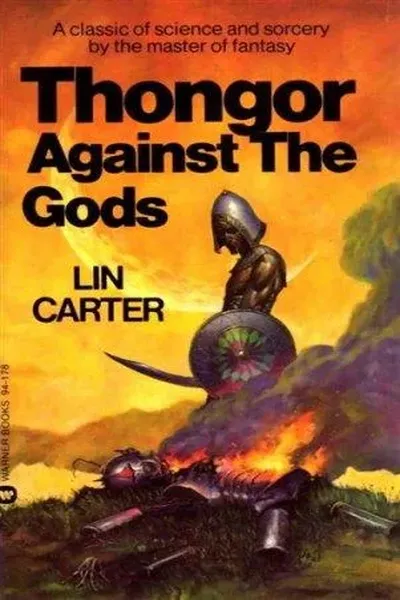
Thongor fights the pirates of Tarakus

 84
84

Thongor fights the pirates of Tarakus
Lin Carter's "Thongor Fights the Pirates of Tarakus" delivers precisely what its title promises: a straightforward, action-packed barbarian adventure. The 1976 publication situates it within a tradition of sword-and-sorcery that valued kinetic prose and clear stakes. Thongor’s direct confrontation with the Tarakus pirates provides a focused narrative arc, eschewing overly complex subplots for the satisfaction of visceral conflict. A particular strength lies in Carter's vivid descriptions of Zanth's primordial landscapes and the monstrous entities that inhabit them, creating an immersive, dangerous world. However, the characterization, while functional for the genre, remains somewhat thin; Thongor’s motivations are primarily reactive, driven by immediate threats rather than deeper introspection. The book excels in its depiction of hand-to-hand combat and desperate escapes, but moments of genuine emotional depth are scarce. Ultimately, "Thongor Fights the Pirates of Tarakus" is a solid entry for fans of pure sword-and-sorcery, offering robust action without unnecessary embellishment.
📝 Description
84
Lin Carter's 1976 novel plunges readers into the prehistoric world of Zanth.
Thongor, a barbarian prince, battles the pirates of Tarakus in Lin Carter's 1976 adventure, "Thongor Fights the Pirates of Tarakus." This story continues the saga of the titular hero as he confronts ancient evils and warring tribes in the savage land of Zanth. The narrative highlights Thongor's martial skill and courage against dangerous adversaries. The pirates of Tarakus pose a significant threat to the coastal regions, and Thongor is often compelled to defend his people or uphold his honor against their raids. The book depicts the brutal clashes and strategic maneuvers involved in this conflict, showing Thongor's leadership in uniting different groups against a common foe.
Zanth itself is a land marked by past cataclysms and residual magic. Carter populates this setting with dangerous creatures, degenerate cults, and the ruins of ancient empires, creating an atmosphere of constant peril. Survival in Zanth requires wit, strength, and a keen awareness of the environment's inherent dangers. The story touches upon the remnants of these lost eras, suggesting the continued influence of cosmic forces and ancient powers.
While not overtly occult, "Thongor Fights the Pirates of Tarakus" taps into the sword and sorcery tradition that often features remnants of forgotten magic and primal forces. The world of Zanth, with its "lingering magical residue" and "ruins of long-vanished empires," echoes the themes found in Robert E. Howard's tales, where ancient, often malevolent, powers lie dormant beneath the surface of civilization. The narrative's focus on a strong, instinctual hero like Thongor confronting both earthly and mystical dangers aligns with a broader interest in primal power and the supernatural.
💡 Why Read This Book?
• Gain an appreciation for the direct, unadorned style of 1970s sword-and-sorcery, exemplified by Thongor's pragmatic approach to threats like the pirates of Tarakus. • Experience the visceral thrill of primal combat and survival against monstrous foes in the prehistoric world of Zanth, a core element of Carter's 1976 work. • Understand the archetype of the barbarian hero as presented in Lin Carter's fiction, focusing on physical prowess and instinctual decision-making in perilous situations.
⭐ Reader Reviews
Honest opinions from readers who have explored this book.
❓ Frequently Asked Questions
When was "Thongor Fights the Pirates of Tarakus" first published?
The book was first published in 1976, positioning it within the wave of sword-and-sorcery fiction that gained prominence in the mid-20th century.
What is the primary setting for the Thongor series?
The Thongor series is set in the prehistoric, post-cataclysmic world of Zanth, a land filled with ancient ruins, dangerous creatures, and warring civilizations.
Who are the main antagonists in "Thongor Fights the Pirates of Tarakus"?
The primary antagonists are the formidable pirates of Tarakus, a maritime threat that challenges Thongor and the inhabitants of Zanth's coastal regions.
What genre does "Thongor Fights the Pirates of Tarakus" belong to?
It belongs to the sword-and-sorcery subgenre of fantasy, characterized by heroic protagonists, low-magic settings, and a focus on action and adventure.
Is Thongor a prince?
Yes, Thongor is often depicted as a barbarian prince, a figure of nobility and leadership within his own tribal context, even as he operates in a savage world.
What is the overall tone of the Thongor books?
The tone is generally adventurous and action-oriented, emphasizing the physical struggles and heroic deeds of its protagonist in a dangerous, primordial world.
🔮 Key Themes & Symbolism
Barbarian Heroism
Thongor embodies the quintessential barbarian hero, relying on brute strength, sharp instincts, and a code of personal honor. His confrontations with the pirates of Tarakus are not just battles for survival but displays of raw courage and leadership. The narrative emphasizes his physical prowess and direct action over complex strategy or moral ambiguity. This theme explores the appeal of primal strength in a world where civilization often brings corruption and weakness, contrasting the 'savagery' of the barbarian with the potential depravity of more 'advanced' societies encountered in Zanth.
Prehistoric World-Building
The setting of Zanth is a crucial element, depicted as a primordial, post-cataclysmic world teeming with ancient dangers and the remnants of forgotten civilizations. "Thongor Fights the Pirates of Tarakus" showcases this world through its monstrous fauna, treacherous landscapes, and lingering magical anomalies. Carter utilizes this setting to create an atmosphere of constant peril, where survival is a daily struggle. The book explores the elements of past eras, hinting at cosmic influences and ancient evils that continue to shape the present, making Zanth a character in its own right.
Confrontation and Survival
Fundamentally, the book is about direct confrontation and the relentless drive for survival. Thongor’s battles against the pirates of Tarakus, as well as the other threats he faces in Zanth, are visceral and often desperate. The narrative focuses on the immediate physical and tactical challenges, highlighting the protagonist's resilience and ability to overcome seemingly insurmountable odds. This theme taps into a primal human experience of facing adversity head-on, where instinct and physical capability are paramount to enduring in a hostile environment.
Lost Civilizations and Ancient Evils
Zanth is a land littered with the ruins of advanced, yet fallen, civilizations. These remnants serve as both backdrops for adventure and sources of lingering danger or forgotten power. "Thongor Fights the Pirates of Tarakus" hints at the vast, mysterious history of this world, suggesting that ancient forces and cosmic entities still influence events. This theme adds a layer of the esoteric and the unknown to the sword-and-sorcery framework, exploring the idea that present-day struggles are often shadowed by the mysteries and potential horrors of the distant past.
💬 Memorable Quotes
Direct passages from the work, attributed to the author.
“Thongor met the charge with a roar, his sword a gleam of death.”
— This phrase captures the essence of Thongor's combat style: direct, ferocious, and deadly. It emphasizes his immediate, visceral response to threats, highlighting his role as a warrior whose primary tool is his martial skill.
“The pirates of Tarakus were a blight upon the coast, their sails like predatory birds.”
— This imagery vividly portrays the menacing nature of the Tarakus pirates. Comparing their sails to predatory birds underscores their swiftness, danger, and the fear they inspire as they move across the waters.
“He moved through the jungle's embrace, every shadow a potential enemy.”
— This highlights the pervasive danger of Zanth's environment. It suggests that even natural settings are hostile, forcing constant vigilance and a heightened awareness of the surroundings for survival.
“The ruins whispered tales of forgotten ages and powers best left undisturbed.”
— This evokes the sense of ancient mystery and latent peril associated with Zanth's lost civilizations. It implies that the past holds dangerous secrets and powers that continue to exert influence, adding an esoteric layer to the setting.
“His strength was the strength of the mountains, his will a force of nature.”
— This description elevates Thongor beyond mere physical prowess. It equates his personal power to the unyielding forces of the natural world, portraying him as a primal, elemental hero.
🌙 Esoteric Significance
Tradition
While primarily a sword-and-sorcery work, the Thongor series, including "Thongor Fights the Pirates of Tarakus," touches upon themes resonant with certain esoteric traditions, particularly those dealing with cyclical history, forgotten ages, and the remnants of lost, powerful civilizations. It echoes a Gnostic or Manichean undercurrent where a primal, often savage, hero battles against degenerate forces and the lingering effects of ancient cataclysms. The world of Zanth, a post-apocalyptic landscape shaped by forgotten powers, can be seen as a distorted reflection of esoteric cosmologies that posit cycles of creation and destruction.
Symbolism
The ruins of lost civilizations within Zanth serve as potent symbols of fallen grandeur and forgotten knowledge, hinting at esoteric truths or powers that once existed and may still linger. Monstrous creatures often represent primal chaos or the degenerate manifestations of ancient magical energies gone awry. Thongor himself can be interpreted as an archetype of the uncorrupted primal force, embodying a raw, instinctual will that cuts through the decay and artifice of a fallen world, much like a spiritual warrior confronting illusion.
Modern Relevance
Contemporary authors and creators in the fantasy and even horror genres continue to draw on the core elements of sword-and-sorcery that Lin Carter exemplified. The archetype of the lone, powerful warrior battling overwhelming odds in a dangerous, primordial world remains a potent narrative engine. Furthermore, the exploration of ancient mysteries and the remnants of lost, powerful civilizations within Zanth can be seen as a precursor to modern fascination with deep-time narratives and cosmic horror, where humanity confronts the vast, indifferent, or hostile forces of the universe and its unfathomable past.
👥 Who Should Read This Book
• Fans of classic 1970s sword-and-sorcery seeking straightforward, action-driven narratives. • Readers interested in the evolution of heroic fantasy and the work of Lin Carter, a significant figure in the genre. • Adventurous readers who appreciate immersive, perilous world-building and tales of primal strength against monstrous threats.
📜 Historical Context
Published in 1976, "Thongor Fights the Pirates of Tarakus" emerged during a period when sword-and-sorcery fiction experienced a significant resurgence, fueled by the enduring popularity of Robert E. Howard's Conan stories and the rise of authors like Michael Moorcock. Lin Carter, a prolific writer and editor himself, was deeply immersed in the pulp traditions and the burgeoning fantasy genre. This era saw a growing interest in heroic fantasy that offered escapism and visceral thrills, often contrasted with the more complex, mythopoeic world-building of authors like J.R.R. Tolkien. Carter's work often drew inspiration from Howard, but he also infused his narratives with his own unique sense of exoticism and ancient mystery. While not facing direct censorship, the genre itself occupied a space distinct from mainstream literary fiction, often found in paperback formats catering to a dedicated readership. Contemporary authors like Poul Anderson and Jack Vance were also exploring similar heroic archetypes and adventurous settings, contributing to a rich range of fantasy literature.
📔 Journal Prompts
Thongor's immediate response to the pirates of Tarakus.
The symbolic weight of Zanth's ancient ruins.
The nature of strength as portrayed in Thongor's battles.
Reflecting on the 'blight' described regarding the Tarakus pirates.
Interpreting the constant peril implied by the jungle setting.
🗂️ Glossary
Zanth
The primary setting for the Thongor series, a prehistoric, post-cataclysmic world filled with ancient ruins, dangerous creatures, and warring civilizations.
Pirates of Tarakus
The main antagonists in this specific novel, a formidable maritime force that threatens the coastal regions of Zanth.
Barbarian Hero
An archetypal protagonist characterized by physical prowess, primal instincts, and a personal code of honor, often operating in a savage or uncivilized environment.
Sword-and-Sorcery
A subgenre of fantasy fiction characterized by heroic protagonists, low-magic settings, and a focus on action, adventure, and visceral conflict.
Primordial World
A world depicted as ancient, raw, and untamed, often predating or surviving major cataclysms, filled with natural dangers and remnants of forgotten eras.
Ancient Evils
Threats or malevolent forces originating from the distant past, often tied to forgotten civilizations, cosmic entities, or residual magical energies.
Cataclysm
A destructive event causing widespread devastation, often implied to be the cause of Zanth's current state and the fall of its previous civilizations.
🔮 Readers Also Liked
Browse all →









More by Lin Carter
All books →



More Free Occult Philosophy Books
View all →