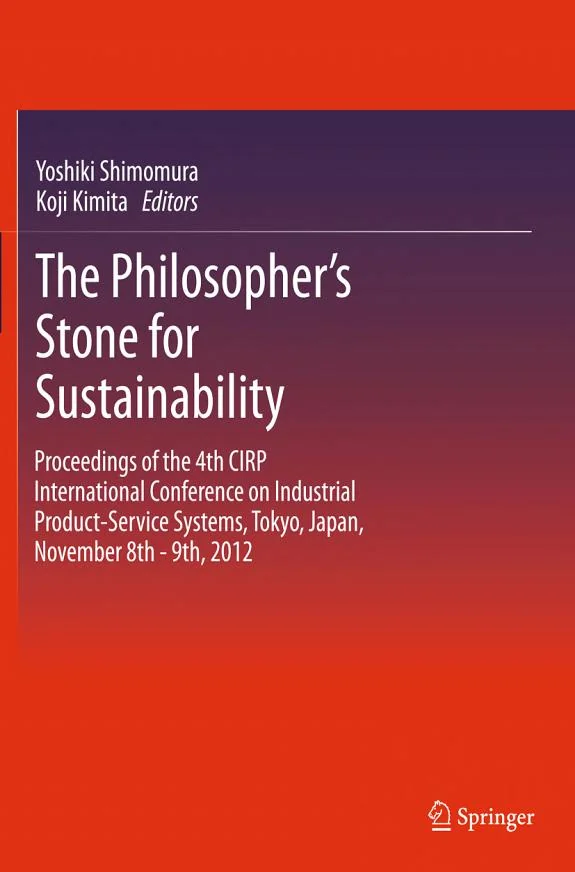
The Philosopher's Stone for Sustainability
 80
80

The Philosopher's Stone for Sustainability
Shimomura and Kimita's 2012 exploration of Industrial Product-Service Systems (IPS2) offers a compelling alchemical metaphor for tackling sustainability. Framing IPS2 as a "philosopher's stone" is an inspired choice, immediately signaling a desire for fundamental transformation rather than superficial adjustments. The strength lies in its clear articulation of how shifting from product ownership to service provision can intrinsically align business incentives with ecological well-being. The discussion around "value in use" is particularly potent, suggesting a paradigm shift where longevity and efficiency become the core drivers of profit. However, the work occasionally feels more like a theoretical proposal than a fully fleshed-out operational blueprint. While the metaphor is strong, the practical implementation details for achieving this alchemical transmutation across diverse industries could benefit from deeper exploration. The book ultimately provides a valuable conceptual framework for rethinking industrial models in the face of environmental imperatives.
📝 Description
80
In 2012, Yoshiki Shimomura and Koji Kimita proposed Industrial Product-Service Systems (IPS2) as a path to ecological and societal well-being.
Published in 2012, Yoshiki Shimomura and Koji Kimita's book introduces Industrial Product-Service Systems (IPS2) as a framework for addressing sustainability issues. IPS2 describes integrated offerings of industrial products and services designed to deliver value through use. The authors argue that this model represents a fundamental shift, moving beyond mere economic advantage or improved Quality of Life (QOL). Instead, they position it as an alchemical transformation aimed at fostering ecological and societal health. The core idea is a transition from a focus on ownership to one centered on access, and from high material consumption to extended service longevity and greater efficiency.
This work is relevant for professionals in industrial design, engineering, business strategy, and environmental policy. It offers a conceptual approach for researchers and practitioners who are looking beyond traditional linear economic models and seeking new frameworks for sustainable development. Academics studying industrial ecology, circular economy principles, and service design integration will find its perspective valuable. It also speaks to business leaders and policymakers interested in practical, yet transformative, methods for environmental stewardship.
The book draws a parallel between the alchemical pursuit of transformation and the systemic changes needed for ecological sustainability. Just as alchemists sought to transmute base metals into gold, Shimomura and Kimita propose a transmutation of industrial models. They suggest that by shifting from product ownership to service access, and prioritizing longevity over throughput, a more profound, 'alchemical' change can occur in our relationship with resources and the environment. This aligns with Hermetic principles of correspondence, where macrocosmic changes (in the industrial system) reflect microcosmic shifts (in societal and ecological health).
💡 Why Read This Book?
• Learn how the Industrial Product-Service Systems (IPS2) model, as detailed in the 2012 publication, proposes a fundamental shift from product ownership to service provision, aligning economic goals with ecological stewardship. • Understand the "philosopher's stone" metaphor as applied to IPS2, revealing how this integrated approach aims to transmute industrial practices from resource depletion to sustainable value creation. • Gain insights into the concept of "value in use," a core tenet of IPS2, and how it incentivizes product longevity, repairability, and efficient resource utilization, as presented by Shimomura and Kimita.
⭐ Reader Reviews
Honest opinions from readers who have explored this book.
❓ Frequently Asked Questions
What is Industrial Product-Service Systems (IPS2) as defined in 'The Philosopher's Stone for Sustainability'?
IPS2 refers to an integrated offering where industrial products and associated services are combined to deliver value in use. This model, explored by Shimomura and Kimita, shifts focus from selling products to providing performance or access, aiming for enhanced sustainability.
How does the book connect IPS2 to the concept of a 'philosopher's stone'?
The authors use the philosopher's stone metaphor to represent the transformative potential of IPS2. Just as the mythical stone could turn base metals into gold, IPS2 is presented as a means to transmute industrial practices, achieving both high added value and sustainability.
Who are Yoshiki Shimomura and Koji Kimita?
Yoshiki Shimomura and Koji Kimita are the authors of 'The Philosopher's Stone for Sustainability,' first published in 2012. They are presented as proponents of Industrial Product-Service Systems (IPS2) as a solution to modern sustainability issues.
What is the primary benefit of IPS2 according to the book?
The primary benefit highlighted is the potential to achieve both high added value and high productivity while simultaneously addressing sustainability challenges. It aims to enrich Quality of Life (QOL) by improving product and service performance over their lifecycles.
When was 'The Philosopher's Stone for Sustainability' first published?
The book 'The Philosopher's Stone for Sustainability' by Yoshiki Shimomura and Koji Kimita was first published on September 19, 2012.
What does 'value in use' mean in the context of IPS2?
'Value in use' signifies that the true worth of a product or service lies in its performance and utility over time, rather than its initial purchase price. IPS2 leverages this by ensuring that the provider is incentivized to maintain and improve that value.
🔮 Key Themes & Symbolism
Alchemical Transformation of Industry
The core theme employs the potent metaphor of the philosopher's stone to conceptualize Industrial Product-Service Systems (IPS2). This isn't just about efficiency; it's about a fundamental transmutation of industrial logic. The work suggests that by integrating product and service offerings, businesses can achieve a state akin to alchemical gold – high economic value and societal benefit derived from resources in a sustainable manner. This reorients the goal from mere material accumulation to enduring functional value and ecological harmony.
Value in Use Over Ownership
A central tenet is the shift from valuing products by their sale price to valuing them by their 'value in use.' This means focusing on the performance, longevity, and serviceability of an integrated product-service offering. When companies provide ongoing services tied to their products, their financial incentive becomes ensuring the product functions optimally for as long as possible, directly aligning their profit motives with durability and reduced environmental impact.
Systemic Sustainability Solutions
The book positions IPS2 not as an incremental improvement but as a systemic solution to the complex sustainability issues facing the early 21st century. It moves beyond end-of-pipe fixes or simple recycling mandates. Instead, it proposes a re-engineering of business models to intrinsically foster resource efficiency, minimize waste, and enhance Quality of Life (QOL) through better-performing, longer-lasting systems. The integration of product and service is presented as the key to unlocking this systemic change.
The Role of Service Design
Implicit in the IPS2 model is the critical role of service design. For an integrated product-service offering to function effectively, the service component must be expertly crafted. This involves understanding user needs, optimizing maintenance schedules, facilitating repair and upgrades, and managing the product lifecycle. The success of IPS2 hinges on a sophisticated approach to service delivery that ensures consistent value and minimizes environmental externalities throughout the product's extended use.
💬 Memorable Quotes
Direct passages from the work, attributed to the author.
“IPS2 is expected to be the “philosopher’s stone” for solving these issues.”
— This central metaphor frames Industrial Product-Service Systems (IPS2) as a transformative agent capable of turning the 'base metals' of industrial waste and resource depletion into the 'gold' of sustainable value and societal well-being.
“an integrated industrial product and service offering that delivers value in use”
— This concise definition expresses the essence of IPS2. It emphasizes that the true measure of success lies not in the product itself, but in the ongoing utility and benefit it provides to the user throughout its operational lifespan.
“has allowed us to achieve both high added value and high productivity”
— This statement highlights the economic rationale behind IPS2. It suggests that by focusing on integrated service offerings, businesses can enhance their profitability and operational efficiency, demonstrating that sustainability need not come at the expense of economic success.
“enriched our QOL by improving the performance of products and services.”
— This points to the human-centric benefit of IPS2. By prioritizing the ongoing performance and reliability of integrated product-service systems, the model contributes to a higher Quality of Life (QOL) for consumers and society.
“struggling with many awkward issues related to sustainability”
— This acknowledges the pressing environmental and societal challenges of the early 21st century. It sets the stage for IPS2 to be presented not just as an improvement, but as a necessary solution to these 'awkward issues'.
🌙 Esoteric Significance
Tradition
While not explicitly aligned with a single traditional esoteric lineage like Hermeticism or Gnosticism, 'The Philosopher's Stone for Sustainability' borrows heavily from the Hermetic concept of transformation. The central metaphor of the philosopher's stone, a legendary alchemical substance capable of turning base metals into gold, serves as a powerful analogy for the book's proposed industrial and economic metamorphosis. It reframes the pursuit of sustainability not as a burden, but as an alchemical process of purification and perfection within industrial systems.
Symbolism
The primary symbol is the 'philosopher's stone' itself, representing the ideal, perfected state achievable through the application of Industrial Product-Service Systems (IPS2). It symbolizes transmutation – turning the 'lead' of unsustainable industrial practices into the 'gold' of ecological harmony and economic prosperity. The concept of 'value in use' can also be seen symbolically, representing a shift from material accumulation (base metal) to functional essence (the perfected substance).
Modern Relevance
Contemporary thinkers and movements focused on the circular economy, sustainable business models, and the sharing economy draw parallels with the IPS2 concept. The emphasis on service provision over ownership aligns with the principles advocated by organizations promoting product-as-a-service models. Furthermore, the book's alchemical framing appeals to modern interpretations of transformation and systemic change, appealing to those seeking profound shifts in societal and economic paradigms rather than incremental adjustments.
👥 Who Should Read This Book
• Business strategists and innovation leaders exploring new models for profitability and market differentiation in an era of resource constraints. • Environmental policy analysts and advocates seeking concrete frameworks for decoupling economic growth from ecological degradation. • Industrial designers and engineers interested in integrating product lifecycle management and service design for enhanced sustainability outcomes.
📜 Historical Context
Published in 2012, Yoshiki Shimomura and Koji Kimita's work emerged during a critical period of heightened environmental awareness and a burgeoning discourse on sustainable industrial practices. The early 21st century saw concepts like the circular economy gaining momentum, influenced by thinkers such as Walter Stahel and his promotion of the 'performance economy' and product longevity. This era also grappled with the limitations of linear 'take-make-dispose' models. While many discussed eco-efficiency and green design, Shimomura and Kimita's specific focus on Industrial Product-Service Systems (IPS2) offered a distinct business-model-centric approach. Their framing of IPS2 as a 'philosopher's stone' positioned it as a potentially alchemical solution, promising to transmute economic activity into sustainable outcomes. The work arrived in an academic and policy landscape increasingly receptive to systemic change, contrasting with purely technological fixes.
📔 Journal Prompts
Reflect on the 'philosopher's stone' metaphor in relation to Industrial Product-Service Systems (IPS2).
Analyze the concept of 'value in use' and its implications for product design and business strategy.
Consider how integrating services with products could transform the 'awkward issues' of sustainability in your field.
Evaluate the potential of IPS2 to enrich Quality of Life (QOL) beyond mere consumerism.
Map the alchemical journey from linear production to IPS2 within a specific industry.
🗂️ Glossary
Industrial Product-Service Systems (IPS2)
An integrated offering combining industrial products with associated services to deliver sustained value in use. It shifts focus from ownership to performance and access.
Philosopher's Stone
A legendary alchemical substance said to be capable of turning base metals into gold. In this context, it symbolizes the transformative power of IPS2 to create sustainable value.
Value in Use
The benefit or utility a user derives from a product or service over its operational lifespan, rather than the initial purchase price. IPS2 aims to maximize this.
Quality of Life (QOL)
The general well-being of individuals and societies. The book suggests IPS2 can enhance QOL through improved product performance and sustainable practices.
Sustainability
Meeting the needs of the present without compromising the ability of future generations to meet their own needs. IPS2 is presented as a means to achieve this.
Transmutation
The act of changing form, nature, or substance. In the book's alchemical metaphor, it refers to the fundamental shift in industrial logic enabled by IPS2.
Productivity
The efficiency of production of goods or services. IPS2 is expected to yield high productivity alongside added value.
This book appears in 1 collection
🔮 Readers Also Liked
Browse all →









From the “Philosopher's Stone” Collection
View all →







More Free Occult Philosophy Books
View all →