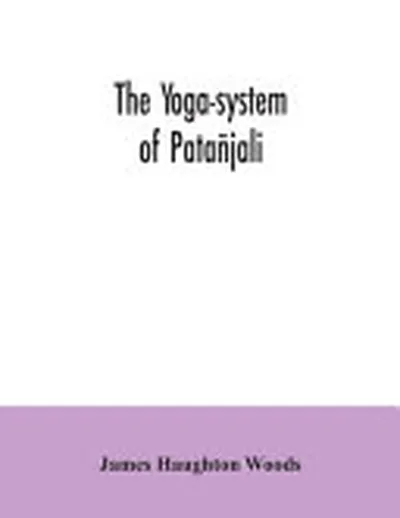
The Yoga-system of Patañjali; Or, The Ancient Hindu Doctrine of Concentration of Mind, Embracing the Mnemonic Rules, Called Yoga-sutras, of Patañjali, and the Comment, Called Yoga-bhashya
 81
81

The Yoga-system of Patañjali; Or, The Ancient Hindu Doctrine of Concentration of Mind, Embracing the Mnemonic Rules, Called Yoga-sutras, of Patañjali, and the Comment, Called Yoga-bhashya
James Haughton Woods' rendition of Patañjali's Yoga-Sutras, accompanied by the Yoga-Bhashya, presents a starkly academic and unvarnished view of this foundational yogic text. The decision to preserve original annotations, as noted in the blurb, is both a strength and a potential barrier for the uninitiated. It offers an unfiltered glimpse into the scholarly reception and presentation of these ancient verses, likely from an early 20th-century academic perspective. The sheer density of the Sanskrit commentary, even in translation, demands significant intellectual rigor. A passage detailing the *samyama* (the combined practice of *dharana*, *dhyana*, and *samadhi*) on various objects, leading to specific powers (*siddhis*), highlights the text's intricate psychological mapping and its potential for esoteric exploration. However, the lack of modern interpretive frameworks or contextualization beyond academic scholarship can make its profound philosophical depth feel inaccessible to contemporary practitioners seeking direct application. This edition serves as a vital historical document for the serious scholar, less so for the casual seeker of spiritual guidance.
📝 Description
81
James Haughton Woods' 1914 translation and commentary on Patañjali's Yoga-Sutras remains a scholarly resource.
This volume presents James Haughton Woods' translation and commentary on the Yoga-Sutras of Patañjali, a core text in Hindu philosophy. It includes the mnemonic rules of the Yoga-Sutras and the significant commentary known as the Yoga-Bhashya. Woods' work offers a primary source for understanding the theoretical basis of classical Yoga, a discipline focused on mental concentration and liberation.
The edition is geared towards students and scholars of Eastern philosophy, comparative religion, and contemplative practices. Researchers interested in an accurate rendering of Patañjali's original work will find value in its preserved annotations. It also serves practitioners of Yoga who seek to connect with the philosophical foundations of their practice, moving beyond contemporary interpretations to the original source.
The Yoga-Sutras themselves are thought to have been compiled between 200 BCE and 400 CE, representing an early systematic treatment of Yoga philosophy. Woods' scholarly endeavor, originally published in the early 20th century, situates these ancient Indian texts within the developing field of Indology. This reprint aims to maintain the integrity of Woods' original scholarly presentation.
The Yoga-Sutras of Patañjali form a foundational scripture for the Raja Yoga tradition within Hinduism. This system elaborates on techniques for mental discipline and spiritual realization, proposing a path to liberation through controlled concentration. Woods' translation and commentary provide direct access to these ancient teachings, situating them within the broader history of Indian philosophical thought. Understanding the Yoga-Sutras is crucial for grasping the theoretical underpinnings of many meditative and spiritual practices that have evolved from this lineage.
💡 Why Read This Book?
• Gain direct access to the foundational philosophical framework of classical Yoga, understanding concepts like *citta-vritti-nirodha* and the eight limbs (*ashtanga yoga*) as articulated in their earliest systematic form. • Explore the detailed commentary of Vyasa (Yoga-Bhashya), which clarifies Patañjali's terse aphorisms and offers early interpretations of crucial terms like *Ishvara* and *siddhis*. • Appreciate the historical academic engagement with Sanskrit philosophical texts, as evidenced by James Haughton Woods' scholarly presentation and the preservation of original annotations from its initial publication.
⭐ Reader Reviews
Honest opinions from readers who have explored this book.
❓ Frequently Asked Questions
What is the primary focus of Patañjali's Yoga-Sutras as presented in this edition?
The primary focus is the ancient Hindu doctrine of concentration of mind, outlined through mnemonic rules (Yoga-Sutras) and elaborated with commentary (Yoga-Bhashya) to achieve mental stillness and spiritual liberation.
Who was James Haughton Woods and what is his contribution?
James Haughton Woods was an academic scholar whose work provided an early, detailed translation and analysis of the Yoga-Sutras and Yoga-Bhashya, contributing significantly to the academic study of Yoga in the early 20th century.
What is the significance of the Yoga-Bhashya included in this volume?
The Yoga-Bhashya is a vital commentary, traditionally attributed to Vyasa, that explains and expands upon Patañjali's concise sutras, offering essential context and interpretation for understanding the philosophical and practical aspects of Yoga.
Why are original annotations preserved in this reprint edition?
The annotations are intentionally left to preserve the book's true nature and the historical scholarly context of its original publication, offering insights into how the text was studied and presented in the past.
What are the 'eight limbs' of Yoga mentioned in Patañjali's system?
The eight limbs, or *ashtanga yoga*, are Yama (ethical restraints), Niyama (observances), Asana (posture), Pranayama (breath control), Pratyahara (withdrawal of the senses), Dharana (concentration), Dhyana (meditation), and Samadhi (absorption).
Is this book suitable for beginners in Yoga practice?
This edition is primarily suited for scholars and advanced practitioners seeking a rigorous, historical academic text. Beginners might find the dense scholarly apparatus and original annotations challenging without supplementary modern guides.
🔮 Key Themes & Symbolism
Cessation of Mental Fluctuations
The core aim of Patañjali's system, termed *citta-vritti-nirodha*, is central. The text meticulously details the nature of mental modifications (*vrittis*) and the techniques for their suppression. This involves understanding the interplay between consciousness (*purusha*) and the mind (*manas*), the senses, and the intellect (*buddhi*), all of which fall under the umbrella of *prakriti* (primordial matter). The Sutras posit that through disciplined practice, these mental disturbances can be stilled, leading to the realization of one's true nature.
The Eight Limbs of Yoga
The *ashtanga yoga* framework provides a progressive path towards self-realization. This includes ethical disciplines like *ahimsa* (non-violence) and *brahmacharya* (continence), personal observances such as *saucha* (purity) and *svadhyaya* (self-study), and internal practices like *pranayama* (breath control) and *dharana* (concentration). Each limb builds upon the previous, preparing the practitioner for deeper states of meditative absorption (*dhyana*) and ultimate union (*samadhi*).
Consciousness and Matter
A fundamental dualism pervades the text: the distinction between pure consciousness (*purusha*) and primordial matter/nature (*prakriti*). The Yoga-Sutras seek to liberate *purusha* from its entanglement with the modifications of *prakriti*, which include the mind, ego, and senses. The commentary explores how the apparent 'self' is often mistaken for the activities of the mind, obscuring the unchanging nature of the true Self.
The Role of Ishvara and Siddhis
The concept of *Ishvara*, a unique consciousness or God, is discussed as a special aid in the path of Yoga, particularly in overcoming obstacles and attaining higher states. The text also addresses the yogic powers (*siddhis*) that can arise from advanced practices, such as concentration (*samyama*) on specific objects or principles, while cautioning that these are potential byproducts and not the ultimate goal of liberation.
💬 Memorable Quotes
Direct passages from the work, attributed to the author.
“Yoga is the cessation of the fluctuations of the mind.”
— This is the most famous sutra, defining the very essence of Yoga. It posits that the mind is naturally restless, and the practice of Yoga aims to bring about a state of profound stillness, allowing for clarity and self-awareness.
“Then the seer (Purusha) abides in its own nature.”
— This sutra describes the ultimate goal of Yoga. When the mind's disturbances are quelled, the true, pure consciousness, distinct from all phenomenal experience, can be recognized and experienced directly.
“The causes of suffering are ignorance, egoism, attachment, aversion, and the fear of death.”
— These five afflictions (*kleshas*) are identified as the root causes of suffering in the phenomenal world. Understanding and dismantling them is crucial for spiritual progress and liberation from the cycle of rebirth.
“By the practice of the limbs of Yoga, the impurities of the body and mind are destroyed.”
— This highlights the holistic approach of Yoga, emphasizing that both physical and mental purification are essential. The eight limbs work in concert to cleanse and refine the practitioner on multiple levels.
“The mind is like a mirror; it reflects whatever comes before it.”
— An interpretation of the nature of *citta* (mind-stuff). This analogy illustrates how the mind passively receives impressions, and that the goal is to refine its reflective capacity so it mirrors truth rather than illusion.
🌙 Esoteric Significance
Tradition
While Patañjali's Yoga is a distinct philosophical system (*darshana*), it deeply informs and is informed by the broader Indic spiritual traditions, particularly Vedanta and Samkhya philosophy. Its esoteric significance lies in its detailed mapping of the human psyche and its potential for transcendence. It provides a systematic framework for inner exploration, aiming for a state of liberation (*kaivalya*) that transcends ordinary consciousness, aligning it with practices found in various mystical traditions seeking direct experience of ultimate reality.
Symbolism
Key symbols include *Purusha*, representing pure consciousness or the Self, often depicted as a passive observer distinct from the active material world (*prakriti*). The *vrittis* (mental fluctuations) can be seen as ripples on the surface of a lake, obscuring the clear reflection of *Purusha*. The *ashtanga* (eight limbs) symbolize a structured ascent, with *asana* (posture) grounding the physical form, *pranayama* (breath control) acting as a bridge to the mind, and *samadhi* representing the ultimate merging of consciousness with its true nature.
Modern Relevance
Contemporary contemplative practices, mindfulness movements, and modern Yoga studios often draw upon Patañjali's system, albeit sometimes simplified. Thinkers and practitioners in fields like transpersonal psychology, consciousness studies, and even secular mindfulness programs engage with concepts like *vritti* control and meditative states. The emphasis on mental discipline and self-awareness continues to resonate with those seeking tools for psychological well-being and spiritual growth in a complex world.
👥 Who Should Read This Book
• Academic researchers and students of comparative religion and Indian philosophy seeking primary source material with scholarly commentary. • Dedicated practitioners of Yoga who wish to understand the philosophical underpinnings and original intent behind the practice, beyond modern adaptations. • Philosophers and psychologists interested in ancient theories of consciousness, mind-body connection, and techniques for mental discipline and self-transformation.
📜 Historical Context
The Yoga-Sutras of Patañjali represent one of the earliest systematic philosophical expositions of Yoga, likely compiled between 200 BCE and 400 CE. This text emerged within a rich intellectual landscape in ancient India, influenced by the Upanishadic traditions and engaging with nascent philosophical schools. The Yoga-Bhashya, a crucial commentary attributed to Vyasa, dates from a later period, possibly around the 4th or 5th century CE, and provides essential clarification for Patañjali's terse aphorisms. The burgeoning field of Indology in the late 19th and early 20th centuries saw renewed scholarly interest in these texts. Figures like Swami Vivekananda had already begun introducing Yoga philosophy to the West, but academic translations like Woods' aimed for critical analysis. This work stands in contrast to the more devotional or ritualistic interpretations of Hinduism prevalent at the time, focusing on the psychological and meditative aspects. Its rigorous academic approach positioned it within a lineage of Western scholarship attempting to systematically understand and present Indian philosophy.
📔 Journal Prompts
The nature of *citta-vritti-nirodha* and its application to daily mental states.
Examining the *kleshas* (afflictions) in one's personal experience.
Reflecting on the relationship between *Purusha* and *prakriti* as perceived through personal awareness.
The practice of *samyama* on a chosen object and its perceived effects.
Understanding the ethical implications of *Yama* and *Niyama* in contemporary life.
🗂️ Glossary
Yoga-Sutras
A collection of aphorisms or mnemonic verses attributed to Patañjali, forming the foundational text of classical Yoga philosophy, detailing its principles and practices.
Yoga-Bhashya
A substantial and ancient commentary on the Yoga-Sutras, traditionally attributed to Vyasa, which elaborates on the meaning and application of Patañjali's concise statements.
Citta-vritti-nirodha
The central tenet of Yoga, translating to the cessation or restraint of the modifications (fluctuations) of the mind-stuff.
Purusha
In Samkhya and Yoga philosophy, the principle of pure consciousness, the self, the observer, which is distinct from matter and its transformations.
Prakriti
Primordial matter or nature, the unmanifest source of all material existence, including the mind, intellect, ego, and senses, which are subject to change.
Ashtanga Yoga
The 'eight limbs' of Yoga: Yama, Niyama, Asana, Pranayama, Pratyahara, Dharana, Dhyana, and Samadhi. A progressive path for spiritual development.
Samyama
The combined practice of Dharana (concentration), Dhyana (meditation), and Samadhi (absorption) on a single object, leading to profound knowledge or insight.