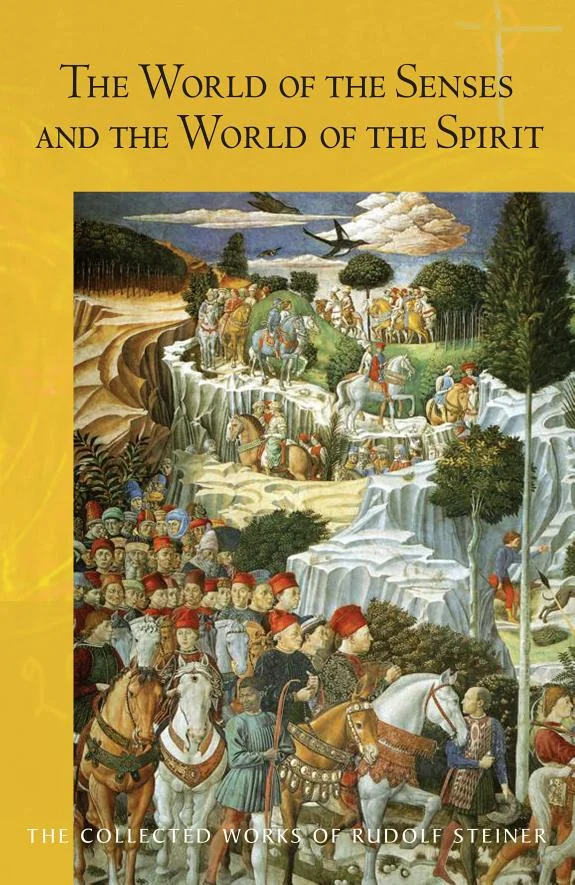
The World of the Senses
 71
71

The World of the Senses
Rudolf Steiner's "The World of the Senses" offers a unique, if challenging, perspective on human perception. Rather than dismissing the senses as mere biological functions, Steiner presents them as intricate spiritual mechanisms. His assertion that our senses are portals to "all-pervading will" and "all-pervading wisdom" is a bold claim that demands careful consideration. The sections dedicated to the phenomenology of hearing and, particularly, color perception are where the work truly shines, providing detailed, albeit abstract, descriptions of how these senses connect us to the etheric body and spiritual realms. However, the dense Anthroposophical terminology and the inherent difficulty in empirically verifying Steiner's claims can be a significant hurdle for readers unfamiliar with his broader philosophical system. The work's strength lies in its radical reframing of the mundane, challenging us to see more than what meets the eye. Its limitation is its accessibility; it requires significant intellectual and perhaps spiritual preparation to fully engage with. Ultimately, "The World of the Senses" serves as a profound, if demanding, exploration of the spiritual underpinnings of our sensory lives.
📝 Description
71
Rudolf Steiner's 1923 lectures posit the senses as gateways to spiritual realities.
Rudolf Steiner's "The World of the Senses," derived from lectures given in 1923, proposes that human senses function as more than just biological tools. Steiner argues they are vital interfaces connecting the physical and etheric bodies, allowing us to engage with spiritual forces he identified as "all-pervading will" and "all-pervading wisdom." This view suggests sensory experience is a two-way street: the outer world influences us, but our inner self also interacts with these spiritual energies.
The book examines how spiritual will, which has both physical and spiritual aspects, appears in our sensory perceptions. Steiner specifically discusses hearing and sight, detailing how we grasp sound and color. He proposes that our apprehension of these phenomena reflects deeper spiritual workings. For example, perceiving color is not just about light waves; it involves the etheric body and its link to the spiritual realm.
Steiner's aim is to help readers perceive the world more consciously, recognizing the spiritual structure beneath physical reality. The lectures seek to equip individuals with a way to understand the spiritual dimensions present in everyday sensory experiences.
This work belongs to the tradition of Anthroposophy, a spiritual philosophy founded by Rudolf Steiner. Anthroposophy seeks to investigate the spiritual world through what Steiner termed 'spiritual science.' "The World of the Senses" is presented as a means to understand human consciousness and the cosmos from a non-materialistic viewpoint. The lectures aim to provide a framework for perceiving spiritual realities that are often overlooked in a purely physical understanding of existence.
💡 Why Read This Book?
• Understand the senses as active spiritual interfaces, not passive receivers, by examining Steiner's concept of the etheric body's role in perceiving phenomena like color. This offers a unique perspective beyond standard sensory science. • Explore the nature of "all-pervading will" and "all-pervading wisdom" as Steiner presents them, linking these spiritual forces directly to the experience of hearing and sight, a connection not typically found in philosophical texts. • Gain insights into the fundamental principles of Anthroposophy through the lens of sensory experience, as Steiner outlines how perception itself can be a pathway to spiritual cognition, a core tenet of his early 20th-century work.
⭐ Reader Reviews
Honest opinions from readers who have explored this book.
❓ Frequently Asked Questions
What is Rudolf Steiner's core argument in 'The World of the Senses'?
Steiner argues that human senses are not just physical organs but spiritual portals. They connect our physical and etheric bodies to realms of "all-pervading will" and "all-pervading wisdom," revealing spiritual realities through sensory experience.
When were the lectures that form 'The World of the Senses' originally given?
The lectures were originally delivered by Rudolf Steiner in the early 20th century, though the book compilation was first published in 2014. This places them within the context of early Anthroposophical development.
How does Steiner explain the perception of color?
Steiner explains color perception as an active process involving the etheric body, connecting it to spiritual dynamics rather than solely physical light waves. He sees it as revealing aspects of the 'all-pervading wisdom'.
Is 'The World of the Senses' suitable for beginners to Steiner's work?
While accessible in its core ideas, the book delves into complex Anthroposophical concepts. Readers new to Steiner might benefit from introductory texts on Anthroposophy before tackling this work's specific focus on sensory perception.
What is the relationship between the senses and the will in Steiner's view?
Steiner posits that our senses reveal the spiritual nature of the will. The way we perceive the world, especially through senses like hearing and sight, is a manifestation of this underlying spiritual and physical phenomenon.
What is the etheric body according to Rudolf Steiner?
The etheric body, or life body, is considered by Steiner to be a subtle, non-physical energetic body that sustains the physical body and is involved in processes like growth, reproduction, and healing, as well as sensory perception.
🔮 Key Themes & Symbolism
Senses as Spiritual Portals
This theme explores the radical idea that human senses are not merely biological instruments but gateways to spiritual dimensions. Steiner posits that through our senses, particularly sight and hearing, we interact with a spiritual reality he calls "all-pervading will" and "all-pervading wisdom." This perspective reframes sensory experience from passive reception to an active, conscious engagement with subtle forces, suggesting that the physical act of perceiving is intertwined with our etheric body's connection to the cosmos.
The Phenomenology of Color and Sound
Steiner provides detailed, esoteric interpretations of how we experience color and sound. He moves beyond purely physical explanations (like light waves or sound vibrations) to describe how these phenomena reveal the spiritual nature of the world and our own inner being. The perception of color, for instance, is linked to the etheric body's activity and its relationship with cosmic forces, offering a spiritual physiology of perception distinct from materialistic science.
Will as a Spiritual-Physical Force
A central concept is the nature of the will, which Steiner presents as a force that is simultaneously spiritual and physical. "The World of the Senses" investigates how this will manifests and is apprehended through our sensory experiences. By understanding how we perceive, Steiner suggests we can gain direct insight into the workings of this fundamental force, which shapes both the external world and our internal consciousness, connecting us to the dynamic processes of existence.
Anthroposophy and Sensory Cognition
The book serves as an introduction to key Anthroposophical ideas, emphasizing the potential for spiritual cognition through the careful observation of the natural world and our sensory interactions. Steiner aims to equip readers with a method for perceiving the spiritual underpinnings of physical phenomena. This approach encourages a transformation of consciousness, where everyday sensory experiences become avenues for direct spiritual insight and understanding of cosmic laws.
💬 Memorable Quotes
Direct passages from the work, attributed to the author.
“The senses reveal the mysterious world of the will, which is at once a spiritual and physical phenomenon.”
— This core statement expresses Steiner's thesis: our sensory apparatus is not just for reading through the physical but for apprehending the spiritual dimensions of existence, specifically the nature of 'will' as a dual force.
“The senses act as a portal connecting our physical and etheric bodies with what Steiner refers to as worlds of 'all-pervading will' and 'all-pervading wisdom.'”
— This highlights the function of the senses as a bridge between the material and the spiritual. It suggests that through perception, we can access higher domains of consciousness and cosmic intelligence.
“Steiner elaborates this theme, giving some unexpected and delightful insights into the senses of hearing and sight, and in particular how we experience colour.”
— This points to the specific focus on the senses of sight and hearing, with a particular emphasis on the experience of color. It suggests the book offers unique, non-conventional explanations for these fundamental human perceptions.
“Our perception of color is presented as an active process involving the etheric body.”
— This interpretation focuses on Steiner's unique view of color, differentiating it from purely physical explanations by linking it to the subtle energetic body and its role in spiritual perception.
💡 Key Ideas
Editorial paraphrase of the work's core concepts — not direct quotes.
The work explores how the human senses reveal the mysterious world of the will.
This paraphrased concept emphasizes the revelatory power of sensory experience in understanding the fundamental force of 'will' as presented in Steiner's spiritual science.
🌙 Esoteric Significance
Tradition
This work is firmly rooted in the Anthroposophical tradition, founded by Rudolf Steiner. While drawing upon broader Western esoteric currents like Hermeticism and Gnosticism in its pursuit of spiritual knowledge beyond the physical senses, Anthroposophy presents a distinct methodology and cosmology. Steiner's focus on the etheric body and his specific understanding of spiritual evolution differentiate it, offering a modern, individualized path to spiritual insight through conscious perception.
Symbolism
While not heavily reliant on traditional symbolic systems, the book uses the human senses themselves as profound symbols. Sight and hearing are explored as primary conduits to the spiritual world. Color, in particular, functions symbolically, representing the manifestation of spiritual forces within the sensory realm. The 'will' and 'wisdom' are abstract concepts that function symbolically, representing divine or cosmic intelligences that are apprehended through our sensory engagement with reality.
Modern Relevance
Steiner's ideas on sensory perception and the spiritual world continue to influence various contemporary fields. Waldorf education, biodynamic agriculture, and anthroposophical medicine draw directly from his work. Thinkers and practitioners interested in consciousness studies, integral spirituality, and alternative epistemologies find value in his detailed phenomenological descriptions of inner experience and the spiritual dimensions of the natural world.
👥 Who Should Read This Book
• Students of Rudolf Steiner and Anthroposophy seeking to deepen their understanding of his core concepts regarding perception and the etheric body. • Individuals interested in comparative philosophy and esoteric traditions who wish to explore non-materialistic perspectives on human consciousness and sensory experience. • Practitioners of contemplative or meditative disciplines looking for frameworks to interpret their inner experiences and perceive subtle realities beyond the physical senses.
📜 Historical Context
Rudolf Steiner delivered the lectures that comprise "The World of the Senses" in the early 20th century, a period marked by intense spiritual and intellectual ferment. As a counterpoint to the prevailing materialistic scientific worldview, Steiner developed Anthroposophy, a spiritual philosophy seeking to bridge science and spirituality. His work engaged with contemporary spiritual movements like Theosophy, from which he eventually diverged, but also with philosophical currents questioning the limits of empirical knowledge. The early 1900s saw figures like William James exploring consciousness and Bergson looking at concepts of duration and intuition, offering alternative frameworks to positivism. While direct documented engagement with specific critics or rival schools within "The World of the Senses" itself is less evident, Steiner's entire oeuvre stood in implicit dialogue with the scientific rationalism of institutions like the Prussian Academy of Sciences. His reception was often polarized, admired by followers for his insights into spiritual realities, but viewed with skepticism by the academic mainstream.
📔 Journal Prompts
The sensory experience of color and its connection to the etheric body.
The role of hearing in apprehending the 'all-pervading will'.
How physical perception might reveal spiritual-physical forces.
Translating Steiner's concept of 'all-pervading wisdom' into daily sensory awareness.
The senses as active participants versus passive receivers of information.
🗂️ Glossary
Anthroposophy
A spiritual philosophy founded by Rudolf Steiner, aiming to understand the human being and the cosmos through spiritual science, emphasizing the development of higher faculties of cognition.
Etheric Body
In Anthroposophy, the 'life body' or etheric body is a subtle, energetic form that sustains the physical body, responsible for life processes, growth, and reproduction. It plays a role in sensory perception.
All-pervading Will
A concept in Steiner's work referring to a fundamental spiritual force or intelligence that underlies and animates the physical world, apprehended through sensory experience.
All-pervading Wisdom
A complementary spiritual force or intelligence to 'all-pervading will,' representing the ordering principles and consciousness inherent in the cosmos, accessible through spiritual perception.
Spiritual Science
Steiner's term for his method of investigating the spiritual world through direct experience and disciplined consciousness, analogous to natural science's investigation of the physical world.
Phenomenology
The philosophical study of the structures of experience and consciousness as experienced from the first-person point of view. Steiner applied this approach to spiritual phenomena.
Will (Spiritual-Physical)
In Steiner's context, the will is not merely a psychological faculty but a fundamental cosmic force with both material and spiritual aspects, revealed through our sensory interactions with the world.
This book appears in 1 collection
🔮 Readers Also Liked
Browse all →




From the “Anthroposophy” Collection
View all →






More Free Theosophy & Anthroposophy Books
View all →