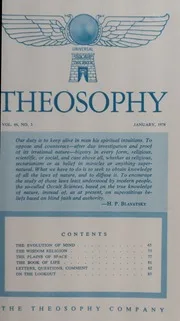
Theosophy
 74
74

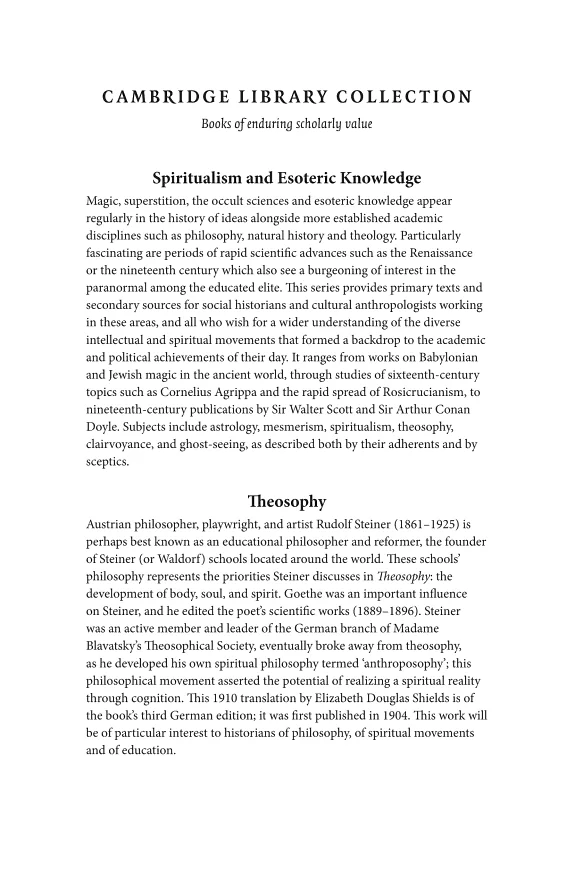
Theosophy
Rudolf Steiner’s "Theosophy" offers a starkly intellectual approach to spiritual inquiry, diverging from the more mystical prose often associated with the Theosophical Society. His detailed exposition on the evolution of consciousness and the various bodies that constitute the human being—etheric, astral, and ego—is rigorous, if at times dense. One particular strength lies in his systematic breakdown of karma and reincarnation, presenting them not as mere dogma but as observable cosmic laws. However, the work’s limitation for the uninitiated is its inherent reliance on Steiner’s unique terminology and conceptual framework, which can feel inaccessible without prior grounding in his Anthroposophical system. The exploration of the spiritual hierarchies, for instance, requires a significant mental adjustment for those accustomed to more traditional theological or philosophical structures. While undeniably a significant text for understanding Steiner’s philosophy, it demands considerable reader effort to fully grasp its intricate architecture.
📝 Description
74
Rudolf Steiner's Theosophy, published in 2015 by Elizabeth Douglas Shields, outlines a spiritual philosophy.
This 2015 edition of Rudolf Steiner's work presents a spiritual philosophy intended to explain the divine, humanity, and the cosmos through esoteric principles. It is aimed at readers seriously interested in spiritual science and esoteric traditions, particularly those studying philosophy, comparative religion, or seeking an understanding of consciousness and existence beyond materialist views. The text requires an inclination for abstract thought and engagement with complex metaphysical ideas.
Steiner, a significant figure in early 20th-century esoteric thought, developed his ideas on Theosophy within the context of the Theosophical Society founded by Helena Blavatsky. His work here reflects a period of increased interest in Eastern religions and occultism, partly as a reaction to industrialization and scientific materialism. This book reflects his philosophical developments, especially following his departure from the Theosophical Society in 1913 to establish Anthroposophy.
Rudolf Steiner’s engagement with Theosophy positions this work within a broader turn-of-the-century interest in spiritual and occult philosophies. His critique and eventual departure from the Theosophical Society, leading to the founding of Anthroposophy, highlight a specific development within esoteric movements of the early 20th century. This book arises from that milieu, which sought alternative explanations for existence and consciousness in contrast to prevailing scientific materialism.
💡 Why Read This Book?
• Gain insight into Rudolf Steiner's specific conceptualization of spiritual science, including his detailed descriptions of the human being's non-physical bodies like the etheric and astral bodies, which informs his unique philosophical system. • Understand the fundamental principles of karma and reincarnation as presented by Steiner, moving beyond popular interpretations to grasp their role in cosmic and individual evolution. • Explore Steiner's perspective on the nature of the spiritual world and the methods for its perception, offering a distinct approach to spiritual development compared to other esoteric traditions.
⭐ Reader Reviews
Honest opinions from readers who have explored this book.
❓ Frequently Asked Questions
What is the primary focus of Rudolf Steiner's Theosophy?
Rudolf Steiner's Theosophy primarily focuses on spiritual science, exploring the evolution of consciousness, karma, reincarnation, and the spiritual structure of the human being and the cosmos.
When was Rudolf Steiner's Theosophy originally published?
While the original intellectual work by Steiner predates it, this specific edition of 'Theosophy' was first published on February 8, 2015, by Elizabeth Douglas Shields.
Is this book suitable for beginners in esoteric studies?
The book presents complex metaphysical concepts and a specific terminology, making it more suitable for those with some background or a strong interest in esoteric philosophy and spiritual science.
What is the relationship between Steiner's Theosophy and Anthroposophy?
Steiner's work on Theosophy formed a basis for his later development of Anthroposophy after he departed from the original Theosophical Society.
Can I find this book in the public domain?
This specific edition notes that the original work is in the public domain in the United States, allowing for its faithful reproduction.
What are the main components of the human being according to Steiner's Theosophy?
According to Steiner's Theosophy, the human being is composed of physical, etheric, astral bodies, and the ego, each representing different levels of existence and consciousness.
🔮 Key Themes & Symbolism
Evolution of Consciousness
The work posits that human consciousness and the cosmos itself are undergoing a continuous process of evolution. Steiner outlines distinct stages of this development, from primordial states to future spiritual potentials, emphasizing humanity's active role in this unfolding process through inner spiritual work and conscious evolution.
Karma and Reincarnation
Steiner presents karma and reincarnation not as fatalistic doctrines but as intricate, intelligent laws governing cause and effect across multiple lifetimes. The book explains how actions and intentions create karmic consequences that shape future experiences, influencing individual development and the broader cosmic order.
The Human Being's Structure
A central theme is the detailed exposition of the human being's multi-layered constitution. Steiner describes the physical body, the life-giving etheric body, the feeling-oriented astral body, and the unique human ego, each with its specific functions and connection to the spiritual realms and earthly existence.
Spiritual Perception
The book addresses the possibility and methods for developing higher faculties of perception, enabling individuals to apprehend the spiritual world directly. Steiner outlines a disciplined path of inner development, distinguishing between imaginative, inspirational, and intuitive cognition.
💬 Memorable Quotes
Direct passages from the work, attributed to the author.
“The Theosophical Society has the task of bringing the spiritual world to the human being.”
— This statement highlights the core mission of the Theosophical movement as understood by Steiner: to act as a bridge, revealing the existence and nature of the spiritual realms to humanity in a comprehensible manner.
“The human being is a microcosm that reflects the macrocosm.”
— This classic esoteric principle, as presented by Steiner, signifies that the internal structure and processes of the individual human mirror the larger universal forces and structures of the cosmos.
“Karma is the law of moral causation.”
— This concise definition expresses Steiner's view of karma not as arbitrary fate, but as an inherent, understandable principle of ethical consequence that operates universally.
“The etheric body is the vehicle of life.”
— Steiner uses this to describe the etheric body's function as the carrier of life forces and organic processes, distinct from the physical body and responsible for growth and vitality.
“The astral body is the bearer of consciousness and feeling.”
— This interpretation emphasizes the astral body's role as the seat of subjective experience, emotions, desires, and the foundation of sentient awareness in Steiner's spiritual science.
🌙 Esoteric Significance
Tradition
This work belongs to the Western Esoteric tradition, specifically within the Theosophical lineage that sought to synthesize Eastern and Western spiritual insights. Steiner's "Theosophy" builds upon foundational Theosophical concepts like karma and reincarnation but significantly reframes them through his developing spiritual-scientific methodology, paving the way for his independent movement, Anthroposophy.
Symbolism
Key symbols include the evolution of consciousness, depicted as a developmental spiral rather than a linear progression. The human being is often symbolized by its layered bodies (physical, etheric, astral, ego), representing stages of manifestation and spiritual potential. The concept of 'Spiritual Hierarchies' also acts symbolically, representing organized spiritual intelligences guiding cosmic evolution.
Modern Relevance
Steiner's extensive work, including "Theosophy," continues to influence contemporary thinkers and practitioners in fields such as Waldorf education, biodynamic agriculture, holistic medicine, and various spiritual communities seeking a comprehensive worldview that integrates science and spirit.
👥 Who Should Read This Book
• Students of Rudolf Steiner's philosophical and spiritual work seeking to understand the origins of his thought before the full development of Anthroposophy. • Individuals interested in the history of the Theosophical movement and its key figures, particularly Steiner's unique contributions and divergences. • Readers exploring comparative esoteric traditions who wish to grasp a systematic spiritual cosmology presented with a 'spiritual-scientific' approach.
📜 Historical Context
Rudolf Steiner's "Theosophy" emerged from the fertile intellectual ground of the late 19th and early 20th centuries, a period marked by intense interest in spiritualism, occultism, and Eastern philosophies, largely catalyzed by figures like Helena Blavatsky and her Theosophical Society. Steiner himself was deeply involved with the Society, serving as its General Secretary in Germany, before famously breaking away in 1913 due to philosophical disagreements, particularly concerning the nature of Christ and the future of spiritual evolution. His "Theosophy," published in German in 1904, reflects his early engagement with these themes, presenting a systematic esoteric cosmology. This era saw numerous spiritual movements arise, from Theosophy and Anthroposophy to various Western Esoteric traditions, often in dialogue or contention with prevailing scientific materialism and established religious doctrines. Steiner's work offered a distinct spiritual-scientific perspective, aiming to provide verifiable knowledge of the supersensible world, differentiating itself from purely devotional or philosophical approaches.
📔 Journal Prompts
The concept of the etheric body's role in life processes.
The cosmic laws of karma and reincarnation as presented.
Rudolf Steiner's description of the astral body's function.
The idea of spiritual hierarchies guiding evolution.
Methods for developing spiritual perception as outlined.
🗂️ Glossary
Etheric Body
In Steiner's work, the etheric body, or life body, is the subtle, non-physical energetic field responsible for life processes, growth, healing, and reproduction, distinct from the physical form.
Astral Body
The astral body is described as the vehicle of consciousness, feeling, desire, and sensation. It is the realm where subjective experiences and emotions reside, connecting the human to the sentient world.
Ego
The ego, in Steiner's system, represents the true spiritual individuality and the principle of self-awareness, consciousness, and moral responsibility, developing over successive incarnations.
Karma
Karma refers to the law of cause and effect governing moral and spiritual actions, where deeds in one life create consequences that influence future existences and experiences.
Reincarnation
The process by which the spiritual essence of a human being returns to physical life in a new body after death, allowing for continued evolution and the working out of karma.
Spiritual Hierarchies
These are organized ranks of spiritual beings (e.g., Angels, Archangels, Archai) that work with and guide the evolution of the cosmos and humanity according to specific divine plans.
Spiritual Science
A term used by Steiner to describe a method of inquiry and knowledge acquisition focused on the spiritual realms, employing faculties of higher cognition to gain verifiable insights.