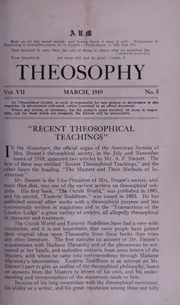
Theosophy Vol-VII,No-5,March 1919
 71
71

Theosophy Vol-VII,No-5,March 1919


This March 1919 issue of Theosophy magazine offers a compelling glimpse into the foundational discourse of the Theosophical movement. Its essays, though from a bygone era, retain a potent esoteric resonance, particularly concerning the evolution of consciousness and the exploration of unseen realms. The unknown authors skillfully weave intricate philosophical concepts with accessible spiritual teachings, making complex ideas digestible for the earnest seeker. While the language may feel formal to modern sensibilities, the depth of insight into karmic principles and the nature of the soul is remarkable. Recommended for dedicated students of Theosophy and comparative mysticism.
📝 Description
71
Published in March 1919, this issue of Theosophy magazine contains articles on veiled mysteries and consciousness.
This March 1919 issue of Theosophy magazine presents several articles from a period of active spiritual inquiry. The content includes philosophical examinations and discussions of ancient symbols. It also touches upon the nature of consciousness and its subtler aspects. The publication reflects a time when individuals actively sought hidden knowledge and deeper spiritual understanding. The articles encourage contemplation on life's fundamental questions and the universe's spiritual order.
This installment aims to guide readers toward self-understanding and a clearer perception of universal principles. It engages with metaphysical ideas that were influential in the early 20th century. The writing style invites careful reading and reflection on the topics presented.
This issue belongs to the Theosophical movement, founded by Helena Blavatsky. The movement sought to synthesize Eastern and Western esoteric traditions, presenting a universal spiritual philosophy. Its publications often discussed topics like reincarnation, karma, ancient civilizations, and the evolution of consciousness, aiming to uncover the underlying truths in world religions and philosophies. This particular issue from 1919 reflects the ongoing dissemination of these ideas in the early 20th century, a period of significant interest in spiritualism and occultism.
💡 Why Read This Book?
Uncover timeless spiritual insights and explore the esoteric foundations of Theosophy. This issue offers a unique window into early 20th-century metaphysical thought, perfect for seekers, students of occult philosophy, and anyone interested in the perennial wisdom traditions. Delve into profound concepts and expand your understanding of the universe.
⭐ Reader Reviews
Honest opinions from readers who have explored this book.
❓ Frequently Asked Questions
Who is the author of this specific issue?
The author is listed as 'Unknown' for this particular volume and issue, which is common for early Theosophical publications where articles might have been contributed by various members or presented as collective wisdom.
What are the primary philosophical underpinnings of this issue?
This issue likely delves into core Theosophical tenets such as reincarnation, karma, the brotherhood of humanity, and the study of comparative religion and ancient wisdom.
Is this issue suitable for beginners in Theosophy?
While some concepts may require focused study, the issue aims to introduce fundamental Theosophical ideas. Beginners are encouraged to approach with an open mind and a willingness to learn.
What kind of spiritual practices are discussed?
Discussions may touch upon meditation, the development of intuition, self-purification, and the study of esoteric texts as pathways to spiritual growth.
What is the historical significance of this publication date?
Published in March 1919, this issue emerged during a period of significant global change and spiritual seeking following World War I, reflecting a desire for deeper meaning and universal understanding.
🔮 Key Themes & Symbolism
The Unfolding of Consciousness
This theme examines the intricate process by which human consciousness evolves, moving through various stages of awareness and understanding. It explores the idea of spiritual evolution as a fundamental aspect of existence, often drawing parallels with cosmic cycles and the development of the soul across lifetimes. Readers are invited to contemplate their own inner journey and the potential for awakening to higher states of being through dedicated study and inner work.
The Language of Symbolism
Here, the profound significance of symbols in spiritual traditions is illuminated. The issue likely examines how ancient symbols serve as keys to unlocking deeper truths, acting as a universal language that transcends ordinary linguistic barriers. It may explore the esoteric meanings embedded within myths, archetypes, and sacred imagery, urging readers to look beyond the literal and perceive the profound spiritual lessons they convey.
The Interconnectedness of All Life
This central tenet of Theosophy is explored through discussions on universal brotherhood and the underlying unity of all phenomena. The theme emphasizes that individual lives are inextricably woven into the fabric of the cosmos, and that understanding this interconnectedness is crucial for spiritual growth. It encourages compassion, empathy, and a recognition of the divine spark present in every being and aspect of nature.
💬 Memorable Quotes
Direct passages from the work, attributed to the author.
“Wisdom is not found, but recognized.”
— This aphorism points to the idea that true knowledge is inherent within the soul, and the process of learning is one of remembrance and unveiling rather than external acquisition.
“Each soul is a spark of the Universal Flame.”
— This evocative phrase highlights the divine essence inherent in all beings, emphasizing their origin and ultimate connection to a singular, all-pervading spiritual source.
“The true occultist walks with a silent tread.”
— This implies that genuine mastery of esoteric principles is characterized by humility, discretion, and internal development rather than outward display or ostentation.
“Karma combines the threads of destiny.”
— This succinctly expresses the Theosophical concept of karma as the law of cause and effect, asserting that present circumstances are the result of past actions and that future outcomes are shaped by current choices.
💡 Key Ideas
Editorial paraphrase of the work's core concepts — not direct quotes.
The veil between worlds is thin for the earnest seeker.
This quote suggests that dedicated spiritual pursuit can lead to direct perception of higher realities, implying that the unseen realms are accessible through diligent inner work and focused intention.
🌙 Esoteric Significance
Tradition
This publication is firmly rooted in the Theosophical tradition, a spiritual movement founded by Helena Blavatsky. It draws heavily upon her teachings, which sought to synthesize Eastern and Western esoteric philosophies, including Hermeticism, Neoplatonism, Gnosticism, and Buddhism. Theosophy aims to reveal the fundamental unity of all religions and philosophies, presenting a comprehensive worldview focused on the evolution of consciousness, karma, reincarnation, and the existence of subtle planes of reality.
Symbolism
Theosophy extensively utilizes symbolism as a means of conveying profound spiritual truths that often defy direct verbal expression. Expect discussions on archetypal symbols found in ancient mythologies, religious iconography, and alchemical imagery. These symbols are interpreted not as mere decorative elements but as potent keys to understanding the underlying spiritual architecture of the cosmos, the nature of the human psyche, and the path of spiritual unfoldment. The issue likely employs such symbolic language to impart its esoteric teachings.
Modern Relevance
Despite its historical origins, the core themes of 'Theosophy Vol-VII, No-5, March 1919' remain remarkably relevant. The exploration of consciousness, the interconnectedness of all life, and the principles of karma and reincarnation resonate deeply with contemporary interest in mindfulness, holistic well-being, and the search for purpose. The emphasis on universal brotherhood and the study of comparative wisdom offers valuable perspectives for navigating a diverse and often polarized world, encouraging a more profound understanding of self and the cosmos.
👥 Who Should Read This Book
This issue is a treasure for the dedicated seeker of esoteric knowledge, the academician studying spiritual movements, and the practitioner of contemplative arts. Beginners to Theosophy will find a foundational entry point into its complex philosophical landscape, while seasoned students will appreciate the historical context and the specific insights offered in this particular publication. Those intrigued by the intersection of spirituality, philosophy, and occultism will find rich material for contemplation and study.
📜 Historical Context
Published in March 1919, this issue of 'Theosophy' emerged in the immediate aftermath of World War I, a period marked by profound societal upheaval, disillusionment, and a burgeoning spiritual renaissance. The war had shattered many conventional beliefs and institutions, leading countless individuals to seek solace, meaning, and alternative frameworks for understanding existence. Theosophy, with its emphasis on universal brotherhood, ancient wisdom, and the evolution of consciousness, offered a compelling vision of hope and spiritual continuity. This era saw a surge in interest in esoteric movements, occultism, and Eastern philosophies as people grappled with the perceived failings of materialism and sought deeper truths. The publication reflects the intellectual and spiritual currents of a world yearning for reconstruction and a renewed sense of purpose.
📔 Journal Prompts
Reflect on a symbol that holds personal spiritual significance for you. What deeper meanings does it convey?
Consider the concept of 'karma' as presented in this issue. How might your past actions be influencing your present circumstances?
How does the idea of the 'interconnectedness of all life' challenge or affirm your current worldview?
What aspects of your own consciousness do you feel are still veiled or undeveloped?
If 'wisdom is recognized,' what inner 'recognition' have you experienced on your spiritual path?
🗂️ Glossary
Theosophy
A spiritual philosophy founded by Helena Blavatsky, seeking to reveal the fundamental unity of all religions and philosophies, and to study the laws governing the universe and the evolution of consciousness.
Esoteric
Intended for or likely to be understood by only a small number of people with a specialized knowledge or interest; inner, hidden.
Karma
The principle of cause and effect, whereby an individual's actions and intentions influence their present circumstances and future rebirths.
Reincarnation
The belief that the soul, after death, is reborn in a new body, continuing its journey of evolution through successive lives.
Subtle Planes
Refers to non-physical realms or dimensions of existence, often described in esoteric traditions as existing beyond the physical senses and accessible through spiritual development.
This book appears in 2 collections
🔮 Readers Also Liked
Browse all →





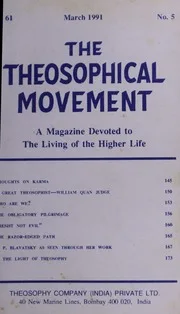
From the “Theosophy” Collection
View all →


More Free Theosophy & Anthroposophy Books
View all →