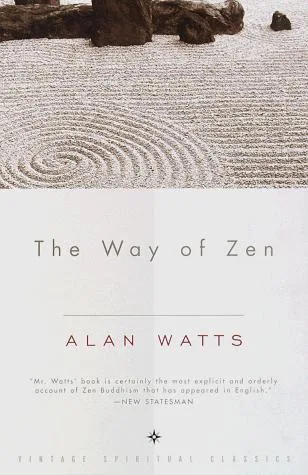
The Way of Zen
 80
80

The Way of Zen
Alan Watts’s "The Way of Zen" remains a cornerstone for Western engagement with its subject, though its approach is undeniably a product of its era. Watts excels at translating the often-abstruse concepts of Zen Buddhism into relatable Western philosophical terms. His explanation of *sunyata* (emptiness) as an absence of fixed self, rather than mere nothingness, is particularly illuminating. However, the book sometimes leans heavily on analogy, which, while aiding comprehension, can also introduce a layer of Watts's own interpretive framework rather than presenting Zen in its unadulterated form. A notable strength is the chapter on Zen art, which connects the aesthetic to the philosophical. The limitation lies in its historical distance; contemporary scholars and practitioners might find certain interpretations dated. Still, for its original purpose of introducing Zen's essence, it largely succeeds.
📝 Description
80
Alan Watts published "The Way of Zen" in 1957 to explain this Eastern philosophy to Western readers.
Alan Watts's "The Way of Zen," published in 1957, serves as an introduction to Zen Buddhism for a Western audience. Watts, known for interpreting Eastern thought, uses accessible language to explain Zen's core ideas, drawing from Buddhist scriptures. The book examines Zen's history and how it differs from other Buddhist traditions.
This book appeals to those curious about Eastern philosophies and spirituality, especially individuals seeking a clear introduction to Buddhism. It is for readers who may feel constrained by conventional religious structures and are looking for different views on consciousness, reality, and the self. Anyone interested in the philosophical basis of mindfulness and meditation, or the influence of Eastern thought on Western culture, will find this work valuable. It is also suitable for students of comparative religion and philosophy.
Published in 1957, "The Way of Zen" arrived during a time of growing Western interest in Eastern spirituality, influenced by figures like D.T. Suzuki. Watts's work acted as a bridge, translating complex Mahayana Buddhist concepts for a general audience. The book's accessibility contributed to its influence on the Beat Generation and later counterculture movements, marking a significant moment in the broader cultural reception of Eastern thought.
💡 Why Read This Book?
• You will learn how Zen's concept of *satori*, or sudden enlightenment, challenges conventional Western notions of gradual spiritual progress, offering a different path to understanding consciousness, as detailed in the book's exploration of this key term. • You will gain insight into the function of *koans* as paradoxical tools for dismantling ego-driven logic, a specific technique Watts explains that offers a unique method for self-inquiry beyond intellectual understanding. • You will discover how Zen art, as discussed in the book, reflects the philosophy of spontaneity and emptiness, providing a concrete, visual example of Zen principles that enriches the reader's grasp of the tradition.
⭐ Reader Reviews
Honest opinions from readers who have explored this book.
❓ Frequently Asked Questions
When was Alan Watts's "The Way of Zen" first published?
"The Way of Zen" was first published in 1957, a pivotal year for introducing Eastern philosophical concepts to a wider Western audience.
What is a koan, according to Watts's "The Way of Zen"?
Watts describes koans as paradoxical riddles or questions used in Zen practice, intended to exhaust the rational mind and lead to sudden insight or enlightenment (satori).
How does "The Way of Zen" explain the concept of emptiness (sunyata)?
The book explains sunyata not as nihilism, but as the absence of an inherent, independent self or essence in all phenomena, a core Mahayana Buddhist doctrine.
Is "The Way of Zen" suitable for absolute beginners to Buddhism?
Yes, Watts's accessible prose makes it an excellent starting point for those new to Buddhist philosophy, demystifying complex ideas without requiring prior knowledge.
What is the role of meditation (zazen) in the context of this book?
Watts presents zazen, or seated meditation, as the central practice in Zen, the primary method for directly realizing the insights into emptiness and selfhood discussed in the book.
Does the book discuss the historical development of Zen Buddhism?
Yes, "The Way of Zen" traces Zen's lineage from Indian Buddhism through China and Japan, explaining its unique characteristics that emerged in East Asia.
🔮 Key Themes & Symbolism
The Nature of Reality
Watts deconstructs conventional Western perceptions of reality, emphasizing Zen's perspective that the world is not a collection of separate, solid objects. He explores the concept of emptiness (*sunyata*) as fundamental, not as a void, but as the lack of inherent, fixed existence. This challenges the ego's tendency to cling to a solid sense of self and external objects, suggesting that true understanding arises from recognizing the fluid, interdependent nature of all things. The book uses analogies to illustrate how our ordinary perception is a construct, and that direct experience is key to seeing reality as it is.
Direct Experience and Awakening
Central to "The Way of Zen" is the idea that enlightenment (*satori*) is not achieved through prolonged study or adherence to dogma, but through direct, intuitive insight. Watts highlights Zen's pragmatic approach, focusing on present moment awareness and immediate apprehension of truth. The practice of *zazen* (seated meditation) is presented as the primary vehicle for this direct experience, a way to quiet the discursive mind. The book argues that intellectual understanding alone is insufficient; true realization comes from lived experience, breaking through conceptual barriers.
The Role of Paradox and Intuition
Watts explains how Zen utilizes paradox, most famously through *koans*, to shock the practitioner out of habitual patterns of thought. These seemingly illogical questions or statements are designed to bypass the intellect, forcing the mind into a state where conventional reasoning fails. This creates an opening for intuitive understanding, a sudden grasp of reality that transcends logic. The book suggests that this embrace of paradox is essential for appreciating the non-dualistic nature of Zen, where opposites are not fundamentally separate.
Zen and Western Thought
Published in 1957, the book serves as a bridge between Eastern spiritual traditions and a Western audience. Watts consciously frames Zen concepts in terms understandable to Western philosophers and psychologists, drawing parallels and contrasts with Western ideas. He addresses potential misunderstandings of Buddhist concepts, such as equating emptiness with nihilism. His work reflects a broader mid-20th-century intellectual current where Eastern philosophies began to significantly influence Western culture, art, and psychology, offering an alternative worldview.
💬 Memorable Quotes
Direct passages from the work, attributed to the author.
“Zen is a way of life, a religion, a philosophy, and an art. It is a way of seeing the world.”
— This interpretation underscores the holistic nature of Zen as presented by Watts. It's not confined to a single discipline but permeates all aspects of existence, influencing perception, action, and understanding across diverse domains.
“To have faith is to trust yourself to the water. When you swim you don't grab hold of the water, because if you do you will sink and drown.”
— This memorable analogy illustrates the principle of effortless action and trust in Zen. It contrasts forceful control with yielding to natural forces, suggesting that true mastery comes from aligning with, rather than against, the currents of life.
💡 Key Ideas
Editorial paraphrase of the work's core concepts — not direct quotes.
The only way to make sense of change is to plunge into it, move with it, and join the dance.
This quote expresses Zen's embrace of impermanence. It suggests that resisting change or trying to intellectually grasp it is futile. Instead, true understanding and peace come from actively participating in the flow of life, accepting its inherent dynamism.
Trying to manage things, trying to force things, trying to control things, trying to make things happen – all of that is the source of our suffering.
This paraphrased concept highlights the Zen emphasis on non-striving and letting go. It points to the ego's constant desire for control as a root cause of anxiety and dissatisfaction, advocating for a more receptive and less interventionist approach to life's events.
The self is not something that is found, but something that is made.
This paraphrased concept speaks to the Zen understanding of 'no-self' (anatman). It suggests that the perceived solid, enduring self is a mental construct, a product of habitual thinking and experience, rather than an inherent, unchanging entity.
🌙 Esoteric Significance
Tradition
While "The Way of Zen" primarily explains a Buddhist tradition, Watts's interpretive approach places it within a broader esoteric landscape that speaks to Hermeticism and Neoplatonism. His focus on direct experience, the illusory nature of the material world, and the realization of an underlying unity can be seen as elements of Gnostic and Hermetic quests for gnosis. Watts bridges Eastern Buddhism with Western philosophical inquiry, framing Zen as a practical path to self-realization that bypasses dogma, a common thread in many esoteric traditions seeking experiential truth.
Symbolism
Key symbols in Zen, as discussed by Watts, include the Bodhi Tree, representing enlightenment and the place of Buddha's awakening, signifying the potential for realization inherent in all beings. The concept of the 'empty' circle (enso) symbolizes ultimate reality, perfection, and the void, representing the boundless and the unity of all things. The paradoxes presented in *koans* function as symbolic gateways, designed to break down the limitations of conceptual thought and point directly to the unconditioned mind, acting as conceptual symbols for a reality beyond description.
Modern Relevance
Watts's interpretation of Zen continues to influence contemporary mindfulness movements, secular Buddhist practices, and psychological approaches like Acceptance and Commitment Therapy (ACT). Thinkers and practitioners in fields ranging from cognitive science to art therapy draw on his accessible explanations of concepts like mindfulness, non-duality, and the nature of self. His work remains a vital entry point for those seeking practical applications of Zen principles in a modern, often secularized, context, demonstrating its enduring appeal beyond its original religious framework.
👥 Who Should Read This Book
• Seekers of alternative spiritual paths: Individuals disillusioned with traditional religious dogma who are exploring Eastern philosophies and contemplative practices will find Watts's accessible introduction to Zen compelling. • Philosophy and comparative religion students: Those studying the history of ideas or comparative religious traditions will benefit from Watts's clear articulation of Zen's core tenets and its historical context. • Creatives and introspective individuals: Artists, writers, and anyone interested in exploring consciousness, perception, and the nature of reality through a non-ordinary lens will find Watts's insights on Zen art and direct experience particularly valuable.
📜 Historical Context
Published in 1957, "The Way of Zen" arrived during a fertile period of Western intellectual curiosity about Eastern thought, significantly shaped by figures like D.T. Suzuki, whose popularizations of Zen heavily influenced Alan Watts. The post-war era saw a growing disillusionment with Western materialism and a search for alternative spiritual frameworks. Zen Buddhism, with its emphasis on direct experience and mindfulness, offered a compelling counterpoint to prevailing philosophical and religious norms. Watts's work positioned itself within this milieu, translating complex Mahayana concepts for an audience largely unfamiliar with Buddhist scholasticism. It engaged with a burgeoning interest that would later profoundly impact the Beat Generation writers like Jack Kerouac, who were deeply receptive to Zen's non-conformist ethos. While Suzuki was a primary influence, Watts also offered his own distinct interpretative voice, making Zen accessible beyond academic circles.
📔 Journal Prompts
The Zen concept of *satori* as a sudden insight, contrasted with gradual understanding.
The function of *koans* in challenging rational thought processes.
Reflecting on the practice of *zazen* as a means to direct experience.
The Zen understanding of emptiness (*sunyata*) and its implications for the self.
The relationship between Zen principles and the practice of Zen art.
🗂️ Glossary
Zen
A school of Mahayana Buddhism that originated in China (as Chán) and later spread to Japan, Korea, and Vietnam. It emphasizes direct experience, meditation, and intuitive understanding over scripture and dogma.
Koan
A paradoxical anecdote or riddle used in Zen Buddhism to provoke doubt and test a student's progress in Zen practice, intended to break down conceptual thinking.
Satori
A Japanese Buddhist term for awakening or enlightenment. It refers to a sudden, intuitive understanding or realization of the true nature of reality.
Sunyata
A Sanskrit term often translated as 'emptiness'. In Mahayana Buddhism, it refers to the doctrine that phenomena are empty of intrinsic, independent existence.
Zazen
A Japanese term meaning 'seated meditation'. It is the primary practice in Zen Buddhism, involving a specific posture and mindful awareness.
Bodhisattva
In Mahayana Buddhism, an enlightened being who postpones their own nirvana to help all sentient beings achieve enlightenment. Watts touches on this ideal.
Dharma
A fundamental concept in Indian religions, meaning 'law', 'teaching', or 'truth'. In Buddhism, it often refers to the teachings of the Buddha.
🔮 Readers Also Liked
Browse all →









More by Alan Watts
All books →




More Free Occult Philosophy Books
View all →