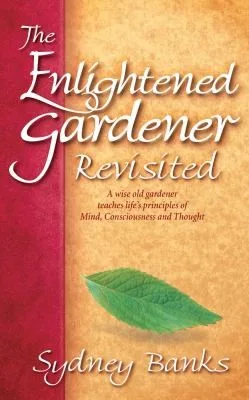
The enlightened gardener revisited
 73
73

The enlightened gardener revisited
Sydney Banks’s "The Enlightened Gardener Revisited" offers a distinct perspective on mental well-being, moving away from the typical problem-solution framework of self-help. The strength lies in its elegant simplicity; the core "Three Principles"—Thought, Consciousness, and Infinite Intelligence—are presented as fundamental, universally applicable truths about the human mind. This is not about managing symptoms but about understanding the root of experience. I found the section explaining the nature of "thinking" particularly illuminating, contrasting the mere act of having a thought with the subjective experience it creates. However, the text occasionally veers into a tone that can feel overly didactic, especially when discussing the "feeling of" versus the "thinking of" a situation. A limitation for some readers might be the lack of concrete, step-by-step exercises, relying instead on a conceptual shift. Yet, the book's true power emerges when one grasps the implication that our internal state is our own creation. It challenges conventional wisdom about causality in a way few books manage.
📝 Description
73
Sydney Banks published The Enlightened Gardener Revisited in 2016, expanding on his Three Principles.
This book revisits and builds upon the psychological framework Sydney Banks introduced through his "Three Principles." It posits that our experience of life stems from an internal mental creation, not external events. The work moves beyond simple self-help to explain the mechanics of thought and consciousness, aiming to help readers find greater ease and resilience. Banks argues that a fundamental shift in perception, rather than changing circumstances, leads to lasting psychological change.
Readers seeking a different approach to life's difficulties will find this book useful. It is for those who have found conventional self-improvement methods ineffective and desire a deeper understanding of their own minds. The book appeals to individuals interested in psychology, spirituality, and personal development who prefer practical philosophy to rigid advice. It also offers a new perspective for those experiencing anxiety, stress, or overwhelm.
Sydney Banks's work, emerging in the late 20th and early 21st centuries, aligns with a growing Western interest in integrating Eastern philosophies and psychological concepts. His "Three Principles" echo ideas of mind over matter found in Christian Science, particularly Mary Baker Eddy's writings, and the Stoic emphasis on internal control. However, Banks presented a secularized interpretation, using the "Enlightened Gardener" metaphor to illustrate how a cultivated inner state leads to a better outer experience of life.
💡 Why Read This Book?
• Gain a novel perspective on the origin of your feelings, understanding how "Thought" as defined by Sydney Banks directly shapes your moment-to-moment experience, a concept central to the "Three Principles" framework. • Discover how to cultivate inner resilience by recognizing the role of "Consciousness" as the awareness through which all thoughts and feelings are perceived, offering a practical shift from external validation. • Learn to differentiate between the "feeling of" a situation and the "thinking of" it, a key insight from "The Enlightened Gardener Revisited" that can fundamentally alter your response to life's adversities.
⭐ Reader Reviews
Honest opinions from readers who have explored this book.
❓ Frequently Asked Questions
What are the "Three Principles" Sydney Banks discusses?
The Three Principles are Thought, Consciousness, and Infinite Intelligence. Banks posits that these are the fundamental workings of the mind, explaining how our reality is created from the inside out.
Is "The Enlightened Gardener Revisited" a self-help book?
While it offers profound personal benefits, it's framed more as a psychological insight than a prescriptive self-help guide. It aims for a fundamental understanding of the mind's mechanics, rather than offering techniques to manage specific problems.
When was Sydney Banks's "The Enlightened Gardener Revisited" first published?
The work was first published in 2016, revisiting and expanding upon concepts previously introduced by the author.
What is the core message of "The Enlightened Gardener Revisited"?
The core message is that our subjective experience of life is generated by our thoughts, not by external circumstances, and that a deeper understanding of Thought, Consciousness, and Infinite Intelligence can lead to innate well-being.
How does this book differ from other spiritual or psychological texts?
It focuses on the universal principles of the mind rather than specific psychological conditions or spiritual doctrines. Its accessibility and the clarity of the "Three Principles" distinguish it.
What does "Infinite Intelligence" refer to in Sydney Banks's work?
In Banks's framework, Infinite Intelligence is the universal creative power or substance from which all thought arises. It's the unseen source of all ideas and life itself.
🔮 Key Themes & Symbolism
The Three Principles
At the heart of "The Enlightened Gardener Revisited" are Sydney Banks's "Three Principles": Thought, Consciousness, and Infinite Intelligence. These are presented not as abstract philosophical concepts but as the fundamental, ever-present mechanics of the human mind. Infinite Intelligence is the formless, universal creative source; Thought is the transient mental activity that shapes our reality; and Consciousness is the awareness of our thoughts and experiences. The book argues that understanding the interplay of these principles is key to unlocking innate well-being and resilience, shifting the focus from external circumstances to internal mental processes. This framework offers a profound reorientation of how one perceives life's challenges.
The Nature of Thought
A significant theme is the exploration of thought itself. "The Enlightened Gardener Revisited" distinguishes between having a thought and the subjective experience that thought generates. It posits that our feelings and reactions are not direct responses to external events but are mediated by the thoughts we have about those events. This understanding is crucial for recognizing the mind's creative power. The book emphasizes that thoughts are temporary and that by not over-identifying with them, individuals can experience greater peace and clarity. This perspective challenges the common belief that specific situations or people are the direct cause of our emotional states.
Innate Well-being
The work posits that well-being is not something to be achieved or earned, but an innate quality of the human mind that is present when we are not clouded by our own thinking. "The Enlightened Gardener Revisited" suggests that by understanding the "Three Principles," individuals can naturally access this state of well-being. It's not about striving for happiness but about recognizing the underlying mental structure that supports it. The book encourages readers to look within for the source of their peace, rather than seeking it in external achievements, relationships, or circumstances, thereby fostering a more stable and profound sense of contentment.
The Gardener Metaphor
The title itself, "The Enlightened Gardener," serves as a potent metaphor throughout the book. The garden represents the mind, and the gardener is the individual tending to it. Just as a gardener cultivates healthy plants by understanding soil, water, and sunlight, an "enlightened gardener" understands the principles of their own mind. This involves discerning which "seeds" of thought to nurture and which to let pass. The metaphor emphasizes the active, yet gentle, role one plays in shaping their inner landscape, promoting growth and flourishing through a deeper, more intuitive understanding of mental cultivation.
💬 Memorable Quotes
Direct passages from the work, attributed to the author.
“Our thinking is what creates our feelings, not the circumstances.”
— This highlights the core tenet that our subjective reality is a product of our internal mental activity. It suggests that by understanding how thoughts arise and pass, we can gain control over our emotional responses, rather than being controlled by external events.
“Thought is the vehicle; Consciousness is the awareness of the ride.”
— This concise statement clarifies the relationship between two of the Three Principles. It illustrates that thoughts are the transient mental events, while Consciousness is the faculty that experiences them, emphasizing the mind's inherent capacity for awareness.
“The feeling of something is not the same as the thinking of something.”
— This distinction is crucial for understanding how we experience life. It suggests that our emotional 'feeling' of a situation is a consequence of our mental processing ('thinking') rather than a direct perception of the event itself.
“Infinite Intelligence is the source from which all thought springs.”
— This defines the foundational principle of the universal mind. It frames the origin of all ideas and inspiration not as a random occurrence but as emanating from a boundless, inherent intelligence within the cosmos.
“You don't have to do anything to be well; you just have to stop getting in your own way.”
— This implies that well-being is an innate state that is often obscured by our own mental habits and patterns of thought. The book suggests that by understanding the mind, we can naturally revert to this inherent state of peace.
🌙 Esoteric Significance
Tradition
Banks's "Three Principles" can be loosely situated within the Hermetic or Neoplatonic traditions due to their emphasis on a fundamental, underlying intelligence and the power of mind to shape reality. However, his articulation is distinct in its direct, non-dogmatic approach, aiming for universal applicability rather than adherence to a specific esoteric lineage. It departs from traditional esoteric systems by stripping away ritual and complex symbolism in favor of a pure focus on the mechanics of consciousness and thought, making it accessible to a broad, modern audience.
Symbolism
The central symbol is the "Enlightened Gardener" tending their "mind-garden." This represents the individual's capacity to cultivate their inner landscape through understanding. The garden symbolizes the mind, with "seeds" representing thoughts and "plants" representing feelings and experiences. The gardener's "enlightenment" comes from understanding the principles of growth (Thought, Consciousness, Infinite Intelligence), allowing for the natural flourishing of well-being, much like a skilled gardener nurtures healthy growth through knowledge of natural laws.
Modern Relevance
The work continues to influence contemporary coaching, therapy, and personal development circles. Thinkers and practitioners in the "Inside-Out" movement, which posits that our internal state creates our external reality, draw heavily on Banks's principles. His ideas are also explored in fields seeking to understand consciousness and subjective experience, resonating with researchers in neuroscience and psychology who are investigating the brain's role in generating perceived reality, offering a philosophical counterpoint to purely mechanistic views.
👥 Who Should Read This Book
• Individuals seeking a fundamental shift in their understanding of stress and anxiety, who will gain a new framework for experiencing challenges from the "Three Principles." • Those disillusioned with conventional self-help methods, who will find a unique perspective on the mind's innate capacity for well-being. • Students of consciousness and psychology, who can benefit from exploring Banks's model of how subjective reality is created through Thought, Consciousness, and Infinite Intelligence.
📜 Historical Context
Sydney Banks's "The Enlightened Gardener Revisited" (2016) arrives in a cultural landscape increasingly receptive to insights into consciousness and mental well-being, a trend building since the late 20th century. His "Three Principles"—Thought, Consciousness, and Infinite Intelligence—can be seen as a secularized interpretation of ideas present in various spiritual and psychological traditions. While Banks published his initial insights earlier, the 2016 edition places his work in dialogue with contemporary movements like positive psychology and mindfulness. It offers an alternative to more conventional therapeutic approaches, echoing the mind-over-matter philosophies found in Christian Science, pioneered by Mary Baker Eddy. Unlike the strictly behavioral or cognitive-behavioral therapies dominant in mid-20th century psychology, Banks's work posits a more fundamental, universal mechanism for psychological experience, accessible to anyone regardless of specific belief systems.
📔 Journal Prompts
The "Enlightened Gardener" tending their mind-garden: What thoughts are you currently cultivating?
Reflecting on "Infinite Intelligence": How might this universal source inform your creative process?
Considering the distinction between "feeling of" and "thinking of": What recent experience was shaped more by your thoughts than the event itself?
The role of "Consciousness": What are you aware of in this present moment, beyond your immediate thoughts?
Sydney Banks's insight on thought: How does recognizing thoughts as transient visitors change your relationship to them?
🗂️ Glossary
The Three Principles
Sydney Banks's core concepts: Thought (the mechanism of mind), Consciousness (the awareness of experience), and Infinite Intelligence (the universal creative source from which thought arises). Understanding these is key to the book's philosophy.
Infinite Intelligence
In Banks's model, this is the formless, all-encompassing creative power of the universe. It is the source of all ideas, inspiration, and life itself, from which our individual thoughts emerge.
Thought
The transient mental activity that shapes our perception of reality. The book emphasizes that thoughts are not facts or reality itself, but mental events that create our subjective experience.
Consciousness
The awareness of our thoughts, feelings, and the world around us. It is the capacity to experience life, and according to Banks, it is from this space of awareness that well-being naturally arises.
Feeling of vs. Thinking of
A key distinction made in the book: the 'feeling of' a situation refers to the emotional experience, while the 'thinking of' refers to the mental process or thoughts that generate that feeling. This highlights that our emotions stem from our thoughts.
Mind-garden
A metaphor used in the book where the mind is likened to a garden. The 'enlightened gardener' (the individual) cultivates this garden by understanding the principles of thought and consciousness.
Innate Well-being
The concept that a state of peace and contentment is an inherent quality of the mind, present when not obscured by excessive or identifying thought. It's a state that can be accessed naturally.
🔮 Readers Also Liked
Browse all →







More by Sydney Banks
All books →
More Free Theosophy & Anthroposophy Books
View all →