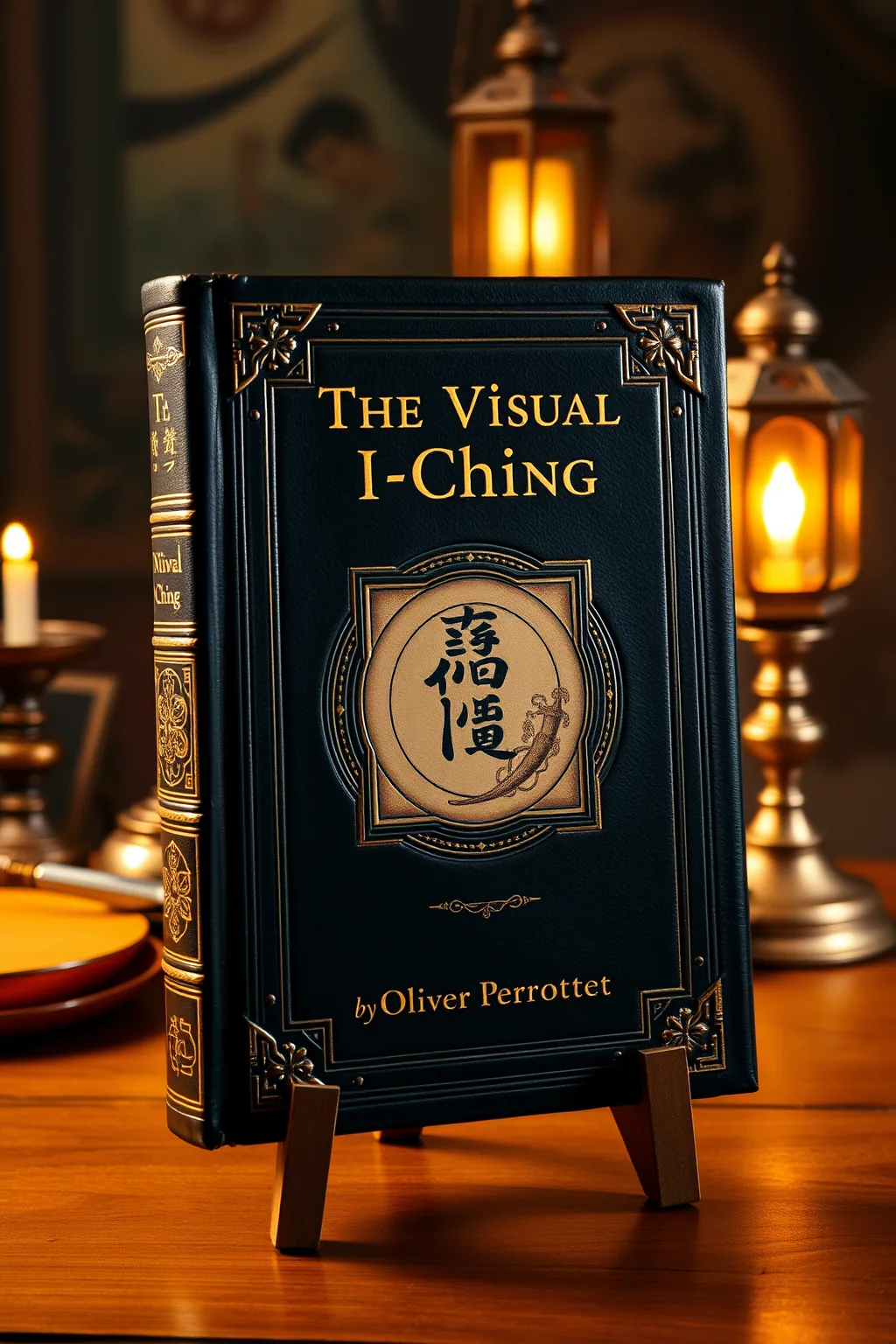
The Visual I Ching
 71
71

The Visual I Ching
Oliver Perrottet’s *The Visual I Ching* offers a refreshing perspective on a text often approached through its divinatory or philosophical pronouncements alone. By centering the visual architecture of the hexagrams, Perrottet provides a compelling argument for an aesthetic interpretation of the I Ching’s wisdom. The strength of the book lies in its ability to reveal new dimensions of familiar symbols through this visual lens, particularly in how the arrangement of lines suggests underlying principles of order and flux. However, the work occasionally feels abstract, sometimes sacrificing the practical application for which the I Ching is widely known. A passage discussing the visual interplay of the trigrams within hexagram 26 (Great Taming) particularly illustrates this unique approach, highlighting how the form itself speaks to power and restraint. Ultimately, *The Visual I Ching* is a valuable, if specialized, addition to the I Ching corpus for those willing to engage with its symbolic forms.
📝 Description
71
Oliver Perrottet's 1987 book, The Visual I Ching, treats the ancient Chinese oracle through its geometric structure.
The Visual I Ching departs from standard textual analyses of the classic Chinese oracle. Instead, Oliver Perrottet focuses on the visual and symbolic aspects of its 64 hexagrams. The book proposes that the arrangement of trigrams and their lines creates a map of cosmic and human events. Perrottet seeks to reveal deeper meanings by appreciating the inherent geometric and aesthetic qualities within the I Ching's design. This approach extends beyond simple divination to consider its philosophical foundations.
This volume is useful for those who want different ways to approach the I Ching. Students of esoteric traditions who value visual languages and symbolic systems will find it engaging. Anyone interested in comparative mythology, the history of divination, or the connection between art and philosophy might appreciate its distinct viewpoint. It is especially helpful for practitioners who feel traditional interpretations fall short or want to examine the I Ching's structural elegance more closely.
Published in 1987, The Visual I Ching arrived during a time of growing Western interest in Eastern philosophy and esoteric studies. While many I Ching translations appeared then, Perrottet's emphasis on visual representation was a unique contribution. His work aligns with a broader trend of syncretic thought that sought to integrate Eastern concepts with Western analytical methods, particularly those focused on patterns, forms, and archetypal imagery. It connects with figures popularizing comparative mythology and Jungian psychology's exploration of symbols.
💡 Why Read This Book?
• Gain a novel interpretive framework for the I Ching by understanding the geometric and visual relationships between trigrams and hexagrams, as explored in the book's analysis of specific hexagram structures. • Discover how the aesthetic principles inherent in the I Ching’s visual design can illuminate its philosophical concepts of change and cosmic order, moving beyond purely textual exegesis. • Access a unique perspective on symbolic systems, particularly relevant if you are interested in the intersection of art, philosophy, and ancient wisdom, as demonstrated by Perrottet's 1987 publication.
⭐ Reader Reviews
Honest opinions from readers who have explored this book.
❓ Frequently Asked Questions
What is the primary focus of The Visual I Ching by Oliver Perrottet?
The book's primary focus is on interpreting the I Ching through its visual and symbolic structure, emphasizing the geometric arrangement of trigrams and hexagrams rather than solely relying on traditional textual meanings.
When was The Visual I Ching first published?
The Visual I Ching was first published in 1987, placing it within a period of significant Western engagement with Eastern esoteric traditions.
Does this book offer practical divination advice?
While it can inform divination, its main goal is to unlock deeper philosophical and symbolic understanding through visual analysis, offering a different kind of insight than purely predictive methods.
Who would benefit most from reading The Visual I Ching?
Students of esoteric studies, comparative mythology, and those interested in symbolic systems or alternative approaches to the I Ching would find this book particularly beneficial.
How does this book differ from other I Ching interpretations?
It distinguishes itself by prioritizing the visual and geometric aspects of the hexagrams, treating their forms as primary carriers of meaning, which is a less common approach than textual or divinatory focuses.
What is a trigram in the context of The Visual I Ching?
A trigram is a fundamental three-line symbol, one of the eight basic building blocks that combine to form the 64 hexagrams of the I Ching, and a key element in Perrottet's visual analysis.
🔮 Key Themes & Symbolism
Hexagram Geometry
The work centers on the geometric architecture of the 64 hexagrams, positing that their visual arrangement of solid and broken lines holds profound meaning. Perrottet analyzes how the combination of the eight trigrams creates distinct visual forms, suggesting that these patterns are not arbitrary but symbolic representations of cosmic and psychological states. This perspective invites readers to see the I Ching as a system of visual logic, where the shape and flow of the lines themselves communicate principles of change and balance. The emphasis is on appreciating the inherent aesthetic order that underpins the entire system.
Symbolic Line Dynamics
Perrottet explores the symbolic significance of the individual lines – solid (yang) and broken (yin) – and their interplay within the hexagrams. The book interprets the dynamic relationships between these lines, their positions, and their interactions as conveyors of meaning. This approach moves beyond simple yang/yin duality to examine how their configurations create specific energetic patterns. The interpretation suggests that understanding the visual interplay of lines offers insights into the forces at play in any given situation, mirroring the constant flux described in Taoist philosophy.
Visual Divination and Philosophy
This book reframes the I Ching not just as a tool for fortune-telling but as a philosophical text accessible through its visual presentation. Perrottet suggests that by focusing on the visual patterns, one can access deeper layers of meaning related to universal principles of order, transformation, and consciousness. The work encourages a contemplative approach, where observing the form of the hexagrams can lead to intuitive understanding and philosophical reflection, bridging the gap between symbolic art and abstract thought.
Aesthetic Order of the Cosmos
A central theme is the idea that the structure of the I Ching reflects an underlying aesthetic order in the universe. Perrottet implies that the harmony and balance found in the visual composition of the hexagrams are not merely symbolic but are indicative of fundamental cosmic laws. This perspective invites readers to consider the universe as a manifestation of elegant design and pattern, accessible through the study of symbolic forms. The book thus connects the study of the I Ching to broader metaphysical considerations about beauty and structure in existence.
💬 Memorable Quotes
Direct passages from the work, attributed to the author.
“The hexagrams' visual structure reveals their inherent meaning.”
— This core idea suggests that the arrangement of lines in the I Ching is not arbitrary but intentionally designed to convey symbolic information, inviting a geometric and aesthetic interpretation.
“Trigrams combine to form a visual language of change.”
— This highlights the foundational role of the three-line trigrams and their visual combinations in creating the 64 hexagrams, presenting the I Ching as a symbolic system built upon visual patterns.
“Aesthetic principles are integral to cosmic order.”
— This interpretation posits that beauty and harmonious design, as seen in the I Ching's structure, are not superficial but fundamental aspects of the universe's underlying principles.
“The I Ching offers a cartography of human experience.”
— This concept suggests that the visual patterns of the I Ching can be understood as a map or diagram illustrating the dynamics and transformations inherent in the human condition.
💡 Key Ideas
Editorial paraphrase of the work's core concepts — not direct quotes.
Understanding the form unlocks the philosophy.
This paraphrased concept emphasizes Perrottet's approach, suggesting that direct engagement with the visual and geometric form of the I Ching hexagrams is key to grasping its deeper philosophical content.
🌙 Esoteric Significance
Tradition
The Visual I Ching operates within the broad stream of Western esoteric interest in the I Ching, often viewed through a lens informed by Hermeticism and Jungian psychology. While not strictly adhering to a single lineage, it shares with Hermetic traditions a focus on correspondence and the idea that macrocosmic patterns are reflected in symbolic systems. It departs from purely traditional Chinese interpretations by emphasizing a visual, almost geometric, approach that appeals to Western symbolic analysis and the search for universal forms, akin to the symbolic language found in Tarot or Kabbalistic diagrams.
Symbolism
The primary symbols are the solid (yang) and broken (yin) lines, which form the eight fundamental trigrams (e.g., Heaven, Earth, Fire, Water). Perrottet interprets the combination of these trigrams into 64 hexagrams as not just sequences of symbols but as visual diagrams. The arrangement and interrelation of these lines and trigrams are seen as symbolic representations of dynamic forces, philosophical concepts, and states of being, offering a visual cartography of cosmic principles.
Modern Relevance
Perrottet's work remains relevant for contemporary practitioners and scholars interested in non-traditional approaches to the I Ching. It speaks to modern interests in visual thinking, symbolic systems, and the intersection of art and philosophy. Thinkers and artists exploring pattern recognition, sacred geometry, or universal symbolic languages may find its visual methodology insightful. Its emphasis on form anticipates contemporary digital and data visualization by treating symbolic structures as inherently meaningful visual data.
👥 Who Should Read This Book
• Students of esoteric studies seeking novel interpretive frameworks for ancient texts, particularly those who appreciate visual and geometric symbolism beyond traditional commentaries. • Comparative mythology enthusiasts interested in how different cultures represent universal concepts through symbolic forms, offering a unique visual angle on Eastern wisdom traditions. • Artists and designers drawn to the interplay of form, pattern, and meaning, who can explore the I Ching’s structure as a source of aesthetic and philosophical inspiration.
📜 Historical Context
Oliver Perrottet's *The Visual I Ching*, published in 1987, emerged during a period of significant Western exploration into Eastern philosophies and esoteric systems. The late 20th century witnessed a growing appetite for texts like the I Ching, often filtered through psychological lenses, notably Jungian archetypes, and comparative mythology as popularized by Joseph Campbell. Perrottet's work distinguished itself by focusing on the visual and geometric aspects of the hexagrams, offering an alternative to purely textual or divinatory interpretations prevalent at the time. While many scholars and practitioners engaged with the I Ching through its philosophical pronouncements or oracle function, Perrottet's emphasis on form and pattern contributed to a broader trend of seeking universal symbolic languages. His approach can be seen as a unique contribution to the syncretic intellectual currents of the era, attempting to bridge ancient Chinese wisdom with Western analytical and aesthetic frameworks.
📔 Journal Prompts
Reflect on the visual interplay of trigrams within a specific hexagram, such as Hexagram 1 (The Creative).
Consider how the geometric arrangement of lines in the I Ching mirrors concepts of balance and transformation.
Analyze a personal situation through the lens of the visual structure of a relevant I Ching hexagram.
Explore the connection between aesthetic principles in the I Ching and the concept of cosmic order.
Document your visual interpretation of a chosen trigram and its potential symbolic meaning.
🗂️ Glossary
I Ching
An ancient Chinese divination text and philosophical classic, also known as the Book of Changes, comprising 64 hexagrams derived from combinations of eight trigrams.
Hexagram
A figure composed of six horizontal lines, either solid (yang) or broken (yin), formed by the combination of two trigrams. It represents a specific situation or principle.
Trigram
A basic symbol composed of three horizontal lines, either solid (yang) or broken (yin). There are eight trigrams, each associated with natural elements and concepts.
Yang Line
A solid line (—) in the I Ching, representing active, masculine, or light principles.
Yin Line
A broken line (-- --) in the I Ching, representing passive, feminine, or dark principles.
Visual Structure
In the context of this book, refers to the geometric arrangement and interplay of lines and trigrams within a hexagram, considered as a primary source of meaning.
Aesthetic Principles
The underlying rules and qualities related to beauty and form, which Perrottet argues are integral to the I Ching's structure and philosophical message.
🔮 Readers Also Liked
Browse all →









More by Oliver Perrottet
All books →


More Free Occult Philosophy Books
View all →