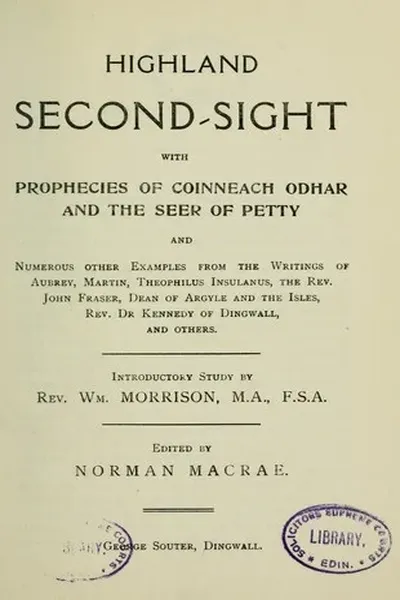
Genuine Mediumship or The Invisible Powers
 77
77

Genuine Mediumship or The Invisible Powers
Swami Bhakta Vishita’s "Genuine Mediumship or The Invisible Powers" arrives with the earnest authority of its 1919 publication date. It distinguishes itself by focusing on the mechanics and discernment of mediumship, a welcome departure from purely devotional or speculative occult texts of the era. Vishita’s insistence on distinguishing genuine spiritual contact from self-generated phenomena is a particular strength, offering a much-needed critical lens for the aspiring or practicing medium.
However, the prose, while direct, can sometimes feel dense, demanding sustained attention from the reader. The historical context, while implicit, could have benefited from more explicit engagement with contemporary debates surrounding Spiritualism. A striking aspect is Vishita's detailed discussion of 'astral currents' and their influence, which feels both grounded in the period's esoteric thought and remarkably prescient in its attempt to map unseen forces.
Read more ↓
Ultimately, "Genuine Mediumship" serves as a valuable, if textually demanding, primer for understanding the practical and ethical considerations of spiritual communication.
📝 Description
77
Swami Bhakta Vishita published "Genuine Mediumship or The Invisible Powers" in 1919 to clarify psychic phenomena.
First released in 1919, Swami Bhakta Vishita's "Genuine Mediumship or The Invisible Powers" attempts a clear explanation of psychic occurrences and spiritual communication. The book addresses both the practical and theoretical sides of mediumship, seeking to demystify what was often seen as an obscure practice. Vishita provides a systematic way to understand the energies and forces involved in spiritual contact.
This work is for serious students of the occult and metaphysics who want a solid grasp of mediumship. It speaks to those who examine spiritual phenomena with a critical yet open perspective, aiming to distinguish real psychic ability from mere suggestion or delusion. Individuals interested in the history of spiritualism and psychic research, especially from the early twentieth century, will find valuable insights here.
Published in 1919, "Genuine Mediumship" emerged during a period of intense interest in Spiritualism and psychical research. This era, following the late 19th-century spiritualist surge, saw many attempts to understand or explain experiences beyond conventional science. Vishita's book fits within this context by offering a structured framework for comprehending mediumship, engaging with contemporary debates about psychic phenomena and the potential for spiritual development.
💡 Why Read This Book?
• Learn to differentiate genuine spiritual impressions from personal psychic projections, a core concept Vishita details through his analysis of 'astral currents.' • Understand the potential pitfalls and ethical considerations for mediums, as outlined in the book's early 20th-century context of spiritualist investigation. • Gain insight into the nature of the 'astral plane' and its perceived role in spirit communication, as described by Swami Bhakta Vishita in 1919.
⭐ Reader Reviews
Honest opinions from readers who have explored this book.
❓ Frequently Asked Questions
What is the primary focus of Swami Bhakta Vishita's 'Genuine Mediumship'?
The book primarily focuses on the practical and theoretical aspects of mediumship, aiming to help readers discern genuine spiritual communication from other psychic phenomena.
When was 'Genuine Mediumship or The Invisible Powers' first published?
This work was first published in 1919, placing it within a significant period of interest in Spiritualism and psychic research.
Does the book offer guidance on developing mediumistic abilities?
Yes, Swami Bhakta Vishita suggests that mediumship is a faculty that can be cultivated and refined through disciplined practice and ethical conduct.
What historical period does the book reflect regarding psychic phenomena?
The book reflects the early 20th century, an era marked by widespread investigation into spiritualism and psychic research, following late 19th-century trends.
Who is Swami Bhakta Vishita?
Swami Bhakta Vishita was an author writing in the early 20th century on esoteric and metaphysical subjects, particularly focusing on spiritual communication.
What is the 'astral plane' according to this book?
According to Vishita, the astral plane is an intermediary spiritual realm that influences communication between the physical and higher spiritual dimensions.
🔮 Key Themes & Symbolism
Discernment of Psychic Phenomena
A central theme is the critical differentiation between authentic spiritual contact and self-generated psychic impressions or illusions. Vishita emphasizes the need for a discerning mind, exploring how an individual's own psyche can influence perceived spiritual messages. This involves understanding the subtle energies and psychic currents that may be mistaken for direct communication from discarnate entities, providing a framework for evaluating the validity of mediumistic experiences.
The Nature of the Astral Plane
The book looks at the concept of the astral plane as a significant intermediary realm in spiritual communication. Vishita posits that this plane is not merely a passive space but an active energetic environment through which spirits and mediums interact. Understanding its characteristics is presented as crucial for both the practitioner and the recipient of spiritual messages, influencing the clarity and authenticity of the exchange.
Cultivation of Mediumship
Contrary to viewing mediumship solely as an innate gift, Vishita presents it as a faculty that can be intentionally developed and refined. The work highlights the importance of discipline, ethical conduct, and focused practice in enhancing one's ability to connect with the invisible world. This perspective encourages a proactive approach to spiritual development, suggesting that consistent effort can lead to greater clarity and control in mediumistic endeavors.
Ethical Spiritual Communication
Integral to the practice of mediumship, as discussed by Vishita, is a strong emphasis on ethical considerations. The book addresses the responsibilities that come with acting as a conduit for spiritual messages, warning against manipulation, ego-driven performance, or the exploitation of vulnerable individuals seeking connection. Maintaining integrity and purity of intent is presented as paramount for ensuring genuine and beneficial spiritual interactions.
💬 Memorable Quotes
Direct passages from the work, attributed to the author.
“The astral plane is not a myth, but a reality.”
— This statement underscores Vishita's conviction that the astral realm is a tangible energetic dimension, crucial for understanding spiritual communication beyond the physical.
“One must learn to distinguish the voice of the spirit from the echo of the self.”
— This highlights the core challenge of mediumship: discerning external spiritual guidance from one's own thoughts, desires, or subconscious projections.
“Mediumship is a sacred trust, not a platform for personal display.”
— This emphasizes the ethical responsibility of a medium to act with integrity, prioritizing genuine spiritual connection over ego gratification or public spectacle.
“The purity of the channel determines the clarity of the message.”
— This concept suggests that a medium's own spiritual and mental state directly impacts the quality and authenticity of the communication received from the unseen realms.
“True mediumship requires disciplined observation of subtle energies.”
— This points to the necessity of rigorous practice and careful attention to the finer energetic nuances involved in spiritual communication, rather than relying on mere intuition.
🌙 Esoteric Significance
Tradition
This work fits within the broader Western esoteric tradition, particularly drawing from the currents of Spiritualism and early 20th-century psychical research. While not strictly aligned with a single lineage like Hermeticism or Kabbalah, it addresses themes common to many esoteric systems: the existence of non-physical planes, the potential for communication with unseen intelligences, and the development of latent human faculties.
Symbolism
The concept of the 'astral plane' functions as a significant symbolic motif, representing an intermediary area of subtle energies and consciousness. 'Invisible powers' itself is a symbolic representation of forces and entities beyond ordinary perception. The 'channel' or 'medium' acts as a symbol of connection, bridging the material and immaterial worlds through focused intent and spiritual attunement.
Modern Relevance
Contemporary practices in mediumship, energy healing, and even certain branches of transpersonal psychology echo Vishita's concerns about discernment and ethical practice. Thinkers and practitioners who emphasize the psychological aspects of mediumship or seek to validate psychic experiences through structured frameworks can find resonance with his early 20th-century analyses of 'astral currents' and psychic projection.
👥 Who Should Read This Book
• Students of early 20th-century occultism: Those researching the historical development of Spiritualism and psychic research will find this book offers direct insight into contemporary thought. • Aspiring mediums: Individuals seeking to understand the practical and ethical foundations of spiritual communication can benefit from Vishita's structured approach to discernment. • Comparative religion scholars: Researchers examining diverse beliefs about the afterlife and inter-dimensional communication will find a valuable case study in Vishita's framework.
📜 Historical Context
Published in 1919, "Genuine Mediumship or The Invisible Powers" emerged during a period of intense fascination with and investigation of psychic phenomena. The preceding decades had witnessed the widespread growth of Spiritualism, with figures like Arthur Conan Doyle becoming prominent advocates. This era was characterized by a complex interplay between fervent belief, rigorous scientific scrutiny, and philosophical exploration of consciousness. Competing schools of thought ranged from materialistic explanations of psychic events to more spiritualist interpretations. Theosophy, with its elaborate cosmology and focus on esoteric development, was also highly influential, offering a parallel framework for understanding unseen realities. Vishita's work, by attempting to codify and explain the mechanics of mediumship, engaged with this milieu by providing a structured, albeit esoteric, perspective on phenomena that captured public imagination and academic debate.
📔 Journal Prompts
The distinction between the 'voice of the spirit' and the 'echo of the self' as presented by Vishita.
Reflect on the ethical responsibilities associated with channeling 'invisible powers'.
Consider the practical implications of the 'astral plane' for everyday spiritual awareness.
How does the concept of 'purity of the channel' relate to personal spiritual discipline?
Analyze the importance of 'disciplined observation of subtle energies' in understanding unseen forces.
🗂️ Glossary
Mediumship
The practice or ability to act as a conduit or intermediary between the spirit world and the physical world, facilitating communication.
Astral Plane
A non-physical area of existence, often described as a plane of subtle energies and consciousness, believed to be accessible through altered states or spiritual development.
Invisible Powers
Refers to forces, energies, or intelligences that exist beyond the scope of normal physical senses and scientific detection.
Psychic Phenomena
Events or abilities that appear to transcend the known laws of physics and biology, such as telepathy, clairvoyance, and spirit communication.
Discernment
The ability to judge well, particularly in distinguishing between genuine spiritual influences and other forms of psychic or mental activity.
Spiritual Communication
The exchange of information or energy between individuals in the physical world and entities or intelligences residing in non-physical realms.
Subtle Energies
Forms of energy that are not detectable by conventional scientific instruments but are believed to be operative in spiritual and psychic processes.
This book appears in 1 collection
🔮 Readers Also Liked
Browse all →







From the “Mediumship” Collection
View all →





More Free Occult Philosophy Books
View all →