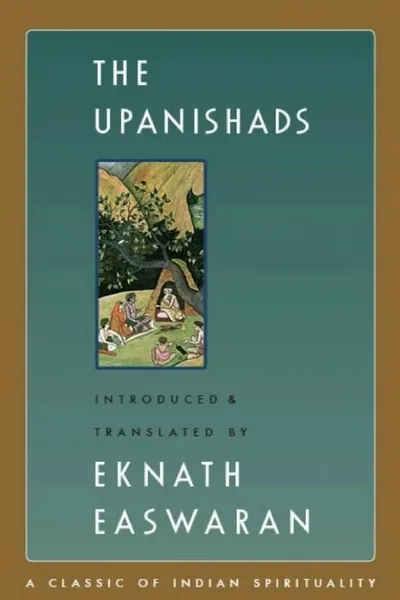
The Upanishads, Part 1

 83
83

The Upanishads, Part 1
Müller's translation of the Upanishads, particularly this 1962 edition, remains a significant scholarly resource, though not without its challenges for the modern reader. The clarity he brings to dense Sanskrit prose is commendable, allowing access to concepts like the identity of Atman and Brahman. However, the sheer density of philosophical argument can be daunting. The Brihadaranyaka Upanishad, for instance, presents intricate dialogues that demand considerable focus. While the translation is faithful to the original text, it occasionally lacks the poetic resonance found in later interpretive renderings. Nevertheless, for those seeking a direct, unadorned scholarly presentation of these pivotal texts, this volume serves its purpose.
This is an essential, albeit demanding, scholarly edition for understanding early Vedanta.
📝 Description
83
F. Max Müller's 1962 edition makes foundational Vedanta texts accessible.
This volume contains key scriptures from the Vedanta tradition of Hindu philosophy. As part of F. Max Müller's larger translation endeavor, it provides a scholarly edition of ancient Sanskrit writings. These dialogues and stories discuss the nature of existence, the self, and the universe.
This work is aimed at students of comparative religion, philosophy, and ancient Indian thought. Scholars, graduate students, and dedicated practitioners who want to study primary sources will find this useful. It is a scholarly resource, not a basic introduction.
First published in 1962, this edition engages with texts originally gathered centuries before the Common Era. F. Max Müller's initial translations, part of his 'Sacred Books of the East' series, began in the late 19th century. This later publication places the Upanishads within the continuing study of world religions.
The Upanishads are central to the Vedanta school of Hindu philosophy, representing a culmination of Vedic thought. They explore metaphysical questions about the nature of consciousness and the universe, seeking to understand the relationship between the individual soul (Atman) and the absolute reality (Brahman). These texts form a bridge between ritualistic Vedic practices and later philosophical developments, emphasizing meditation and self-knowledge as paths to spiritual realization. Their insights into the self and reality have influenced numerous contemplative traditions.
💡 Why Read This Book?
• Gain direct access to the foundational philosophical inquiries of the Upanishads, as presented in a scholarly translation first made widely available through F. Max Müller's work. • Understand the core concept of Atman, the individual self, and its relationship to Brahman, the absolute reality, as explored in dialogues from texts like the Chandogya Upanishad. • Grasp the ancient Indian philosophical underpinnings of liberation (moksha) and the cycle of existence (samsara), concepts central to Hindu and other Indian traditions.
⭐ Reader Reviews
Honest opinions from readers who have explored this book.
❓ Frequently Asked Questions
What are the Upanishads and why are they important?
The Upanishads are a collection of ancient Sanskrit philosophical texts that form the theoretical basis of Hinduism. They explore concepts of Brahman (ultimate reality) and Atman (the self), and are considered Vedanta, the end of the Vedas.
Who was F. Max Müller and what is his significance?
Friedrich Max Müller (1823-1900) was a German-born philologist and orientalist who dedicated his life to the study of Sanskrit and ancient Indian literature. His translations, including the Upanishads, were pivotal in introducing these texts to the Western world.
When were the Upanishads originally composed?
The exact dates of composition are debated, but the core Upanishads are generally believed to have been composed between 800 and 400 BCE, with later additions extending this period.
What is the relationship between Atman and Brahman in the Upanishads?
A central tenet of the Upanishads is the concept of 'Atman is Brahman,' meaning the individual soul or self (Atman) is identical to the ultimate reality or cosmic spirit (Brahman).
Is this edition suitable for beginners?
This edition, being a scholarly translation by F. Max Müller, is best suited for students and scholars of philosophy and religion. Beginners might find it dense and may benefit from introductory commentaries first.
What is the 'Vedanta' tradition mentioned in relation to the Upanishads?
Vedanta, meaning 'end of the Vedas,' is a school of Hindu philosophy based on the Upanishads. It focuses on metaphysical questions about reality, consciousness, and liberation.
🔮 Key Themes & Symbolism
The Nature of Brahman
This volume grapples with the concept of Brahman, the impersonal, all-pervading ultimate reality. The texts describe Brahman not through anthropomorphic attributes but as the fundamental substratum of existence, the source from which all phenomena arise and to which they return. Müller's translation allows readers to confront these abstract descriptions, often presented through negation (neti neti - 'not this, not that') or through analogies, seeking to convey an understanding beyond ordinary sensory perception or conceptualization.
The Doctrine of Atman
Central to the Upanishads is the exploration of Atman, the true self or soul within each individual. The texts posit that Atman is not merely the ego or personality but an eternal, unchanging essence. The profound discovery presented is the identity of Atman with Brahman. This realization, achieved through rigorous contemplation and philosophical inquiry, is presented as the key to liberation from suffering and the cycle of rebirth.
Samsara and Moksha
The Upanishads introduce and elaborate on the concepts of Samsara, the continuous cycle of birth, death, and rebirth, driven by karma, and Moksha, liberation from this cycle. The texts suggest that ignorance of the true nature of reality (Brahman) and the self (Atman) perpetuates this cycle. Attaining Moksha involves transcending ignorance and realizing the unity of Atman and Brahman, leading to a state of eternal peace and freedom.
The Path of Knowledge
Rather than emphasizing ritual alone, the Upanishads highlight Jnana Yoga, the path of knowledge, as the primary means to achieve liberation. This involves deep philosophical contemplation, study of the scriptures (like those within this volume), and guidance from a qualified guru. The aim is to achieve direct experiential realization of the truth about Brahman and Atman, thus dissolving the illusion of separation.
💬 Memorable Quotes
Direct passages from the work, attributed to the author.
“The Self is the lord of all beings, the king of all beings.”
— This statement emphasizes the supreme status of the Atman, the true self, not as a ruler in a worldly sense, but as the fundamental essence that governs and underlies all existence. It points to the inherent divinity and sovereignty within each conscious being.
“As a spider spins out its web, as herbs grow on the earth, from the one the world arises.”
— This analogy illustrates the Upanishadic concept of creation. The world is not seen as separate from the ultimate reality (Brahman), but as an emanation or manifestation from it, akin to a spider's web originating from the spider itself, or plants growing from the earth.
“He who knows the Self, is freed from the mouth of death.”
— This highlights the salvific power of self-knowledge. Realizing the true nature of the Atman as eternal and identical with Brahman is presented as the ultimate means to overcome mortality and the cycle of death and rebirth.
“The wise, who know the Self as formless, within all forms, the eternal among transient things, they perceive.”
— This describes the enlightened perspective, where the seer recognizes the underlying, unchanging, formless essence (Atman/Brahman) that pervades and transcends all the diverse and impermanent phenomena of the material world.
“What is here is there, and what is there is here. He who sees difference here, goes from death to death.”
— This succinctly captures the non-dualistic core of Upanishadic thought. The perceived separation between the individual and the cosmos, or between different aspects of reality, is an illusion that binds one to the cycle of Samsara.
🌙 Esoteric Significance
Tradition
The Upanishads are foundational to Vedanta, a major school within Hindu philosophy, which profoundly influenced later esoteric traditions globally. While not strictly 'Hermetic' or 'Gnostic' in the Western sense, their non-dualistic metaphysics and emphasis on inner realization align with core esoteric principles found across various lineages, including Theosophy and certain branches of Western mysticism seeking direct experience of the divine within.
Symbolism
Key symbols include the syllable 'Om' (AUM), representing the totality of consciousness and the universe, and the 'cave of the heart,' a metaphor for the innermost sanctuary where the Atman resides. The concept of the 'chariot' from the Katha Upanishad (though potentially in Part 2) serves as a complex allegory for the body, senses, mind, and intellect controlled by the Self (Atman), guiding the soul through existence.
Modern Relevance
Contemporary practitioners of various contemplative disciplines, from mindfulness meditation to integral yoga, draw upon Upanishadic concepts of consciousness and the self. Thinkers in transpersonal psychology and New Age spirituality frequently reference Upanishadic ideas about the unity of existence and the potential for human transformation through inner awareness.
👥 Who Should Read This Book
['• Academic researchers in religious studies and philosophy: To engage with a foundational scholarly translation of key Vedanta texts, essential for understanding the historical development of Hindu thought.', '• Dedicated students of comparative mysticism: To explore the ancient roots of non-dualistic philosophy and concepts of ultimate reality that echo in various esoteric traditions worldwide.', '• Initiates seeking primary source material: To move beyond secondary interpretations and directly confront the philosophical rigor and metaphysical inquiries presented in these seminal scriptures.']
📜 Historical Context
F. Max Müller's monumental 'Sacred Books of the East' series, which began publication in 1879, aimed to present the foundational scriptures of world religions to a Western audience. This specific volume, 'The Upanishads, Part 1,' published in 1962, represents a later scholarly edition stemming from that project. The late 19th century saw a surge of interest in Eastern philosophies, partly fueled by the British colonial presence in India and the intellectual curiosity of figures like Schopenhauer, who had engaged with earlier Persian translations of Upanishadic texts. Müller's work provided a more direct and scholarly conduit, challenging prevailing European notions of religious and philosophical superiority. While influential, his translations and interpretations were debated; scholars like Paul Deussen later offered alternative analyses of Vedanta philosophy, engaging directly with Müller's corpus. Reception was largely academic, though the spiritual implications were widely discussed.
📔 Journal Prompts
The concept of Brahman as described in the Chandogya Upanishad.
Reflecting on the 'Neti Neti' ('not this, not that') approach to understanding reality.
The perceived relationship between the individual self (Atman) and the universal self (Brahman).
The implications of the cycle of Samsara for one's present actions.
Analyzing the allegorical language used to describe the human condition.
🗂️ Glossary
Brahman
The ultimate, unchanging, all-pervading reality or absolute consciousness that is the source and substratum of all existence in Hindu philosophy.
Atman
The individual self, soul, or innermost essence. In Upanishadic thought, it is often equated with Brahman, signifying the eternal, unchanging core of a being.
Vedanta
A school of Hindu philosophy literally meaning 'the end of the Vedas.' It is based primarily on the Upanishads and focuses on metaphysical inquiry into the nature of reality and the self.
Samsara
The continuous cycle of birth, death, and rebirth, governed by karma, which is considered to be the state of mundane existence from which liberation is sought.
Moksha
Liberation or release from the cycle of Samsara. It is achieved through spiritual knowledge, self-realization, and the transcendence of ignorance.
Jnana Yoga
The path of knowledge or wisdom. It is considered a primary means in Vedanta for achieving Moksha, involving philosophical study, contemplation, and direct realization of the truth.
Karma
The principle of cause and effect, where actions (karma) influence future consequences, shaping an individual's experiences within the cycle of Samsara.
🔮 Readers Also Liked
Browse all →








More by F. Max Müller
All books →




More Free Occult Philosophy Books
View all →