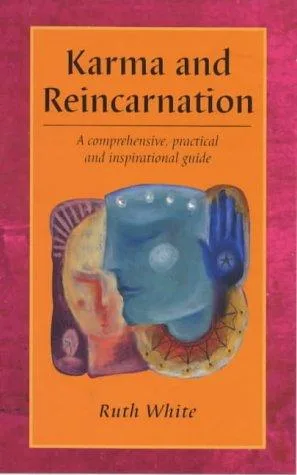
Karma and Reincarnation
 72
72

Karma and Reincarnation
Ruth White's Karma and Reincarnation provides a lucid, if somewhat academic, dissection of a cornerstone concept in many spiritual traditions. Her strength lies in systematically breaking down the complex interplay of cause, effect, and rebirth into digestible components. She avoids sensationalism, opting instead for a measured approach that grounds abstract principles in logical progression. A particularly insightful passage details the difference between accidental and intentional karmic imprints, highlighting the ethical nuances often overlooked. However, the book occasionally suffers from a lack of vivid illustrative examples; the theoretical framework is robust, but the practical, lived experience of karma can feel distant. Despite this, White offers a solid, well-organized resource for understanding the mechanics of karmic law. It's a valuable primer for the serious student.
📝 Description
72
Ruth White's Karma and Reincarnation, published in 2000, examines cause and effect across lifetimes.
Published in 2000, Ruth White's Karma and Reincarnation looks at the principles of cause and effect as they span multiple lives. The book explains how actions, intentions, and their results are not limited to a single life but continue into future rebirths. These consequences shape individual futures and shared experiences. White presents karma not as a system of punishment, but as a natural law guiding spiritual growth.
This book is for those interested in esoteric philosophy, comparative religion, and spiritual development. It is for readers who want to understand how the soul operates after death and how past actions affect current situations. People questioning fate, free will, and personal accountability will find a structured way to think about these ideas within its pages. White's work provides a framework for understanding the soul's progression through different incarnations.
The early 2000s saw a renewed interest in Eastern philosophies and their integration into Western esoteric thought. Movements like Theosophy had already introduced concepts like karma and reincarnation to a Western audience. White's book builds on this foundation, offering a modern and systematic approach to these ideas. It appeared at a time when topics once confined to religious texts were being discussed more widely in philosophical and psychological circles, making it relevant to contemporary spiritual questions.
💡 Why Read This Book?
• Understand the mechanics of karmic law as presented by Ruth White, gaining insight into how actions in 2000 and beyond influence future lives. • Explore the concept of spiritual evolution and how conscious choice, as detailed in the book, can actively shape one's karmic trajectory. • Differentiate between individual and collective karma, learning how personal decisions contribute to broader karmic patterns described in the text.
⭐ Reader Reviews
Honest opinions from readers who have explored this book.
❓ Frequently Asked Questions
What is the primary focus of Ruth White's 'Karma and Reincarnation'?
The book primarily examines the principles of cause and effect across multiple lifetimes, detailing how actions and intentions shape an individual's destiny through reincarnation.
When was 'Karma and Reincarnation' first published?
Ruth White's 'Karma and Reincarnation' was first published in the year 2000, reflecting a growing interest in esoteric philosophy at the turn of the millennium.
Does the book discuss different types of karma?
Yes, the work explores various classifications of karma, including individual and collective forms, and discusses how they are incurred and resolved over time.
Is 'Karma and Reincarnation' suitable for beginners in esoteric studies?
The book offers a systematic approach that can benefit beginners, providing a structured understanding of complex spiritual concepts like karma and rebirth.
How does White's work relate to earlier esoteric traditions?
White builds upon established esoteric concepts popularized by movements like Theosophy in the late 19th century, offering a modern, analytical perspective on reincarnation.
What is the book's stance on free will versus destiny?
The work addresses the interplay between predetermined karmic patterns and the capacity for conscious choice, suggesting that individuals can influence their karmic path.
🔮 Key Themes & Symbolism
The Law of Cause and Effect
This theme is central to White's exploration, positing karma as an immutable law governing spiritual progression. The book illustrates how every action, driven by intention, generates a corresponding effect that must eventually manifest, either in the current life or subsequent ones. This principle underscores the interconnectedness of all events and beings, suggesting that consequences are not random but inherent to the fabric of existence. Understanding this law is presented as the first step toward conscious spiritual development and mastery over one's destiny.
Cycles of Reincarnation
White meticulously details the process of reincarnation as the mechanism through which karmic patterns unfold. The work explains that birth and death are not endpoints but transitions within a continuous cycle of learning and growth. Each incarnation presents unique challenges and opportunities designed to address unresolved karmic debts and facilitate the soul's evolution. The book examines the conditions and purpose behind these successive lives, offering a framework for comprehending life's recurring themes and lessons.
Conscious Spiritual Evolution
Beyond merely describing karmic mechanics, the book emphasizes the potential for conscious intervention and growth. White argues that through self-awareness, ethical conduct, and spiritual practice, individuals can actively influence their karmic inheritance and accelerate their evolution. This theme highlights free will's role within a deterministic framework, suggesting that understanding karmic laws empowers one to make choices that lead to liberation rather than further entanglement. The goal is to transcend repetitive cycles through wisdom and intentional living.
Interconnectedness of Being
A foundational concept explored is the inherent unity of all existence. The book posits that karma operates not in isolation but within a web of interconnected lives and events. Actions taken by one individual inevitably impact others, creating complex karmic relationships and shared destinies. This perspective encourages a sense of global responsibility and compassion, illustrating how personal liberation is intrinsically linked to the well-being of the collective. White uses this theme to advocate for altruism as a powerful force in karmic resolution.
💬 Memorable Quotes
Direct passages from the work, attributed to the author.
“Karmic imprints are shaped as much by the intent behind an action as by the action itself.”
— This highlights the subtle yet crucial role of mental and emotional states in generating karmic consequences. It suggests that even seemingly minor actions can carry significant karmic weight if motivated by strong intentions, whether positive or negative.
“Reincarnation provides the necessary canvas for the soul's ongoing lessons.”
— This interpretation frames multiple lifetimes not as punishment or reward, but as essential opportunities for spiritual learning and development. Each life serves as a unique classroom for the soul to resolve past patterns and gain wisdom.
“The law of karma operates impartially, like a natural force.”
— This emphasizes that karma is not a form of divine judgment but an inherent, impersonal principle of cosmic order. Its effects are predictable consequences of actions, rather than arbitrary decisions made by an external entity.
“Understanding collective karma fosters a sense of shared responsibility.”
— This points to the idea that societal issues and global events are often the result of accumulated karmic patterns shared by groups of people. Recognizing this encourages a more compassionate and cooperative approach to resolving collective challenges.
“Conscious choices can alter the trajectory of one's karmic path.”
— This interpretation underscores the empowering aspect of karma, suggesting that individuals are not merely passive victims of past actions. Through awareness and deliberate effort, one can actively reshape their future karmic landscape.
🌙 Esoteric Significance
Tradition
This work fits within the broad lineage of Western Esotericism, particularly drawing from Theosophical interpretations of Eastern religions, which became prominent in the late 19th and early 20th centuries. It engages with concepts central to Dharmic traditions (Hinduism, Buddhism) but reframes them through a lens accessible to Western philosophical inquiry. While not strictly Hermetic or Kabbalistic, it shares with them an emphasis on cosmic laws and spiritual evolution as governing principles of existence.
Symbolism
A key motif is the 'Wheel of Samsara,' representing the cyclical nature of birth, death, and rebirth driven by karma. Another significant symbol is the 'thread of destiny,' illustrating how karmic connections link individuals across lifetimes, shaping relationships and life events. The concept of 'karmic debt' can also be seen as symbolic, representing an imbalance that requires resolution for spiritual progress.
Modern Relevance
Contemporary spiritual seekers, particularly those interested in mindfulness, conscious living, and personal growth, find resonance with White's systematic approach to karma. Her work informs discussions on the psychological impact of past experiences and the potential for intentional change. It is often referenced in circles exploring Eastern philosophies, comparative mysticism, and the integration of spiritual principles into secular life.
👥 Who Should Read This Book
• Students of comparative religion and Eastern philosophies seeking a structured explanation of karma and reincarnation. • Individuals exploring personal spiritual development and seeking to understand the underlying principles of cause and effect in their lives. • Researchers in esoteric studies looking for a comprehensive overview of these concepts from a post-Theosophical perspective.
📜 Historical Context
Published in 2000, Ruth White's 'Karma and Reincarnation' emerged during a period of increased Western engagement with Eastern spiritual philosophies, building upon foundations laid by earlier movements. The Theosophical Society, founded in 1875 by Helena Blavatsky, had already been instrumental in popularizing concepts like karma and reincarnation among Western audiences. White's work can be seen as a systematic continuation and refinement of these ideas, presented in a more analytical style. In the intellectual climate of the late 20th century, which saw a rise in New Age spirituality and comparative religion studies, her book offered a structured framework for understanding these complex doctrines. It appeared in an era where alternative spiritualities were gaining broader acceptance, contrasting with earlier periods where such ideas might have faced greater skepticism or been confined to niche circles. While not directly engaging in public debate with specific contemporaries in this work, its systematic approach implicitly responded to the need for clarity in a field often characterized by varied interpretations.
📔 Journal Prompts
Karmic imprints and their connection to intention.
The soul's lessons across successive incarnations.
Personal responsibility within the law of cause and effect.
The role of conscious choice in altering one's karmic path.
Manifestations of collective karma in contemporary society.
🗂️ Glossary
Karma
In this context, the universal principle of cause and effect, where actions and intentions generate consequences that shape future experiences across lifetimes.
Reincarnation
The process by which a soul or consciousness is reborn into a new physical body after death, continuing its spiritual journey and working through karmic patterns.
Samsara
The cycle of birth, death, and rebirth driven by karma, often viewed as a state of suffering from which liberation is sought in Dharmic traditions.
Karmic Debt
Unresolved consequences of past actions that necessitate future experiences or lifetimes for balance and resolution.
Spiritual Evolution
The process of growth and development of the soul or consciousness over multiple lifetimes, guided by karmic experiences and lessons.
Intent
The mental or emotional purpose behind an action, considered crucial in determining the karmic weight and consequence of that action.
Collective Karma
Karmic patterns and consequences shared by groups of people, such as families, nations, or humanity as a whole.
🔮 Readers Also Liked
Browse all →









More by Ruth White
All books →





More Free Occult Philosophy Books
View all →