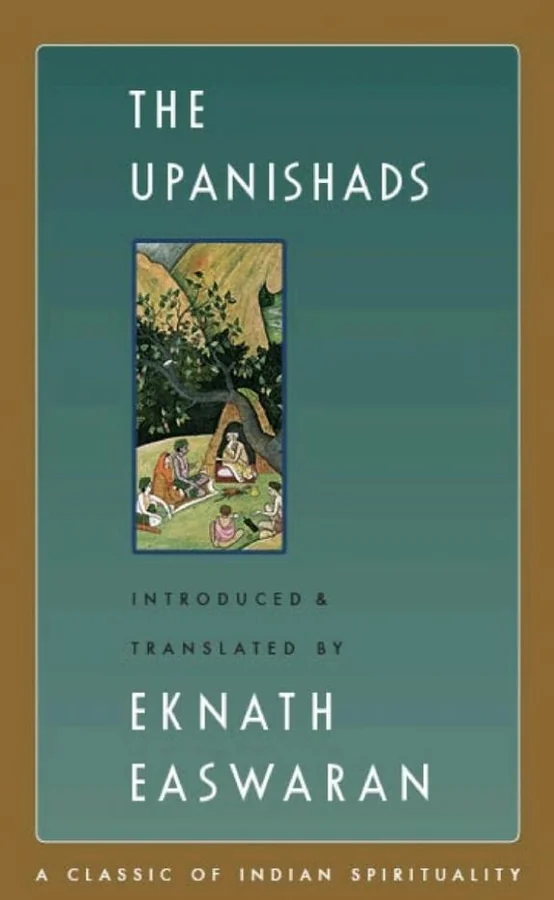
The Upanishads
 73
73

The Upanishads
Eknath Easwaran’s translation of The Upanishads offers a lucid entry point into these ancient Indian philosophical dialogues. His foreword contextualizes the work effectively, while the selected passages prioritize clarity for the modern seeker. The strength lies in Easwaran’s ability to render dense philosophical discourse into approachable prose, making concepts like Brahman and Atman comprehensible. However, the selection process, while practical for accessibility, inevitably omits certain nuances and debates present in the full corpus of Upanishadic literature. A specific passage, such as the exploration of the Self as being "without qualities" (nirguna) in certain sections, is handled with commendable directness. Ultimately, this edition serves as a valuable, if curated, introduction to a cornerstone of Indian spiritual thought.
📝 Description
73
The Upanishads, written between 800 and 200 BCE, are foundational Sanskrit texts from ancient India.
This collection features philosophical dialogues and meditations on the nature of reality, consciousness, and the self. They represent a significant shift in Vedic thought, moving from ritualistic concerns to introspective inquiry. The texts are structured as conversations between illumined sages, or gurus, and their disciples, asking fundamental questions about existence. Eknath Easwaran's translation and introduction are aimed at contemporary readers interested in spiritual philosophy. This edition is particularly suited for those new to Indian thought or finding the original Sanskrit challenging. Individuals seeking accessible explanations of complex metaphysical ideas, as well as those interested in comparative religion and Eastern spirituality, will find value here.
Emerging during a period of significant intellectual ferment in India, the Upanishads arose between 800 and 200 BCE. They mark a transition from the earlier Vedic Samhitas and Brahmanas. This era also saw the rise of other philosophical traditions, including early Buddhism and Jainism, though the Upanishads are firmly rooted in the Brahmanical tradition. They became a cornerstone of the Vedanta school of Hindu philosophy.
The Upanishads are central texts within the Vedanta tradition of Hinduism, a school of thought that became a cornerstone of Indian philosophy. They represent a move towards understanding the ultimate nature of reality and the individual self, moving beyond the earlier emphasis on ritual found in the Vedas. Their focus on inner knowledge and the realization of the identity between the individual soul (Atman) and the absolute reality (Brahman) places them within a lineage of contemplative and mystical inquiry that sought direct experience of the divine or ultimate truth.
💡 Why Read This Book?
• Gain an understanding of Brahman and Atman, the central concepts in Upanishadic philosophy, which explain the relationship between the ultimate reality and the individual self, as discussed in passages like the Mandukya Upanishad. • Explore the concept of moksha, the ultimate liberation, and the paths described within the texts, such as the pursuit of knowledge and self-awareness, offering a different perspective on spiritual freedom. • Appreciate the historical significance of these texts, which emerged around 800 BCE and profoundly influenced the Vedanta school of Hindu philosophy, providing context for a major intellectual tradition.
⭐ Reader Reviews
Honest opinions from readers who have explored this book.
❓ Frequently Asked Questions
What are the main philosophical ideas presented in The Upanishads?
The Upanishads primarily explore the relationship between Brahman (the absolute reality) and Atman (the individual soul), asserting their fundamental unity. They also discuss karma, reincarnation, and the path to liberation (moksha) through self-knowledge.
When were The Upanishads originally composed?
The composition of The Upanishads spans a considerable period, generally believed to be between 800 BCE and 200 BCE, making them some of the oldest philosophical texts in India.
Who is Eknath Easwaran and why is his translation significant?
Eknath Easwaran was a respected teacher of meditation and comparative religion. His translation of The Upanishads is significant for its accessibility, aiming to make the complex philosophical ideas understandable to a modern, Western audience.
What does 'Upanishad' mean and why is it important?
'Upanishad' literally means 'sitting near' or 'sitting down close,' referring to the tradition of disciples sitting near a guru to receive profound teachings. This emphasizes the oral transmission and intimate nature of the knowledge.
How do The Upanishads relate to Hinduism?
The Upanishads are considered the concluding part of the Vedas, the most ancient scriptures of Hinduism, and form the basis of the Vedanta school of philosophy, profoundly shaping Hindu thought and practice.
Are The Upanishads only about religious doctrine?
While deeply spiritual, The Upanishads are primarily philosophical and metaphysical texts exploring the nature of existence, consciousness, and reality. They delve into existential questions rather than focusing solely on ritual or dogma.
🔮 Key Themes & Symbolism
Brahman and Atman
The central inquiry of The Upanishads revolves around the nature of Brahman, the ultimate, unchanging reality, and Atman, the individual self or soul. A core teaching is the profound identity between these two concepts – 'Atman is Brahman.' This idea challenges the perception of individual separateness, suggesting a universal consciousness underlying all existence. Easwaran’s translation aims to illuminate this complex metaphysical assertion, often using analogies to bridge the conceptual gap for readers unfamiliar with Indian philosophical traditions dating back to circa 800 BCE.
Karma and Reincarnation
The Upanishads present a framework for understanding the cycle of birth, death, and rebirth, known as samsara, driven by the law of karma. Actions (karma) create consequences that determine future existences. Liberation (moksha) is achieved by transcending this cycle through spiritual knowledge and self-realization. The texts explore how understanding the true nature of the self and its connection to Brahman can break the chains of karma, offering a path to ultimate freedom from suffering.
The Path to Liberation (Moksha)
Moksha, or liberation, is the ultimate goal described in The Upanishads. It signifies freedom from the cycle of samsara and the realization of one's true nature. This is not achieved through ritual alone but through direct knowledge and meditative insight. The texts advocate for practices such as contemplation, discrimination between the real and unreal, and detachment from worldly desires to attain this state of enlightenment and unity with Brahman.
The Nature of Consciousness
These ancient texts engage deeply with the nature of consciousness, differentiating between waking, dreaming, and deep sleep states. The Mandukya Upanishad, for instance, famously analyzes the syllable 'Om' as representing the stages of consciousness and the transcendent fourth state (Turiya). This exploration of inner experience seeks to reveal the pure, underlying consciousness that is not subject to the limitations of the empirical mind, a concept crucial for understanding the self.
💬 Memorable Quotes
Direct passages from the work, attributed to the author.
“That thou art.”
— This concise phrase, 'Tat Tvam Asi,' is a direct statement of the Upanishadic principle that the individual self (Atman) is identical to the ultimate reality (Brahman). It signifies a profound ontological unity, challenging the illusion of separation.
“As a flame, when fanned by the wind, leaps up and burns brightly, so does the Self, when fed by the teachings of the guru, become luminous.”
— This analogy illustrates the transformative power of spiritual instruction. It suggests that the inherent potential of the Self (Atman) requires external guidance and nourishment, like a flame needing fuel and air, to achieve its full realization.
“The Self is not to be obtained by the weak.”
— This emphasizes the need for strength, perseverance, and mental fortitude in the pursuit of spiritual knowledge. The path to self-realization requires overcoming inertia, doubt, and the allure of the mundane, demanding a robust inner disposition.
“He who knows the Self as the pure consciousness, beyond all qualities, attains the highest.”
— This highlights the Upanishadic concept of the Self as pure awareness, untouched by the transient attributes of the phenomenal world. Realizing this formless, attributeless consciousness is presented as the pinnacle of spiritual achievement.
“All this is Brahman.”
— A fundamental declaration of monism, this statement posits that the entire universe, in all its diversity, is ultimately an expression or manifestation of the single, underlying reality, Brahman. It encourages a perception of unity in all existence.
🌙 Esoteric Significance
Tradition
The Upanishads are a foundational text for the Advaita Vedanta tradition within Hinduism, which emphasizes non-duality. While not typically categorized under Western esoteric lineages like Hermeticism or Kabbalah, their exploration of consciousness, the ultimate nature of reality, and the path to liberation through inner realization shares common ground with many esoteric systems seeking direct experience of the divine or absolute.
Symbolism
Key symbols include 'Om,' representing the totality of existence and consciousness, encompassing the past, present, future, and that which transcends time. The 'Self' (Atman) is often symbolized as a lotus or as the inner fire, representing purity, growth, and the divine spark within. The concept of the 'cave of the heart' symbolizes the inner sanctuary where the Atman resides and can be realized through meditation.
Modern Relevance
Contemporary thinkers and spiritual practitioners across various disciplines continue to draw from the Upanishads. Concepts like non-duality and the nature of consciousness have influenced modern psychology and philosophy of mind. New Age movements and meditation teachers often reference Upanishadic ideas to guide individuals towards self-discovery and inner peace, demonstrating their enduring appeal as a source for understanding subjective experience.
👥 Who Should Read This Book
• Students of comparative religion and philosophy seeking to understand the origins of Vedanta and major Indian spiritual concepts like Brahman and Atman. • Individuals interested in meditation and self-inquiry who wish to explore the philosophical underpinnings of Eastern contemplative practices. • Readers new to Indian spiritual texts looking for an accessible introduction to profound metaphysical ideas, presented in a clear and digestible format by Eknath Easwaran.
📜 Historical Context
The Upanishads emerged in India between approximately 800 and 200 BCE, a period characterized by intense philosophical inquiry that also saw the parallel development of early Buddhism and Jainism. These texts represent a significant evolution within the Vedic tradition, shifting focus from the ritualistic concerns of the Brahmanas to introspective contemplation on the nature of reality, consciousness, and the self. They became the philosophical bedrock for the Vedanta school, heavily influencing later thinkers like Shankara. Their intellectual impact was profound, shaping Indian thought for millennia. While not directly engaging with contemporaries like the Buddha in their original form, their ideas set the stage for much of the subsequent spiritual discourse in the subcontinent, offering a sophisticated metaphysical counterpoint to emerging ascetic movements.
📔 Journal Prompts
The concept of Brahman as the underlying reality of all existence.
Reflections on the meaning of 'Tat Tvam Asi' (That thou art) in daily life.
The role of the guru in transmitting knowledge, as depicted in Upanishadic dialogues.
Exploring the nature of the Atman beyond the physical body and mind.
Meditating on the syllable 'Om' and its representation of consciousness.
🗂️ Glossary
Brahman
The ultimate, unchanging reality or absolute consciousness that is the source and sustainer of all existence. It is considered the supreme cosmic spirit, formless and infinite.
Atman
The individual soul or self, the inner essence of a living being. In Upanishadic philosophy, Atman is ultimately identical with Brahman.
Moksha
Liberation or release from the cycle of birth, death, and rebirth (samsara). It is the ultimate spiritual goal, achieved through self-knowledge and realization of the unity of Atman and Brahman.
Karma
The law of cause and effect governing actions and their consequences. Actions performed in this life determine the circumstances of future lives within the cycle of reincarnation.
Samsara
The continuous cycle of birth, death, and reincarnation, driven by karma and ignorance. It is characterized by suffering and impermanence.
Guru
A spiritual teacher or master who imparts knowledge and guidance to disciples. The term implies a profound wisdom and a role in facilitating spiritual awakening.
Om (Aum)
A sacred syllable considered the sound of the universe. It represents the totality of existence, consciousness, and the underlying reality, encompassing various states of being.
This book appears in 1 collection
🔮 Readers Also Liked
Browse all →









From the “Upanishads” Collection
View all →






More Free Occult Philosophy Books
View all →