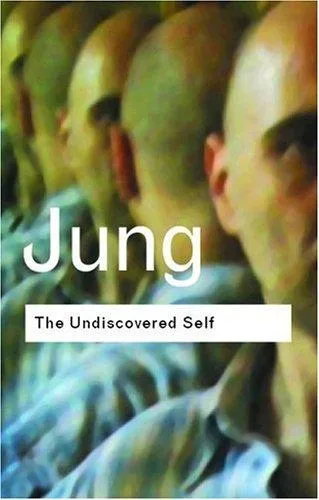
The Undiscovered Self
 76
76

The Undiscovered Self
Jung’s "The Undiscovered Self" is less an academic treatise and more a stark, urgent summons to internal examination. He rails against the modern world’s obsession with the external, seeing it as a flight from the difficult, yet essential, work of understanding oneself. A significant strength lies in his unflinching portrayal of the dangers posed by unchecked collective movements and the suppression of individual psychic reality. He articulates this with particular force when discussing the 'state' and its demand for conformity. However, the book can feel dense, at times relying on a psychological vocabulary that requires prior familiarity with Jungian concepts. For instance, his discussion of the "shadow" as a collective as well as personal phenomenon, while powerful, assumes a reader already attuned to his archetypal psychology.
This is a challenging, but ultimately rewarding, call to psychic integrity.
📝 Description
76
Carl Jung published 'The Undiscovered Self' in 1957, critiquing modern society's outward focus.
Jung's 1957 work, 'The Undiscovered Self,' addresses the modern tendency to ignore inner life in favor of external validation and societal norms. He argues that this outward direction leads to a loss of individual authenticity and psychic imbalance. The book examines the consequences of societal pressures on the individual psyche, advocating for a return to introspection. Jung believed that true self-understanding comes from confronting the unconscious aspects of oneself, rather than seeking meaning solely in the collective or material world. This text is for those feeling alienated or disconnected, seeking a deeper psychological and spiritual understanding.
Emerging in the post-World War II era, Jung's 'The Undiscovered Self' connects with a tradition of psychological inquiry that seeks meaning beyond purely materialistic or behaviorist frameworks. It resonates with earlier Gnostic and alchemical ideas about the inner transformation of the individual. Jung's focus on the unconscious and archetypes links to Hermeticism's emphasis on correspondence between inner and outer realities, and the idea that understanding the self is key to understanding the cosmos. The book reflects a broader cultural search for individual meaning amidst societal upheaval.
💡 Why Read This Book?
• Gain an understanding of the dangers of prioritizing collective identity over individual psychic truth, a concept Jung explores through his critique of modern society in "The Undiscovered Self." • Learn about the concept of "individuation" as the process of becoming a whole person by integrating conscious and unconscious elements, a central theme Jung developed. • Discover the importance of confronting one's "shadow" – the unacknowledged aspects of the personality – as a crucial step towards self-knowledge, a concept elaborated upon in this work.
⭐ Reader Reviews
Honest opinions from readers who have explored this book.
❓ Frequently Asked Questions
What is the main argument of Carl Jung's "The Undiscovered Self"?
The book argues that modern society's focus on external achievements and collective ideologies leads individuals away from self-knowledge, creating psychic imbalance and alienation. Jung urges a return to introspection and understanding the unconscious for true fulfillment.
When was "The Undiscovered Self" originally published?
The work was first published in 1957, reflecting Jung's reflections on the human condition in the post-World War II era.
How does "The Undiscovered Self" relate to Jung's other works?
It serves as a more accessible introduction to core Jungian concepts like the unconscious, archetypes, and individuation, presented in a direct, almost polemical style, distinct from his more clinical or theoretical writings.
What are the consequences of ignoring the 'undiscovered self,' according to Jung?
Jung warns that neglecting the inner life leads to psychological distress, susceptibility to mass movements that suppress individuality, and a loss of personal meaning and authenticity.
Is "The Undiscovered Self" suitable for beginners in psychology?
While direct, its concepts can be challenging. Beginners might benefit from reading it alongside introductory materials on Jungian psychology or after exploring some of his earlier essays.
What societal trends does Jung criticize in this book?
Jung criticizes the rise of state power, mass media influence, and scientific materialism that he believed contributed to the erosion of individual consciousness and critical thinking.
🔮 Key Themes & Symbolism
The Danger of Externalization
Jung critically examines the modern tendency to project inner needs and responsibilities onto external structures like the state, science, or collective ideologies. He posits that this externalization creates a void within the individual, leading to a loss of personal meaning and an increased vulnerability to manipulation. The work argues that true psychic health requires turning inward, acknowledging and integrating the disowned parts of the self rather than seeking solutions solely in the external world.
Individuation as a Process
Central to Jung's thought, individuation is presented not as a goal but as a lifelong process of becoming a psychologically integrated and whole individual. This involves differentiating oneself from the collective and integrating conscious and unconscious aspects of the personality, including the shadow and anima/animus. "The Undiscovered Self" emphasizes that this journey is often arduous, marked by encounters with the unconscious that can be unsettling but are vital for authentic selfhood.
The Collective Unconscious and Archetypes
Jung argues for a universal, inherited layer of the psyche—the collective unconscious—which contains archetypes, primordial patterns of thought and imagery. These archetypes, such as the Mother, Hero, or Wise Old Man, manifest in myths, dreams, and symbols across cultures. In "The Undiscovered Self," he highlights how these universal patterns influence individual behavior and how understanding them can provide insight into our deepest motivations and fears.
Critique of Modernity
Published in the mid-20th century, the book offers a potent critique of the prevailing intellectual and social currents. Jung decries the overemphasis on rationalism and scientific materialism, which he believed neglected the vital role of the psyche and the spiritual dimension of human existence. He expresses concern about the psychological consequences of mass society and the diminishing importance of individual conscience in the face of overwhelming external pressures.
💬 Memorable Quotes
Direct passages from the work, attributed to the author.
“The greatest and most fundamental fact about the individual is his wholeness.”
— This statement expresses Jung's core aim: the integration of all psychic aspects, conscious and unconscious, into a unified self. It suggests that true psychological health lies not in eliminating parts of oneself, but in recognizing and embracing the totality of one's being.
“One cannot force a personality; it has to grow.”
— This highlights Jung's view of development as an organic, internal process rather than something imposed externally. It cautions against trying to artificially shape oneself or others, emphasizing patience and attentiveness to the natural unfolding of the psyche.
“The persona… is that compromise between the ego and the outside world, in other words, between the individual and society.”
— This defines the persona as the social mask we wear, a necessary interface for working through the external world. However, Jung warns that identifying too strongly with the persona leads to a neglect of the true self, the 'undiscovered self'.
“Modern man has lost all the greater joys and sorrows that have characterized human existence in the past.”
— Jung suggests that contemporary life, with its emphasis on moderation and rational control, has led to a flattening of emotional experience. This loss, he implies, contributes to feelings of emptiness and a lack of profound connection to life's fundamental experiences.
“The decisive thing is to know oneself.”
— This simple yet profound statement serves as the central imperative of the book. Jung asserts that self-knowledge, particularly of the unconscious aspects of the psyche, is the prerequisite for any meaningful personal or societal transformation.
🌙 Esoteric Significance
Tradition
While not strictly adhering to a single esoteric lineage, Jung's work draws heavily from Gnostic ideas of the inner spark and the need for self-knowledge, Hermetic principles of "as above, so below" applied to the psyche, and influences from alchemy and Eastern philosophies. "The Undiscovered Self" fits within the broader Western esoteric tradition by emphasizing the primacy of the inner world and the symbolic language of the unconscious, offering a psychological framework for spiritual exploration.
Symbolism
The concept of the "shadow" is a potent symbol representing the repressed, unacknowledged aspects of the personality, both individual and collective. The "undiscovered self" itself functions as a symbol for the totality of the psyche, encompassing the conscious ego and the vast, often hidden, unconscious realms. Jung also frequently employed alchemical symbols, seeing the transformative processes described in alchemy as metaphors for psychological integration and the attainment of the "self."
Modern Relevance
Jung's ideas, particularly as articulated in "The Undiscovered Self," remain highly relevant. Contemporary movements in depth psychology, transpersonal psychology, and even aspects of self-help and mindfulness practice owe a debt to his work. Thinkers and practitioners exploring archetypal patterns in culture, the nature of consciousness, and the psychological impact of modern technology continue to engage with Jung's foundational concepts.
👥 Who Should Read This Book
['• Individuals experiencing existential unease or a sense of alienation in contemporary society, seeking to understand the psychological roots of these feelings.', '• Students and practitioners of Jungian psychology and analytical psychology, looking for a direct articulation of core concepts like individuation and the collective unconscious.', '• Philosophers and cultural critics interested in examining the relationship between the individual psyche and societal structures, particularly in the context of post-war thought.']
📜 Historical Context
Carl Gustav Jung penned "The Undiscovered Self" in 1957, a period defined by the Cold War's existential anxieties and a burgeoning scientific materialism that often sidelined the subjective human experience. Following the profound societal dislocations of World War II, there was a widespread hunger for understanding the human psyche's darker aspects and its susceptibility to destructive ideologies. Jung, already a globally recognized figure, used this work to articulate his growing concern that modern civilization was increasingly alienating individuals from their inner lives. He directly challenged prevailing reductionist psychological theories and the burgeoning influence of mass media and state power, which he feared were eroding individual autonomy. His contemporaries included figures like Sigmund Freud, with whom Jung had a seminal falling out, and existentialist thinkers such as Jean-Paul Sartre and Albert Camus, though Jung’s focus remained distinctly on the inner psychic landscape rather than pure philosophy. The book's reception was significant, resonating with many who felt disenfranchised by the modern world, while simultaneously being viewed with skepticism by more orthodox scientific circles.
📔 Journal Prompts
The persona's function in mediating between the ego and society.
The personal consequences of prioritizing external validation over internal awareness.
Archetypal patterns observed in contemporary cultural narratives.
The process of integrating the shadow aspects of the self.
Defining one's own "wholeness" beyond societal expectations.
🗂️ Glossary
Individuation
The lifelong psychological process by which a person becomes their true, whole self, integrating conscious and unconscious aspects of the personality to achieve a unique and complete identity.
Collective Unconscious
A concept describing a universal, inherited layer of the human psyche containing archetypes and instincts common to all humankind, independent of personal experience.
Archetype
Primordial images and patterns of thought inherited in the collective unconscious, which influence human behavior and perception, manifesting in myths, symbols, and dreams.
Shadow
The unconscious or disowned parts of the personality, comprising aspects that the conscious ego does not identify with, often perceived as negative but essential for wholeness.
Persona
The social role or mask that an individual presents to the world, serving as a mediator between the ego and external society.
Ego
In Jungian psychology, the center of consciousness; the part of the personality that encompasses awareness, identity, and the sense of self.
Self
The totality of the psyche, encompassing both the conscious and unconscious realms; the archetype of wholeness and the central organizing principle of personality.
🔮 Readers Also Liked
Browse all →









More by Carl Gustav Jung
All books →


More Free Occult Philosophy Books
View all →