Science Meets Vedanta
 81
81

Science Meets Vedanta
Jayant Kapatker’s "Science Meets Vedanta" attempts a bold synthesis, suggesting that scientific theories from quantum entanglement to cosmological models can be read as corroborations of ancient Vedantic thought. The strength lies in its ambition to foster dialogue, presenting complex ideas from both domains in an accessible manner. However, the interpretation can sometimes feel strained, forcing conceptual fits rather than organic connections. A particularly illustrative moment occurs when discussing the observer effect in quantum physics, drawing a direct parallel to the Vedantic idea of consciousness as the ultimate reality. While the book provides a stimulating overview, its primary limitation is the potential for oversimplification in bridging such disparate fields. It serves as an interesting primer for those new to the intersection, but seasoned scholars might find the arguments less rigorous. It is a call to reconsider, not a definitive statement.
📝 Description
81
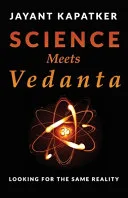
Jayant Kapatker's 2022 book, Science Meets Vedanta, argues modern science confirms ancient Vedantic truths.
Published in 2022, Science Meets Vedanta examines the connections between contemporary scientific thought and the philosophical system of Vedanta. Kapatker suggests that a closer look at scientific principles reveals their alignment with Vedantic ideas. The book invites readers to question their standard views on reality, consciousness, and the universe. It is written for intellectually curious people interested in the overlap of scientific observation and metaphysical questions. Readers who enjoy comparative philosophy, the history of science, or dialogue between different knowledge systems will find this work engaging. It offers a chance to consider established scientific ideas alongside alternative perspectives on existence.
The central argument is that many recent scientific findings, especially in quantum mechanics and cosmology, reflect Vedantic principles. Kapatker discusses concepts like non-duality (Advaita), the nature of awareness, and universal interconnectedness. The goal is to bridge the perceived divide between the material focus often seen in science and Vedanta's holistic outlook.
This book continues a dialogue that gained prominence in the West with figures like Swami Vivekananda in the late 19th century. Vivekananda's 1893 address to the Parliament of Religions in Chicago marked a significant moment for introducing Indian philosophical thought to a wider audience. Science Meets Vedanta responds to current scientific developments, particularly in physics and cosmology, by interpreting them through the lens of ancient Indian wisdom. It addresses contemporary discussions on consciousness and the nature of reality, drawing from Vedanta's established metaphysical frameworks.
💡 Why Read This Book?
• Gain a new perspective on scientific concepts by examining them through the lens of Vedanta, as discussed in the book's exploration of quantum mechanics. • Understand how ancient Indian philosophy, specifically Vedanta, offers frameworks for interpreting modern scientific discoveries about consciousness and reality. • Challenge conventional scientific paradigms by exploring the potential for interconnectedness between empirical data and metaphysical principles, a core argument presented from the book's 2022 publication.
⭐ Reader Reviews
Honest opinions from readers who have explored this book.
❓ Frequently Asked Questions
What is the main argument of "Science Meets Vedanta"?
The book argues that many modern scientific concepts, particularly in physics and cosmology, can be interpreted to align with the principles of Vedanta, suggesting an underlying interconnectedness of reality.
When was "Science Meets Vedanta" first published?
The book was first published on March 2, 2022, reflecting contemporary scientific discourse.
Who is the author of "Science Meets Vedanta"?
The author is Jayant Kapatker, who explores the intersection of science and Vedantic philosophy.
What scientific fields are discussed in relation to Vedanta?
The book frequently references concepts from quantum mechanics and cosmology, examining their potential parallels with Vedantic ideas.
Does the book claim science proves Vedanta?
No, it suggests that interpretations of scientific concepts can show interconnection and encourage questioning conventional understanding, rather than claiming definitive proof.
What is Vedanta?
Vedanta is one of the six orthodox schools of Hindu philosophy, focusing on the Upanishads and exploring themes like the nature of Brahman (ultimate reality) and Atman (self).
🔮 Key Themes & Symbolism
Consciousness and Reality
The work posits that Vedantic notions of consciousness as fundamental to reality find echoes in contemporary scientific discussions, particularly within quantum physics. It explores how the observer effect and the entangled nature of particles challenge a purely materialist view, suggesting that mind or consciousness might play a more integral role in the universe's fabric than previously assumed.
Interconnectedness of All Things
A central theme is the Vedantic concept of non-duality (Advaita), where all existence is seen as a unified whole. The book draws parallels to scientific theories like entanglement and the interconnectedness of cosmic structures, arguing that science, when properly interpreted, supports this holistic worldview rather than contradicting it.
Challenging Materialism
The book encourages readers to question the limitations of a strictly materialistic scientific framework. By highlighting potential overlaps with Vedanta, it suggests that a broader understanding of the universe can accommodate both empirical findings and metaphysical insights, moving beyond a purely reductionist approach to existence.
Complementary Worldviews
Instead of presenting science and Vedanta as opposing forces, "Science Meets Vedanta" advocates for their complementary nature. It argues that both offer valid, albeit different, perspectives on the same underlying reality, and that dialogue between them can lead to a richer, more comprehensive understanding of existence.
💬 Memorable Quotes
Direct passages from the work, attributed to the author.
“Interpreting scientific concepts properly reveals the interconnection between science and Vedanta.”
— This core assertion suggests that a re-evaluation of scientific findings through a Vedantic lens can uncover deeper meanings and unify seemingly disparate fields of knowledge.
“This will encourage us to question the conventional understanding of science and the universe.”
— The author aims to provoke critical thinking, urging readers to move beyond dogma in both scientific and philosophical realms and to be open to new paradigms.
“So be prepared!”
— This is a call to intellectual readiness, signaling that the book will present ideas that may challenge established beliefs and conventional wisdom about reality.
“If you properly interpret many of the scientific concepts...”
— This implies that the author believes current interpretations of science may be incomplete and that a different perspective, like Vedanta, is needed for a fuller comprehension.
“It will show the interconnection between science and Vedanta.”
— The promise is one of synthesis, demonstrating how two distinct systems of thought can illuminate each other and reveal a unified truth about existence.
🌙 Esoteric Significance
Tradition
This work aligns with the broader Neo-Vedantic movement, which seeks to reinterpret traditional Indian philosophies for a modern, global audience. It draws heavily from the Advaita Vedanta tradition, emphasizing non-duality and the ultimate reality of Brahman. While not strictly adhering to a specific esoteric lineage like Hermeticism or Kabbalah, it shares their aim of uncovering hidden universal truths through symbolic interpretation and philosophical reasoning.
Symbolism
The book implicitly uses scientific concepts as modern symbols for ancient Vedantic ideas. For instance, quantum entanglement can be seen as a symbol for the interconnectedness (Ananta) that Vedanta describes as the fundamental nature of reality. The concept of the observer in quantum mechanics serves as a symbol for the role of consciousness (Chit) in perceiving and perhaps even constituting reality, echoing the Vedantic emphasis on consciousness as the ultimate substratum.
Modern Relevance
Contemporary thinkers exploring the nature of consciousness, the implications of quantum physics for metaphysics, and the integration of Eastern philosophy into Western thought find resonance in Kapatker's work. It speaks to modern spiritual seekers and scientists alike who are looking for frameworks that can reconcile empirical data with subjective experience and holistic understandings of the cosmos.
👥 Who Should Read This Book
['• Students of comparative philosophy: Those seeking to understand the potential overlaps between Eastern metaphysical systems like Vedanta and Western scientific paradigms.', '• Science enthusiasts with a philosophical bent: Individuals interested in how cutting-edge scientific theories might inform or challenge our understanding of existence and consciousness.', '• Spiritual seekers exploring non-dual traditions: Readers who are drawn to the principles of Vedanta and wish to see how they might be supported or illuminated by modern scientific perspectives.']
📜 Historical Context
Published in 2022, "Science Meets Vedanta" emerges in an era where the dialogue between physics and consciousness, and Eastern thought and Western science, has gained significant traction. This intellectual current owes much to earlier pioneers like Fritjof Capra, whose 1975 book "The Tao of Physics" explored similar connections. Kapatker’s work engages with contemporary scientific advancements in quantum mechanics and cosmology, fields that continue to challenge classical, deterministic worldviews. While not directly engaging with specific censorship events, the book operates within a broader cultural shift where alternative perspectives on reality are increasingly explored, often in contrast to the reductionist tendencies that dominated much of 20th-century scientific thought. It builds upon the groundwork laid by thinkers who, since the late 19th century, sought to bridge the perceived chasm between empirical inquiry and spiritual traditions.
📔 Journal Prompts
The interconnectedness of science and Vedanta as presented in the book.
Questioning conventional understanding of the universe from a Vedantic viewpoint.
The implications of quantum physics for understanding consciousness.
How does the concept of non-duality challenge materialist explanations?
Reflecting on the role of the observer in both scientific and philosophical contexts.
🗂️ Glossary
Vedanta
A school of Hindu philosophy emphasizing the Upanishads, concerned with the nature of ultimate reality (Brahman) and the self (Atman).
Advaita Vedanta
A prominent sub-school of Vedanta, meaning 'non-dualism,' which asserts that the individual self (Atman) is identical to the ultimate reality (Brahman).
Quantum Mechanics
The fundamental theory in physics describing nature at the smallest scales of energy and matter, known for its counter-intuitive phenomena like entanglement and superposition.
Cosmology
The scientific study of the origin, evolution, and eventual fate of the universe, exploring concepts like the Big Bang and dark matter.
Non-duality
The philosophical concept that reality is ultimately a single, unified whole, with no fundamental separation between the observer and the observed, or between spirit and matter.
Materialism
The philosophical view that matter is the fundamental substance in nature, and that all phenomena, including mental states and consciousness, can be explained by material interactions.
Observer Effect
In quantum physics, the principle that the act of observing a system can influence its state, challenging the idea of an objective reality independent of observation.