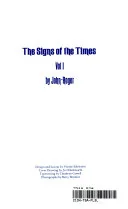
The Signs of the Times
 73
73

The Signs of the Times
John-Roger's "The Signs of the Times" offers a direct, almost conversational approach to spiritual guidance, a welcome departure from overly academic or flowery esoteric texts. Its strength lies in its unvarnished encouragement for personal responsibility in spiritual development. The author doesn't shy away from challenging the reader's assumptions, particularly regarding perception and the nature of spiritual truth. A notable limitation, however, is the occasional vagueness in its pronouncements; while aiming for universality, some concepts could benefit from more concrete illustration. For instance, the repeated emphasis on "knowing" without a clearer framework for developing that knowing can leave the reader feeling adrift. The passage discussing the "aura" as a reflection of inner state is particularly illustrative of the book's core message, but also its potential for being interpreted in widely divergent ways. Ultimately, "The Signs of the Times" serves as a potent, if sometimes abstract, call to inner vigilance and conscious living.
📝 Description
73
John-Roger published "The Signs of the Times" in 1981, a collection of spiritual discourses.
This book consists of teachings intended for individuals pursuing spiritual development. It addresses the perceived spiritual evolution of humanity and the individual's place within this unfolding process. The text is structured as a series of direct transmissions, aiming to stimulate consciousness and offer practical guidance for spiritual living.
Rather than presenting a narrative, the book engages readers through direct questions, prompting self-reflection. It discusses shifts in global consciousness and the personal changes individuals might experience in response. The language is straightforward, encouraging active participation in one's spiritual journey.
Published in 1981, "The Signs of the Times" appeared during a period of growing interest in New Age thought and Eastern philosophies in the West. This era saw popular figures and movements discussing spiritual awakening and concepts like reincarnation. John-Roger's teachings contributed to this cultural milieu, distinguishing themselves from both traditional religious doctrines and some other New Age philosophical texts of the time. The book reflects the era's focus on personal transformation and spiritual growth.
💡 Why Read This Book?
• Gain practical methods for discerning spiritual truth, as John-Roger guides readers to recognize the "aura" of truth within themselves, a skill vital for navigating modern spiritual information. • Understand the concept of "soul retrieval" as presented by John-Roger, offering a unique perspective on integrating fragmented aspects of self for wholeness. • Learn to identify the "signs of the times" not as external prophecies but as internal shifts in consciousness, empowering you to participate actively in your spiritual evolution.
⭐ Reader Reviews
Honest opinions from readers who have explored this book.
❓ Frequently Asked Questions
What is the primary message of John-Roger's 'The Signs of the Times'?
The book's primary message is that humanity is undergoing a significant spiritual evolution, and individuals must cultivate inner awareness and discernment to navigate this shift. It emphasizes personal responsibility in spiritual growth and the recognition of a 'new consciousness'.
When was 'The Signs of the Times' first published?
'The Signs of the Times' was first published in 1981, reflecting the burgeoning interest in New Age and esoteric thought during that period.
Does the book offer specific predictions about the future?
The book focuses less on predicting specific future events and more on guiding individuals to understand the underlying spiritual shifts occurring in consciousness. It offers a framework for interpreting 'signs' as internal developments rather than external prophecies.
Who is John-Roger, the author?
John-Roger (1934-2014) was an American spiritual teacher and author who founded the Movement of Spiritual Inner Awareness (MSIA). His teachings often centered on spiritual consciousness, self-awareness, and the practical application of spiritual principles.
Is 'The Signs of the Times' suitable for beginners in spirituality?
Yes, the book is suitable for beginners who are actively seeking spiritual understanding. Its direct language and focus on practical self-awareness can be accessible, though some concepts may require contemplation.
What does the book mean by 'new consciousness'?
The 'new consciousness' refers to a perceived elevation in human awareness and spiritual understanding. John-Roger suggests this is an ongoing evolutionary process that individuals can consciously participate in and contribute to.
🔮 Key Themes & Symbolism
Spiritual Evolution and New Consciousness
This theme posits that humanity is in a period of accelerated spiritual growth, moving towards a 'new consciousness.' John-Roger frames this not as an apocalyptic event but as an internal awakening. He encourages readers to recognize the subtle shifts within themselves and society as indicators of this evolution. The work suggests that understanding these 'signs' is crucial for aligning oneself with this higher frequency of being, fostering a sense of participation rather than passive observation in the grand unfolding of consciousness.
Inner Discernment and the Higher Self
Central to reading through the spiritual shifts is the cultivation of inner discernment. The book teaches readers to trust their inner knowing and the guidance of their 'higher self.' This involves developing sensitivity to energetic signatures and distinguishing between lower vibrations of fear or ego and higher vibrations of love and truth. John-Roger implies that the ability to discern truth is not an intellectual exercise but a felt sense, an intuitive recognition that bypasses mental conditioning and societal programming.
Soul Retrieval and Integration
The concept of 'soul retrieval' or integration is presented as a key process in spiritual development. It refers to the reclaiming and harmonizing of fragmented aspects of the self, often resulting from life experiences or past lives. John-Roger suggests that this integration is essential for achieving wholeness and moving forward on the spiritual path. By consciously engaging with these fragmented parts, individuals can heal, regain their spiritual power, and embody their true essence more fully.
Conscious Living and Spiritual Responsibility
The teachings strongly advocate for conscious living, emphasizing that individuals are co-creators of their reality. This involves taking full responsibility for one's thoughts, emotions, and actions. The book encourages readers to move beyond blame or victimhood, recognizing their inherent spiritual power. Living consciously means actively choosing alignment with spiritual principles, thereby contributing to the collective awakening and manifesting a higher reality on Earth.
💬 Memorable Quotes
Direct passages from the work, attributed to the author.
“The signs of the times are not about the end of the world, but the awakening of the world.”
— This statement reframes traditional apocalyptic interpretations. It suggests that the perceived 'signs' of change are indicative of a positive, evolutionary shift in global consciousness and individual awareness, rather than a catastrophic conclusion.
“Your aura is the book of your soul; learn to read it.”
— This highlights the importance of energetic sensitivity. The 'aura' is presented as a direct reflection of one's inner state and spiritual progress, encouraging readers to develop their perception of subtle energies as a tool for self-understanding.
“The greatest service you can render is to be yourself, fully and consciously.”
— This emphasizes authenticity and self-realization as the ultimate spiritual practice. It suggests that fulfilling one's unique divine potential is not selfish but a contribution to the collective consciousness.
“Truth has a ring to it; you will feel it when it is spoken.”
— This points to intuitive discernment as a primary method for recognizing truth. It suggests that genuine spiritual or factual statements resonate with an inner knowing, bypassing the need for purely intellectual validation.
“We are all part of the great awakening.”
— This underscores the interconnectedness of all beings in the process of spiritual evolution. It fosters a sense of unity and shared purpose, encouraging individuals to see their personal journey as part of a universal movement towards higher consciousness.
🌙 Esoteric Significance
Tradition
John-Roger's teachings, as exemplified in "The Signs of the Times," can be situated within the broader context of modern Western esotericism, particularly drawing from New Thought and the spiritualist movements of the late 19th and early 20th centuries. While not strictly adhering to Hermetic, Gnostic, or Kabbalistic lineages, his work shares an emphasis on the power of consciousness, the divinity within the individual, and the principle of "as above, so below." It departs from some older traditions by focusing on a more direct, immediate experience of the divine and a less hierarchical structure, emphasizing personal sovereignty in spiritual development.
Symbolism
The concept of the "aura" serves as a key symbolic motif, representing the energetic field that reflects an individual's inner state and spiritual progress. It functions as a symbolic "book of the soul." Additionally, the "signs of the times" themselves can be seen as symbolic indicators of an evolving collective consciousness, urging readers to interpret external events through an internal, spiritual lens. The "higher self" functions symbolically as the divine spark within, the ultimate guide and source of truth for the individual.
Modern Relevance
The work's emphasis on personal consciousness, energetic awareness, and spiritual sovereignty continues to find resonance today. Contemporary practices in mindfulness, energy healing, and self-empowerment echo John-Roger's core teachings. Thinkers and practitioners in fields like positive psychology and conscious leadership often engage with similar concepts of self-creation and the power of intention. The book's focus on discerning truth in a complex information landscape remains particularly relevant in the digital age.
👥 Who Should Read This Book
• Individuals exploring spiritual awakening and consciousness expansion who seek direct, actionable guidance. • Students of esoteric traditions interested in comparative spiritual philosophies and modern esoteric movements. • Those feeling a call to understand their role in global spiritual shifts and seeking personal empowerment.
📜 Historical Context
Published in 1981, "The Signs of the Times" emerged from the fertile ground of the late 20th-century spiritual renaissance. This era saw a surge in interest in non-Western religions, esoteric philosophies, and personal transformation, heavily influenced by figures like Marshall McLuhan's "global village" concept and the widespread availability of Eastern spiritual texts. John-Roger's work found its place alongside other movements like Transcendental Meditation, which gained significant public attention in the 1970s. While distinct from the more academic explorations of mysticism found in some contemporary scholarly circles, John-Roger's direct, experiential approach resonated with those seeking practical guidance outside traditional religious frameworks. His teachings offered an alternative to the more structured, dogmatic spiritual paths, reflecting a cultural desire for personalized spiritual discovery.
📔 Journal Prompts
The "aura" as a spiritual indicator: How does your inner state manifest energetically?
Reflecting on the "new consciousness": What personal shifts signify this for you?
The "higher self" as guide: How can you better tune into its wisdom today?
Interpreting the "signs of the times": What internal shifts are you currently perceiving?
Practicing conscious living: Identify one area where you can increase your spiritual responsibility.
🗂️ Glossary
Aura
The subtle energy field surrounding a person, believed to reflect their physical, emotional, mental, and spiritual state. It's considered a direct indicator of inner well-being and consciousness.
Higher Self
The divine aspect of an individual, representing their true spiritual nature and ultimate wisdom. It is seen as the inner guide for authentic living and spiritual progression.
New Consciousness
A term referring to an evolving state of human awareness characterized by increased spiritual understanding, interconnectedness, and a shift away from materialistic or ego-driven perspectives.
Soul Retrieval
A spiritual process aimed at reclaiming lost or fragmented parts of the soul or self, often resulting from trauma or significant life events, leading to greater wholeness and integration.
Signs of the Times
Refers not to specific prophecies but to the subtle indicators of spiritual evolution occurring within individuals and collective consciousness. It emphasizes internal shifts over external events.
Spiritual Evolution
The ongoing process of growth and development of consciousness towards higher states of awareness, understanding, and being. It is seen as a natural unfolding for humanity.
Discernment
The ability to perceive, understand, and judge spiritual truths or energetic signatures accurately, distinguishing higher vibrations from lower ones.
This book appears in 1 collection
🔮 Readers Also Liked
Browse all →








From the “Soul Travel” Collection
View all →








More Free Magic & Ritual Books
View all →