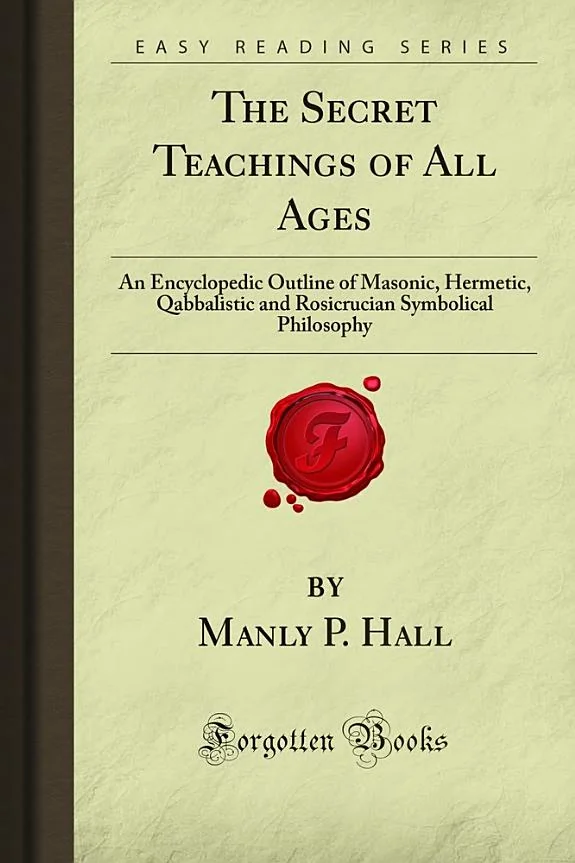
The Secret Teachings of All Ages
 79
79

The Secret Teachings of All Ages
Manly Palmer Hall's *The Secret Teachings of All Ages* is an undeniable monument to esoteric scholarship, a sprawling compendium that attempts to map the entire landscape of hidden knowledge. Its strength lies in its breathtaking ambition and the sheer breadth of traditions it covers, from Egyptian hieroglyphics to the philosophical underpinnings of Freemasonry. The 1928 publication date lends it a certain historical gravity, presenting a vision of esotericism that feels both encyclopedic and deeply earnest. However, the book's encyclopedic nature is also its primary limitation. Hall's tendency to present disparate ideas as seamlessly interconnected can sometimes feel like an oversimplification, a tendency to find universal patterns where the reader might discern significant divergences. For instance, his treatment of alchemy often conflates the chemical processes with purely spiritual allegory without fully acknowledging the historical materialist aspects of early alchemical practice. Despite this, the chapter on the "Hermetic Art" remains a potent distillation of alchemical symbolism, offering a compelling entry into its symbolic language. It is an essential, if sometimes unwieldy, resource for serious students of the occult.
📝 Description
79
Manly Palmer Hall published *The Secret Teachings of All Ages* in 1928, an encyclopedia of esoteric philosophy.
This 1928 volume by Manly Palmer Hall functions as a thorough compendium of philosophical and mystical traditions. Hall organized the book as a series of lectures, covering subjects from ancient Egyptian and Greek mysteries to Rosicrucianism and Freemasonry. His stated goal was to unify the world's religions and secret doctrines, identifying a common thread of wisdom across different cultures and historical periods. The work's considerable scale makes it a primary resource for anyone wanting a wide survey of esoteric thought.
Readers interested in comparative religion, mythology, and the history of Western esotericism will find this book useful. It particularly suits those starting their study of occultism, offering a structured introduction to complex topics such as alchemy, Kabbalah, and astrology. Students of Freemasonry and Rosicrucianism will find detailed information on these groups. The book's dense writing and broad coverage may challenge casual readers looking for simple explanations. An engaged reader committed to deep study of philosophical ideas will best appreciate its contents.
Published in 1928, *The Secret Teachings of All Ages* appeared during a time of significant interest in spiritualism and occult movements. Hall built upon earlier esoteric compendiums, aiming for a work that was both accessible and authoritative. The book's emergence coincided with a renewed focus on groups like Freemasonry and Rosicrucianism, which Hall documented extensively. It reflects a broader cultural fascination with hidden knowledge and ancient philosophies prevalent in the early 20th century.
💡 Why Read This Book?
• Gain an unparalleled overview of diverse esoteric traditions, understanding how concepts like the "Great Work" of alchemy are presented as part of a unified wisdom lineage, a scope rarely matched. • Grasp the symbolic language of Hermeticism and Kabbalah as explored by Hall, learning to interpret ancient motifs and their purported universal meanings as detailed in the text. • Understand the historical milieu of 1928, recognizing how Hall's synthesis of occult philosophies responded to and influenced the spiritual currents of his time, especially regarding secret societies.
⭐ Reader Reviews
Honest opinions from readers who have explored this book.
❓ Frequently Asked Questions
Is *The Secret Teachings of All Ages* publicly available online?
Yes, Manly Palmer Hall's seminal 1928 work is in the public domain and can be found freely accessible on numerous esoteric and historical archive websites, making this vast repository of knowledge readily available.
What is the primary focus of Manly Palmer Hall's exploration in this book?
Hall's primary focus is on presenting a unified understanding of the world's esoteric philosophies, secret societies, and mystical traditions, tracing common symbolic and philosophical threads across cultures and history.
How does Hall discuss alchemy in *The Secret Teachings of All Ages*?
Hall discusses alchemy extensively, often interpreting its processes and symbols as allegories for spiritual transformation and the attainment of higher consciousness, framing it as a key component of the "Great Work."
Who were some of Manly Palmer Hall's contemporaries in the esoteric field?
Hall was active during a period influenced by figures like Helena Blavatsky and Theosophy, and his work engaged with traditions explored by earlier writers such as Eliphas Lévi and figures associated with Freemasonry and Rosicrucianism.
What makes the symbolism in Hall's book significant?
The symbolism is presented as a universal language through which ancient initiates conveyed profound truths about cosmology, human nature, and spiritual evolution, with Hall detailing symbols like the Ouroboros and the Caduceus.
Is *The Secret Teachings of All Ages* suitable for beginners in esoteric studies?
While comprehensive, the book's dense prose and vast scope make it best suited for dedicated beginners or those with some prior exposure to esoteric concepts, offering a structured yet deep dive.
🔮 Key Themes & Symbolism
The Unified Wisdom Tradition
Hall posits the existence of a single, unbroken line of esoteric knowledge stretching from antiquity to his present day. He argues that diverse traditions—Hermeticism, Kabbalah, Gnosticism, Freemasonry—are merely different exoteric expressions of an underlying, singular esoteric doctrine. This 'Ancient Wisdom' is presented as the root of all religions and philosophies, accessible through symbolic interpretation and initiation. The book meticulously traces this lineage, illustrating how concepts like the microcosm and macrocosm, divine archetypes, and the cyclical nature of existence appear in various cultural guises, suggesting a universal spiritual grammar.
Symbolism as Universal Language
Central to Hall's thesis is the power of symbolism to convey profound spiritual and philosophical truths that transcend ordinary language. He dedicates significant portions of the text to decoding the symbolic language found in hieroglyphics, alchemical texts, astrological charts, and the rituals of secret societies. Symbols like the Ouroboros, the Caduceus, and the Pythagorean Tetraktys are presented not as mere decorative elements but as keys to understanding cosmic order, human psychology, and the path of spiritual evolution. This emphasis on visual and symbolic language is crucial for accessing the hidden meanings within religious and philosophical traditions.
The Great Work and Human Evolution
Hall interprets many esoteric practices, particularly alchemy, through the lens of the "Great Work"—a process of spiritual and psychological transformation aimed at achieving self-mastery and divine union. This internal alchemy mirrors the macrocosmic processes of creation. The book explores the concept of man as a divine spark undergoing an evolutionary journey through various stages of consciousness, often represented by allegorical figures and cosmological diagrams. The pursuit of this inner transformation is depicted as the ultimate goal of secret teachings, leading to the realization of one's true, divine nature.
Secret Societies and Their Role
The work provides extensive detail on various secret societies, including the Rosicrucians, Freemasons, and ancient mystery schools. Hall views these organizations not as mere social clubs or historical curiosities, but as custodians of the Ancient Wisdom, preserving and transmitting esoteric knowledge through initiation, ritual, and allegory. He argues that these societies played a vital role in safeguarding spiritual truths from corruption and ignorance, acting as conduits for the Great Work across generations. Their hierarchical structures and symbolic teachings are presented as deliberate methods for guiding initiates toward enlightenment.
💬 Memorable Quotes
Direct passages from the work, attributed to the author.
“The universe is a divine thought made manifest.”
— This statement captures the idealistic and monistic underpinnings of Hall's philosophy, suggesting that all of reality originates from a singular, divine consciousness or intellect, and that material existence is an expression of this fundamental spiritual principle.
“Man is the microcosm, reflecting the macrocosm.”
— This core Hermetic principle, 'As above, so below,' is interpreted by Hall to mean that the human being contains within them all the principles and patterns of the entire universe. Understanding oneself is thus a path to understanding the cosmos.
“Alchemy is the science of the soul's purification.”
— Hall frequently frames the alchemical "Great Work" not just as a physical process of transmutation, but primarily as a metaphor for the spiritual and psychological refinement of the individual, leading to higher consciousness and self-realization.
“Symbolism is the language of the gods.”
— This highlights Hall's belief in the profound power of symbols, arguing that they are a direct means of communicating divine truths and cosmic principles, capable of conveying complex spiritual ideas more effectively than literal language.
“Initiation is the process of awakening divine consciousness.”
— Hall views initiation within esoteric traditions as a structured method for accelerating spiritual evolution, guiding the aspirant through stages of understanding and experience that lead to the realization of their inherent divinity.
🌙 Esoteric Significance
Tradition
This work is primarily situated within the Western Esoteric Tradition, heavily drawing from Hermeticism, Neoplatonism, Kabbalah, and Rosicrucianism. Hall aimed to synthesize these disparate threads into a coherent narrative of a singular, ancient wisdom lineage. He departs from strict adherence to any single tradition by presenting a comparative, encyclopedic overview, seeking universal principles that underpin them all, rather than focusing on the unique practices or theological nuances of one specific school.
Symbolism
Hall meticulously examines numerous symbols. The Ouroboros, the serpent eating its tail, represents cosmic cycles, eternal return, and the unity of creation. The Caduceus, Mercury's staff entwined with two snakes, symbolizes balance, duality, and the healing power of unified opposites, often interpreted as representing the kundalini or spiritual energies within the human body. The Pythagorean Tetraktys, the sacred number ten arranged in a triangle, is explored as a foundational symbol of cosmic order and divine manifestation.
Modern Relevance
Contemporary practitioners of Hermeticism, Kabbalah, and even some forms of modern occultism continue to reference Hall's work as a foundational text for understanding historical esoteric concepts. His synthesis has influenced numerous authors and teachers in the New Age movement and beyond. Thinkers exploring comparative mythology and the history of consciousness often engage with his broad interpretations, making it a continuing point of reference for those seeking to understand the historical development and interconnectedness of Western mystical traditions.
👥 Who Should Read This Book
• Aspiring students of Western Esotericism seeking a comprehensive, albeit dense, introduction to major traditions like Hermeticism, Kabbalah, and Rosicrucianism. • Researchers in comparative religion and mythology interested in Hall's thesis of a unified "Ancient Wisdom" underlying global spiritual expressions. • Members and students of fraternal orders like Freemasonry and Rosicrucianism who wish to explore the philosophical and symbolic dimensions of their traditions as interpreted by Hall.
📜 Historical Context
Published in 1928, *The Secret Teachings of All Ages* emerged during a vibrant period for esoteric thought in the Western world. The preceding decades had seen the rise of Theosophy, led by Helena Blavatsky, which popularized Eastern philosophies and occultism among a broad audience. Hall’s work synthesized and expanded upon this interest, drawing heavily from Hermeticism, Kabbalah, Rosicrucianism, and Freemasonry—movements experiencing renewed attention. It offered a more systematic and encyclopedic approach than many of its contemporaries, positioning itself as a definitive guide to the "Ancient Wisdom." While figures like Aleister Crowley were also active, pursuing more ceremonial magic, Hall’s approach was broadly philosophical and comparative. The book was met with considerable acclaim within esoteric circles, solidifying Hall's reputation as a leading authority on occult philosophy, and it has remained a cornerstone text for students of Western esotericism ever since.
📔 Journal Prompts
The concept of the microcosm reflecting the macrocosm in Hall's work, how does this apply to your personal understanding of self?
Reflect on the symbolic meaning of the Ouroboros as presented in the text, and its relation to cycles in your own life.
Consider Hall's interpretation of the 'Great Work' – what 'elements' might you need to transmute in your own inner life?
Analyze the role of secret societies as 'custodians of knowledge' as described by Hall. What is the value of preserved, esoteric knowledge today?
Examine the Caduceus symbol and its representation of balanced opposites. How can this principle inform your approach to duality in your experiences?
🗂️ Glossary
Hermeticism
An esoteric tradition based on writings attributed to Hermes Trismegistus, emphasizing divine wisdom, the unity of all things, and the principle of 'As above, so below.' It encompasses philosophy, magic, and spiritual development.
Kabbalah
A system of Jewish mysticism that explores the relationship between the divine and the created universe, often using the Tree of Life as a symbolic map of creation and spiritual ascent.
Alchemy
An ancient practice involving the transformation of matter, often interpreted as a symbolic allegory for spiritual purification and the attainment of higher consciousness or immortality, known as the "Great Work."
Rosicrucianism
A mystical and esoteric movement founded in the early 17th century, often associated with secret societies, alchemy, and the pursuit of spiritual enlightenment through hidden knowledge.
Freemasonry
A fraternal organization with a complex history, utilizing allegorical rituals and symbols derived from stonemasonry to teach moral and philosophical lessons, often seen as a form of esoteric tradition.
Microcosm/Macrocosm
The philosophical concept that the human being (microcosm) is a reflection or miniature representation of the entire universe (macrocosm), embodying similar principles and structures.
The Great Work
The central aim in alchemy and other esoteric traditions, referring to the process of spiritual perfection, enlightenment, or the attainment of divine consciousness through purification and transformation.
This book appears in 1 collection
🔮 Readers Also Liked
Browse all →








From the “Freemasonry” Collection
View all →



More Free Kabbalah & Jewish Mysticism Books
View all →