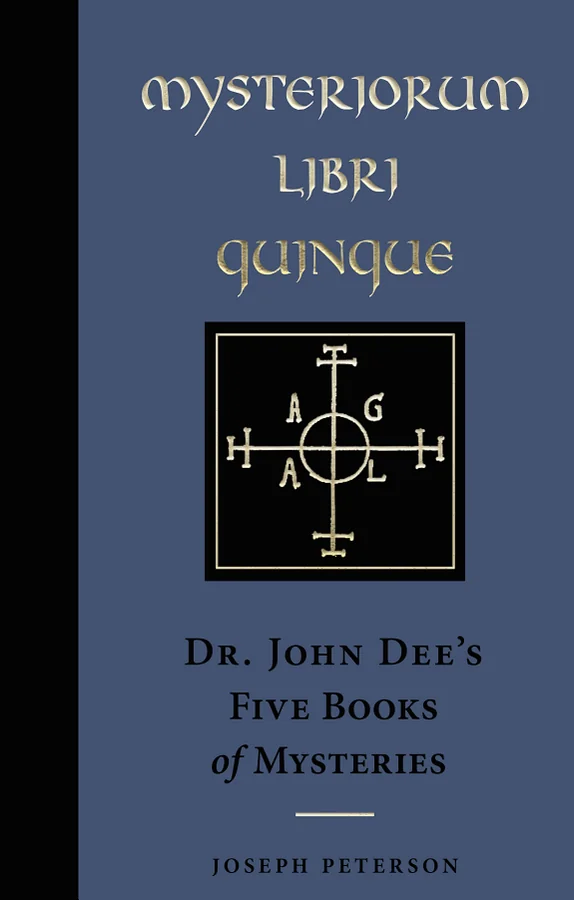
Mysteriorum Libri Quinque
 77
77

Mysteriorum Libri Quinque
John Dee's "Mysteriorum Libri Quinque" is less a philosophical treatise and more a raw, almost diary-like record of an ambitious occult experiment. The 2024 edition effectively presents Dee's painstaking efforts to establish contact with angelic intelligences, primarily through the mediumship of Edward Kelley. The strength lies in its unvarnished portrayal of the process: the meticulous notes, the complex symbolic language, and the sheer dedication required. However, the dense, often repetitive nature of the angelic "conversations" can be a significant hurdle for the uninitiated reader. A particularly striking element is Dee's detailed cataloging of angelic names and their associated powers, a section that feels both alien and strangely systematic. While the introduction and appendices of this edition provide valuable context, the core text demands considerable patience and a background in Dee's unique brand of magic. It is an essential, if challenging, document for understanding practical Renaissance occultism.
📝 Description
77
John Dee's 1583 manuscript detailing his angelic communications is now accessible in a 2024 edition.
Mysteriorum Libri Quinque compiles the private occult researches and angelic dialogues of John Dee, a significant figure in Elizabethan science and mysticism. This 2024 edition presents Dee's meticulous records of his experiments and methods for engaging with what he called "angelic intelligence." It grants direct access to the thought processes of a scholar active during a period of intellectual transition, one who engaged with both empirical study and esoteric questions.
This work is intended for dedicated students of Western esotericism. Those interested in the history of magic, early modern occultism, and the practical aspects of ceremonial magic will find it valuable. It also appeals to scholars of intellectual history, alchemy, and Renaissance studies seeking primary source material on individuals who influenced occult traditions. Readers interested in the connection between science and spirituality before the Enlightenment will discover ample content here.
John Dee's work on angelic communication, recorded in Mysteriorum Libri Quinque, emerged from a late Renaissance worldview where the natural and supernatural were not sharply divided. This perspective contrasted with the increasing rationalism of the early Scientific Revolution. Dee's systematic approach to contacting angelic beings through scrying and ritual places him within a tradition of Western ceremonial magic that sought direct experience of divine or spiritual forces.
💡 Why Read This Book?
• Gain direct insight into John Dee's unique method for angelic communication, the "angelical conversation," as detailed in his meticulous records, offering a practical approach to ceremonial magic distinct from theoretical texts. • Understand the historical milieu of Elizabethan England's esoteric landscape, learning how Dee integrated nascent scientific inquiry with ancient magical principles, a period marked by figures like Giordano Bruno. • Explore the practical application of complex symbolic systems and angelic hierarchies presented in the book, providing specific examples of the language and structures used in 16th-century ceremonial magic.
⭐ Reader Reviews
Honest opinions from readers who have explored this book.
❓ Frequently Asked Questions
What was John Dee's primary goal in writing Mysteriorum Libri Quinque?
John Dee's main objective was to meticulously record his system for communicating with angelic beings, which he termed "angelical conversation." He sought to document the process, the received information, and the practical application of this spiritual science.
Who was Edward Kelley and what was his role in Mysteriorum Libri Quinque?
Edward Kelley was John Dee's associate and scryer. In Mysteriorum Libri Quinque, Kelley is presented as the primary medium through whom Dee received angelic communications, acting as the visual and auditory conduit for the "angelical conversation."
When was Mysteriorum Libri Quinque originally compiled by John Dee?
While the 2024 edition is a modern publication, John Dee compiled his records for Mysteriorum Libri Quinque throughout the latter half of the 16th century, primarily between 1581 and 1583.
What kind of information did Dee claim to receive from the angels?
Dee claimed to receive a vast array of information, including divine secrets, the true nature of creation, angelic hierarchies, the "Book of Enoch," and instructions for a spiritual "Great Work." The content is often presented in a complex, symbolic language.
How does Mysteriorum Libri Quinque relate to Dee's scientific work?
Mysteriorum Libri Quinque represents the esoteric side of Dee's intellectual pursuits, which also included mathematics, navigation, and astronomy. He viewed his angelic communications as a form of divine science, seeking to reconcile spiritual knowledge with empirical observation.
Is this book considered a primary source for Renaissance occultism?
Yes, Mysteriorum Libri Quinque is considered a vital primary source for understanding the practical occultism and ceremonial magic of the Elizabethan era, offering direct evidence of John Dee's extensive experiments and beliefs.
🔮 Key Themes & Symbolism
Angelic Communication System
The central theme is John Dee's meticulous methodology for engaging in what he termed "angelical conversation." This involved specific ritualistic preparations, the use of scrying tools, and the detailed recording of communications received through Edward Kelley. The work explores the nature of angelic intelligence, its perceived hierarchy, and the practical steps necessary to achieve contact. Dee's approach was not mere theoretical speculation but a dedicated scientific and spiritual endeavor to access divine knowledge, detailed herein with rigorous observation and notation.
Renaissance Esotericism and Science
Mysteriorum Libri Quinque stands as a evidence of the fluid boundaries between science and magic in the 16th century. John Dee, a respected mathematician and navigator, dedicated significant effort to these esoteric pursuits, viewing them as complementary. The book showcases how empirical observation (scrying, notation) was applied to supernatural phenomena, reflecting a worldview where the hidden causes of nature were accessible through divinely inspired means, a stark contrast to later purely materialistic scientific paradigms.
Symbolic Language and Interpretation
A significant aspect of the book is the complex, often abstract, symbolic language through which the angels communicated. Dee's records meticulously document these symbolic transmissions, along with his attempts to interpret their meaning. This theme highlights the esoteric practice of deciphering divine or hidden knowledge embedded within symbolic forms, a common thread in traditions like Kabbalah and Hermeticism, demonstrating Dee's engagement with the hermeneutic challenges of occult texts and revelations.
The Great Work and Spiritual Alchemy
While not explicitly an alchemical text in the traditional sense, Mysteriorum Libri Quinque touches upon themes associated with the "Great Work." The angelic communications often contain revelations about spiritual transformation, the nature of the cosmos, and humanity's place within it, aligning with the broader alchemical goal of spiritual perfection and enlightenment. Dee's pursuit of angelic knowledge can be seen as a form of spiritual alchemy, aiming to transmute the mundane into the divine through rigorous practice and divine guidance.
💬 Memorable Quotes
Direct passages from the work, attributed to the author.
“The angel Uriel instructed Dee on the nature of the "Book of Enoch."”
— This highlights a specific instance where a named angel, Uriel, provided Dee with significant theological or cosmological information, referencing a key apocryphal text and underscoring the biblically-informed context of Dee's angelic communications.
“Dee meticulously recorded the "call" or invocation used to summon specific angelic intelligences.”
— This points to the practical, ritualistic aspect of Dee's work, emphasizing the structured approach he took to ceremonial magic and the belief that specific incantations or 'calls' were necessary to establish contact.
“The work details the 'table of practice' used for scrying, often involving geometric patterns.”
— This refers to a specific tool and its symbolic design within Dee's system. The geometric patterns are crucial for focusing the scryer's vision and creating a conduit for spiritual communication, reflecting the importance of visual aids in esoteric practices.
“The angelic communications frequently employed a unique alphabet, later termed the "Enochian" alphabet.”
— This highlights the linguistic innovation within Dee's system. The creation of a new alphabet for angelic communication signifies a profound attempt to establish a direct, uncorrupted channel of discourse with the divine, distinct from human languages.
“Dee recorded his personal anxieties and hopes regarding the "angelical conversation."”
— This interpretation emphasizes the human element within the esoteric text. Beyond the ritual and doctrine, Dee's personal reflections reveal the psychological and spiritual stakes involved in his ambitious project, adding a layer of personal narrative to the occult research.
🌙 Esoteric Significance
Tradition
Mysteriorum Libri Quinque is a cornerstone text for the Western Esoteric Tradition, particularly within Hermeticism and ceremonial magic. It draws heavily on Kabbalistic concepts of divine names and angelic hierarchies, while its practical application through scrying aligns with Neoplatonic and Gnostic ideas of spiritual ascent. Dee sought to synthesize these traditions, creating a unique system that aimed for direct, experiential knowledge of the divine, departing from purely scholastic or theoretical approaches prevalent at the time.
Symbolism
The work is rich with specific symbols. The "angelical alphabet" (later termed Enochian) is a key motif, representing a divine language meant to bypass human corruption. Geometric figures, particularly those used in the "table of practice," serve as focal points for scrying, symbolizing cosmic order and the divine mind. Angelic names and sigils also function symbolically, acting as keys to understanding the specific attributes and powers of various celestial intelligences.
Modern Relevance
Contemporary practitioners of ceremonial magic, especially those working with Enochian magic, directly engage with the material presented in Mysteriorum Libri Quinque. Thinkers in comparative occultism and historians of science continue to analyze Dee's methods as a case study in Renaissance thought. Modern occult orders and individual practitioners often cite Dee's system as a foundational element in their own magical practices, seeking to replicate or adapt his methods for spiritual development and divine contact.
👥 Who Should Read This Book
• Students of Renaissance occultism: Those seeking primary source material on Elizabethan magical practices and the intellectual world of figures like John Dee will find invaluable detail. • Practitioners of ceremonial magic: Individuals interested in the historical development and practical application of systems for angelic communication and scrying will benefit greatly. • Scholars of Western Esotericism: Researchers examining the lineage of magical traditions, the intersection of science and spirituality, or the evolution of occult thought will find this text essential.
📜 Historical Context
John Dee operated at the zenith of Elizabethan England's intellectual ferment, a period where the boundaries between natural philosophy, magic, and nascent science were remarkably fluid. His work on angelic communication, detailed in Mysteriorum Libri Quinque, emerged during a time when figures like Tycho Brahe were revolutionizing observational astronomy, and radical thinkers like Giordano Bruno proposed complex cosmological theories. Dee's meticulous, almost scientific approach to what he termed "angelical conversation" placed him at a unique intersection. While contemporaries like William Gilbert were investigating magnetism with empirical rigor, Dee pursued a different kind of knowledge, seeking divine revelation through scrying and ritual. His methods, particularly those involving his associate Edward Kelley, were not universally accepted, and his reputation fluctuated, yet his influence on subsequent generations of occultists, particularly within groups like the Hermetic Order of the Golden Dawn, was profound, solidifying his legacy as a key figure in Western esotericism.
📔 Journal Prompts
The angelic alphabet: How might a newly devised symbolic language alter perception?
John Dee's scrying sessions: Reflect on the role of focused visualization in seeking knowledge.
The hierarchy of angels described by Uriel: Consider different organizational structures for spiritual entities.
Edward Kelley's role as medium: Explore the dynamics of channeled information and interpretation.
Dee's integration of science and magic: Analyze the historical context of merging empirical and esoteric inquiry.
🗂️ Glossary
Angelical Conversation
The term John Dee used to describe his systematic method of communicating with angelic beings through scrying and spiritual practices, aiming to receive divine knowledge.
Scrying
A divination technique involving gazing into a reflective surface (like a crystal ball or dark mirror) to perceive visions, receive messages, or enter altered states of consciousness.
Enochian Language
The unique alphabet and language that John Dee and Edward Kelley claimed to receive from angelic beings, forming a key component of their magical system.
Sigil
A symbol or emblem believed to possess magical power, often created with specific intent or derived from divine names or correspondences.
The Great Work
In esoteric traditions, particularly alchemy and Hermeticism, this refers to the process of spiritual transformation, enlightenment, and the perfection of the soul.
Book of Enoch
An ancient Jewish religious work, ascribed by tradition to Enoch, the great-grandfather of Noah. It is considered apocryphal by most Jewish and Christian denominations but was highly influential in some esoteric circles.
Table of Practice
A specific scrying aid designed by John Dee, often a circular or square tablet with geometric patterns and inscriptions, used as a focus for angelic communication.
This book appears in 1 collection
🔮 Readers Also Liked
Browse all →








From the “Enochian Magic” Collection
View all →


More Free Magic & Ritual Books
View all →