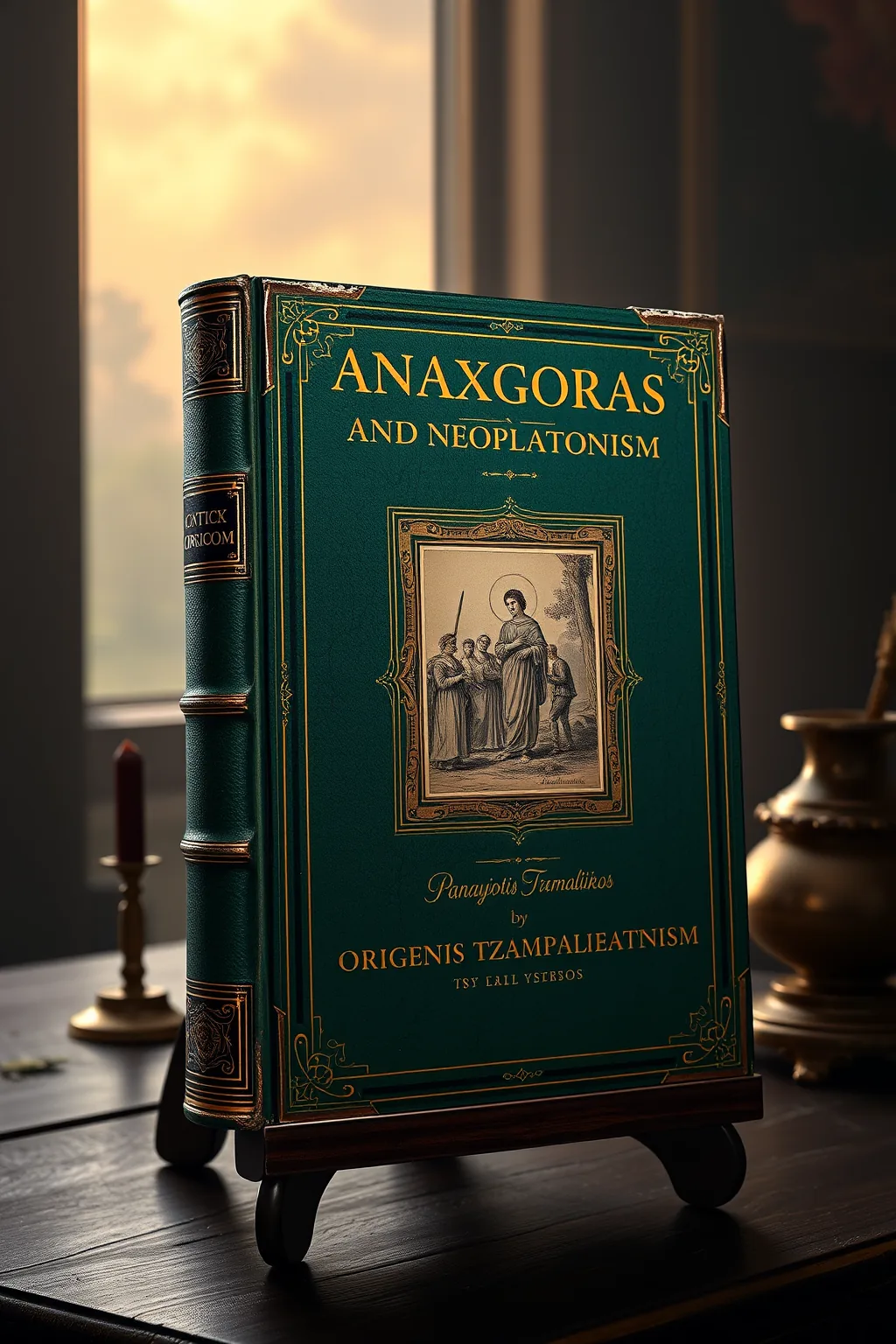
Anaxagoras, Origen, and Neoplatonism
 80
80

Anaxagoras, Origen, and Neoplatonism
Panayiotis Tzamalikos offers a compelling, if dense, revisionist account of Origen. The book’s strength lies in its rigorous tracing of philosophical influences, particularly the often-overlooked legacy of Anaxagoras and the Neoplatonists on Origen’s theology. Tzamalikos compellingly argues against viewing Origen solely through a theological lens, asserting that his philosophical framework, derived from classical sources, is paramount. The limitation, however, is the sheer academic density; this is not introductory material. A particular strength is the detailed exposition of how Anaxagoras's concept of Nous, mediated through later thinkers, subtly shapes Origen's understanding of divine providence. The work effectively challenges established interpretations by focusing on this intellectual lineage. Ultimately, this is a vital, albeit challenging, contribution for specialists in ancient philosophy and theology.
📝 Description
80
Panayiotis Tzamalikos argues Origen's theology was shaped by Presocratic Anaxagoras and Neoplatonism.
Panayiotis Tzamalikos's "Anaxagoras, Origen, and Neoplatonism" reconstructs the philosophical foundations of the early Christian theologian Origen. The study posits that Origen's theological positions were significantly influenced by his engagement with classical philosophy, moving beyond purely hagiographical or theological analyses. The book traces an intellectual lineage for Origen's thought, with a particular focus on Anaxagoras and his impact on later philosophical schools.
The work places Origen within the 3rd century CE intellectual landscape, a time of active philosophical discussion and emerging Christian thought. It examines how Anaxagoras's ideas on cosmic order and intellect, or Nous, were transmitted and reinterpreted through figures like Plato, Aristotle, and the Stoics. Tzamalikos contends that this philosophical inheritance, especially as it passed through Neoplatonism, formed the implicit structure for Origen's theological system. This challenges a view of Origen as solely a theologian.
The central argument rests on the idea that a 'philosophical background' is determinative for theological expression. The book highlights the transmission of Anaxagoras's concepts of a cosmic intellect (Nous) and its role in ordering the cosmos. It scrutinizes the Neoplatonic understanding of these concepts and their adoption by Origen, showing how philosophical ideas provided the framework for his theological system.
This book examines the complex relationship between early Christian thought and ancient Greek philosophy, specifically how pagan philosophical concepts were adapted and integrated into theological systems. It focuses on the Presocratic Anaxagoras and the Neoplatonic school as key intermediaries. By demonstrating the philosophical underpinnings of a major early Christian thinker like Origen, the study reveals how esoteric traditions of thought, even those originating outside of Christianity, could inform and shape developing religious doctrines.
💡 Why Read This Book?
• Gain a new perspective on Origen's theology by understanding its roots in Presocratic and Neoplatonic philosophy, as detailed in Tzamalikos's analysis of Anaxagoras's influence. • Grasp the philosophical mechanisms behind early Christian thought by examining how concepts like Nous were transmitted and adapted, a process illuminated by the book's discussion of Plato and Aristotle. • Appreciate the intellectual currents of Late Antiquity by seeing how philosophical ideas shaped theological discourse, particularly through the lens of Origen and the Neoplatonists as presented in the work.
⭐ Reader Reviews
Honest opinions from readers who have explored this book.
❓ Frequently Asked Questions
What is the main argument regarding Origen's philosophical background?
The book argues that Origen's theological positions were decisively shaped by his philosophical background, particularly his engagement with Anaxagoras and Neoplatonism, which implicitly determined his theological exposition.
Which ancient philosophers are central to this study?
Anaxagoras is central, with his philosophy's legacy explored through Plato, Aristotle, the Stoics, and ultimately Origen and Neoplatonism.
How does this book differ from standard studies of Origen?
It shifts focus from Origen as solely a theologian to an examination of his philosophical underpinnings, challenging reliance on Eusebius's hagiography and emphasizing implicit philosophical determination.
What is the significance of Anaxagoras in this context?
Anaxagoras's ideas, especially concerning Nous (Intellect) and cosmic order, are presented as a foundational philosophical inheritance that influenced later thinkers and, indirectly, Origen.
Who is Panayiotis Tzamalikos?
Panayiotis Tzamalikos is the author of "Anaxagoras, Origen, and Neoplatonism," first published in 2016, focusing on ancient philosophy and early Christian thought.
What is Neoplatonism's role in the book?
Neoplatonism is presented as a crucial intermediary, mediating Anaxagoras's philosophy to Origen and demonstrating the continuity and transformation of classical ideas in late antiquity.
🔮 Key Themes & Symbolism
Philosophical Determinism in Theology
This work posits that theological systems are implicitly, yet decisively, determined by their philosophical underpinnings. Tzamalikos argues against viewing Origen merely as a theologian, asserting that his inherited philosophical concepts from Anaxagoras, Plato, and Neoplatonism provided the essential framework for his theological doctrines. The exposition focuses on how concepts like Nous and cosmic ordering, central to classical thought, were reinterpreted and integrated into Origen's Christian worldview, rather than being purely divinely inspired theological pronouncements.
The Legacy of Anaxagoras
The book reconstructs the often-underestimated influence of Anaxagoras on later philosophical and theological traditions. Tzamalikos traces the transmission of Anaxagoras's ideas, particularly his concept of Nous as a cosmic ordering principle, through figures like Plato, Aristotle, and the Stoics, culminating in their adaptation by Neoplatonists and Origen. This detailed lineage highlights how ancient philosophical debates continued to shape thought centuries later.
Origen Between Paganism and Christianity
This study reframes Origen not as an isolated Christian thinker, but as a product of the Hellenistic intellectual environment. By examining his philosophical dialogues, the work reveals how he engaged with, and was influenced by, pagan philosophical traditions. The interaction between classical concepts and Christian dogma is explored through the lens of Neoplatonic interpretations, demonstrating the syncretic nature of early Christian intellectual life.
Neoplatonism as a Philosophical Bridge
Neoplatonism functions as a critical bridge in Tzamalikos's argument, connecting the philosophical world of Anaxagoras and Plato to the theological system of Origen. The work analyzes how Neoplatonic thinkers reinterpreted classical doctrines and how these interpretations, in turn, provided Origen with a sophisticated philosophical vocabulary and conceptual toolkit. This mediation is key to understanding the implicit philosophical architecture of Origen's theology.
💬 Memorable Quotes
Direct passages from the work, attributed to the author.
“Origen has been always studied as a theologian and too much credit has been given to Eusebius’ implausible hagiography of him.”
— This statement challenges the conventional approach to Origen, suggesting that historical and theological studies have overlooked his crucial philosophical foundations by relying too heavily on potentially biased biographical accounts.
“This book explores who Origen really was, by pondering into his philosophical background, which determines his theological exposition implicitly, yet decisively.”
— This expresses the book's central thesis: Origen's true identity and theological output are best understood through his engagement with classical philosophy, which acted as an unspoken but powerful determinant of his thought.
“For this background to come to light, it took a ground-breaking exposition of Anaxagoras’ philosophy and its legacy to Classical and Late Antiquity.”
— This highlights the methodological necessity of revisiting Anaxagoras's philosophy to reveal its transmission and adaptation through various schools, thereby informative the philosophical soil from which Origen's ideas grew.
“assessing critically the extent to which Anaxagoras’ thought was transmitted and transformed.”
— This points to the critical analytical approach employed in the book, focusing on the dynamic process of philosophical transmission and transformation rather than a simple adoption of ideas.
“The philosophical background determines his theological exposition implicitly, yet decisively.”
— This concise statement captures the core argument: the unstated philosophical framework of a thinker like Origen holds decisive power over their theological constructions, even if not explicitly acknowledged.
🌙 Esoteric Significance
Tradition
While not strictly belonging to a single esoteric lineage like Hermeticism or Gnosticism, this work illuminates the philosophical roots that informed early Christian thought, which itself became a foundational element for later Western esoteric traditions. It bridges classical philosophy (Plato, Aristotle, Stoics) with early Christian theology, revealing how metaphysical concepts crucial to esoteric thought were formulated and debated in antiquity.
Symbolism
The primary symbolic concept explored is 'Nous' (Intellect), originating with Anaxagoras. In this context, Nous represents a divine, ordering principle responsible for the cosmos's structure and intelligibility. Its transmission through Plato and Neoplatonism, and its implicit influence on Origen, signifies the enduring classical idea of an intelligent, rational force governing existence, a concept echoed in various esoteric cosmologies.
Modern Relevance
Contemporary thinkers and schools interested in the philosophical underpinnings of Western metaphysics and theology, particularly those exploring the Hellenistic roots of spiritual thought, find relevance here. It informs discussions on consciousness, cosmology, and the relationship between reason and faith, offering a historical perspective crucial for understanding modern esoteric philosophies that draw on Neoplatonic and early Christian ideas.
👥 Who Should Read This Book
• Advanced students of Ancient Philosophy: Gain a deeper understanding of the reception and transformation of Anaxagoras's thought through key figures like Plato and Aristotle. • Patristics Scholars and Early Christian Historians: Re-evaluate Origen's work by exploring his philosophical influences beyond traditional theological interpretations. • Researchers of Neoplatonism: Understand how Neoplatonic ideas mediated classical concepts to later theological systems, particularly within the context of Origen's writings.
📜 Historical Context
Published in 2016, Panayiotis Tzamalikos's "Anaxagoras, Origen, and Neoplatonism" engages with the intellectual field of the 3rd century CE, an important era for both classical philosophy and Christian theology. This period saw the flourishing of Neoplatonism, particularly with figures like Plotinus, who sought to synthesize Platonic thought with earlier philosophical traditions. Tzamalikos positions Origen within this context, challenging the prevalent view that he was solely a Christian theologian. The work revisits the legacy of Anaxagoras, whose ideas on Nous (Intellect) and cosmic organization had been transmitted and reinterpreted by Plato, Aristotle, and the Stoics. Tzamalikos argues that these transmitted ideas, especially as filtered through Neoplatonic interpretations, provided the implicit philosophical structure for Origen's theological system. This approach counters the simplistic dichotomy between pagan philosophy and Christian doctrine, highlighting the complex intellectual borrowings and adaptations occurring at the time.
📔 Journal Prompts
The philosophical legacy of Anaxagoras and its impact on Origen's theological framework.
Mapping the transmission of the concept of Nous from Anaxagoras to Neoplatonism.
Assessing the implicit influence of classical philosophy on Origen's doctrines.
The role of Eusebius's hagiography in shaping traditional views of Origen.
Comparing Neoplatonic interpretations of Anaxagoras with Origen's use of philosophical concepts.
🗂️ Glossary
Anaxagoras
A pre-Socratic Greek philosopher (c. 500–428 BCE) known for his theory of 'Nous' (Mind or Intellect) as the cosmic ordering principle and his pluralistic metaphysics.
Origen
An influential early Christian theologian and scholar (c. 184–253 CE) whose work synthesized Greek philosophy with Christian doctrine, though his orthodoxy was later questioned.
Neoplatonism
A philosophical system originating in the 3rd century CE, primarily associated with Plotinus, which interprets Plato's philosophy in a more mystical and systematic way, influencing later Western thought.
Nous
Greek for 'mind' or 'intellect'. In philosophy, it refers to the divine intellect or cosmic reason that orders the universe, a key concept in Anaxagoras and later thinkers.
Hagiography
The writing of the lives of saints or revered figures, often presenting a highly idealized or uncritical account, as Eusebius's work on Origen is described in the book.
Theological Exposition
The detailed explanation or interpretation of religious doctrines or beliefs, which Tzamalikos argues is implicitly shaped by philosophical background.
Classical Antiquity
The period of history covering the ancient Greek and Roman civilizations, roughly from the earliest recorded history to the fall of the Western Roman Empire in the 5th century CE.